书单
百科
这个词条暂时没有中文维基百科条目,下面是英文维基百科的内容(英文原文):
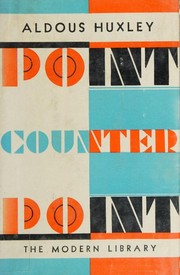
Point Counter Point is a novel by Aldous Huxley, first published in 1928. It is Huxley's longest novel, and was notably more complex and serious than his earlier fiction.
In 1998, the Modern Library ranked Point Counter Point 44th on its list of the 100 best English-language novels of the 20th century.
The novel entered the public domain in the United States in 2024.
Title and construction
The novel's title is a reference to the flow of arguments in a debate, and a series of these exchanges tell the story. Instead of a single central plot, there are a number of interlinked story lines and recurring themes (as in musical "counterpoint"). As a roman à clef, many of the characters are based on real people, most of whom Huxley knew personally, such as D. H. Lawrence, Katherine Mansfield, Nancy Cunard, and John Middleton Murry, and Huxley is depicted as the novel's novelist, Philip Quarles. Huxley described the structure of Point Counter Point within the novel itself, in a stream of consciousness musing of Quarles:
The musicalization of fiction. Not in the symbolist way, by subordinating sense to sound. . . . But on a large scale, in the construction. Meditate on Beethoven. The changes of moods, the abrupt transitions . . . More interesting still, the modulations, not merely from one key to another, but from mood to mood. A theme is stated, then developed, pushed out of shape, imperceptibly deformed, until, though still recognizably the same, it has become quite different. . . . Get this into a novel. How? The abrupt transitions are easy enough. All you need is a sufficiency of characters and parallel, contrapuntal plots. . . . You alternate the theme. More interesting, the modulations and variations are also more difficult. A novelist modulates by reduplicating situations and characters. He shows several people falling in love, or dying, or praying in different ways -- dissimilars solving the same problem. Or, vice versa, similar people confronted with dissimilar problems. In this way you can modulate through all the aspects of your theme, you can write variations in any number of different moods. Another way: The novelist can assume the god-like creative privilege and simply elect to consider the events in the story in their various aspects -- emotional, scientific, religious, metaphysical, etc. He will modulate from one to the other -- as, from the aesthetic to the physico-chemical aspect of things, from the religious to the physiological or financial. . . . Put a novelist in the novel. He justifies aesthetic generalizations, which may be interesting -- at least to me. He also justifies experiment. Specimens of his work may illustrate other possible or impossible ways of telling a story."
Main characters and storylines
Some of the main characters are:
Walter Bidlake, a young journalist. A weak and ineffectual man, Walter is living with Marjorie Carling, a married woman whose husband refuses to grant her a divorce. Marjorie is pregnant with Walter's child, but their relationship is disintegrating, largely because Walter has fallen desperately in love with the sexually aggressive and independent Lucy Tantamount (based on Nancy Cunard, with whom Huxley had a similarly unsatisfactory affair).
John Bidlake, Walter's father, a painter (based on Augustus John). He is famous for his work and for his scandalous love life. However, his recent paintings show a creative decline, which he himself recognises but refuses to admit. He has an illness which is eventually diagnosed as terminal cancer. His wife Mrs. Bidlake is inspired by Lady Ottoline Morrell.
Philip Quarles, a writer (a self-portrait of Huxley) and his wife Elinor, John Bidlake's daughter. They return from India to England. Quarles is a withdrawn, cerebral man, ill at ease with the everyday world and its emotions; Elinor loves him, but is tempted to enter into an affair with the bold and attractive Everard Webley, a political demagogue and leader of his own quasi-military group, the Brotherhood of British Freemen. (Webley is often assumed to be based on Oswald Mosley, but there are reasons for doubting this: see below.) Quarles' father, Sidney, is unlike his son: outwardly impressive, he is in reality pretentious, feeble and self-indulgent. An undistinguished MP and failed businessman, he has retired from public life, supposedly to concentrate on writing a vast and definitive study of democracy. In fact he has written nothing, but he employs a secretary; the girl becomes pregnant by him and threatens to make a scandal. Philip and Elinor have a young son, little Phil, who becomes ill and dies of meningitis.
Mark Rampion, a writer and painter. Based on D. H. Lawrence, whom Huxley admired greatly, Rampion is a fierce critic of modern society. A full chapter in flashback shows Rampion's courtship and marriage to his wife, Mary (based on Lawrence's wife Frieda).
以上文字摘自英文维基百科「Point Counter Point」(有删节,去掉了参考文献等尾部小节),按 CC BY-SA 4.0 使用,作者为维基百科的各位编者。
资料卡
- 原题
- Point Counter Point
- 原作语言
- 英语
- 首次出版
- 1928 年
- 作品形式
- 长篇小说
- 故事发生地
- 英格兰
资料卡来自 Wikidata Q119246(CC0),众包数据,个别字段可能不全。
改编作品
取材于它的书1
名单来自 Wikidata(CC0):只列条目里写明「改编自 / 取材于」这本书的作品,不按名字猜;众包数据,可能不全。