书单
百科
这个词条暂时没有中文维基百科条目,下面是英文维基百科的内容(英文原文):
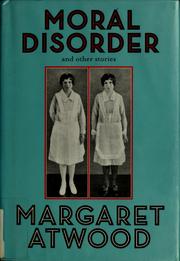
Moral Disorder (ISBN 0-7475-8162-2) is a collection of connected short stories by Margaret Atwood. It was first published on 4 September 2006 by McClelland and Stewart. It chronicles the hidden pains of a troubled Canadian family over a 60-year span. All the short stories have the same female main character at different times of her life, except the last one, which is an autobiographical tale.
The book title is taken from the title of the novel that Graeme Gibson was writing in 1996, when he decided to stop writing novels.
Summary of the stories
The Bad News
The female character reflects on the morning habits of her husband and herself. He rushes into the bedroom to tell her the news from the paper. He is eager to share the burden. But she would rather wait until breakfast. Their behavior has settled into patterns. She feels that they are just waiting for the time when their world will start collapsing. Remembering a vacation to Glanum, she imagines them as ancient Romans, discussing over breakfast the bad news about the Barbarian invasions.
The Art of Cooking and Serving
The girl is aged 11, and her mother is pregnant with a child. The girl struggles to understand what her mother is experiencing, and resents the lack of household contribution throughout the pregnancy. The young girl works diligently to complete all of the household chores, as well as knitting the baby a layette.
With the birth of the baby, the girl begins to rebel against her mother's wishes, ultimately succeeding in her wish to gain more freedom.
The Headless Horseman
In the present, the main character and her sister talk about the past while driving to visit their mother, whose health is failing. They talk about their youth. When the older sister was thirteen, the baby being two, she made a Halloween costume of the Headless Horseman. Later the baby sister included the severed head in her games. She was always very sensitive and impressionable, coming close, in her teens, to suicidal thoughts. This section particularly explores how her sister goes through several childhood socialisation issues along with health issues, this being failing to sleep amongst many others.
My Last Duchess
Before her final high-school exam, she studies with her boyfriend Bill. In particular, they analyze the poem My Last Duchess by Robert Browning. It is a monologue by the Duke of Ferrara that implies he may have killed his young wife because "she smiled too much". Bill, whose strength is algebra and exact sciences, can't understand the poem. The main character makes an effort to explain it to him, but finds that she herself is haunted by questions. Her first superficial erotic experiences are contrasted with the dark side hinted at by the poem. She and Bill eventually break up because he accuses her of defending the Duke. There is some truth in the accusation, since she finds the Duchess a "dumb bunny".
The Other Place
As a young adult, the main character travels a lot, going from job to job as a kind of intellectual nomad. During this time, her friends settle down and have a family. She wonders whether she will always be alone and roaming or will she eventually settle down. Even when the sexual revolution happens and behavior like hers becomes common, she feels different because she has a seriousness that others don't show. At one time, she has an apartment in Vancouver and a similarly lonely friend comes often to visit. He tells her about when his three brothers almost killed him in a cruel joke by locking him in an ice box. Later she marries Tig and lives the settled life she was thinking about. But she often dreams of being in an apartment similar to the one she had in Vancouver and of knowing that a child is locked away dying in one of the rooms. She wonders if the place in her dream represents the past or is a place in her future.
Monopoly
In this story the narration switches to third person. We learn that the main character is called Nell. She is a free-lance editor and gets a job helping an author, Oona, write a self-help book for women. In a moment of confidence, Oona tells Nell that her marriage with Tig is in crisis and they stay together only for the benefit of their two sons. They have liberal sexual attitudes and Oona selects Nell as Tig's lover. Later Tig moves out of the marriage and rents a farm. Nell goes to visit but is not allowed to stay when the children come. Eventually she has the permission to stay at the farm when they are there but is supposed to take care of them. She plays Monopoly with them and can't help being competitive and beating them. She feels like a concubine or a governess.
Moral Disorder
Tig and Nell move to a new farm. They start growing vegetables and raising animals, first hens, then peacocks, cows, and sheep. The locals see them as town people ignorant of the country lifestyle, but they also help. One of the new-born lambs need to be fed by hand and kept inside the house. Nell grows attached to it. When the lamb grows up, it doesn't adapt to living with the other sheep and becomes aggressive against Tig out of jealousy for Nell. It has to be put down. Coming back from the slaughterhouse, Nell cries and accuses Tig of not wanting her to have babies.
以上文字摘自英文维基百科「Moral Disorder」(有删节,去掉了参考文献等尾部小节),按 CC BY-SA 4.0 使用,作者为维基百科的各位编者。
资料卡
- 原作语言
- 英语
- 首次出版
- 2006 年 9 月 4 日
- 作品形式
- 短篇小说
- 首版出版社
- 麦克莱兰与斯图尔特
资料卡来自 Wikidata Q16209753(CC0),众包数据,个别字段可能不全。