 书单
百科
这个词条暂时没有中文维基百科条目,下面是英文维基百科的内容(英文原文):
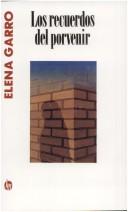
Recollections of Things to Come (Spanish: Los recuerdos del porvenir) is a 1963 novel by Mexican writer Elena Garro. Inspired by her childhood in Southern Mexico, the novel uses a nonlinear structure to explore themes of historical memory, national identity, and sexism. The fictional town of Ixtepec narrates the story of its military occupation during the Cristero War, a conflict precipitated by attempts to secularize the country following the Mexican Revolution of 1910–1920. The town is able to recall events its inhabitants may not, while the rules of normal time do not always apply.
The manuscript was composed in 1953 and remained in a trunk for several years. Following its partial destruction in a fire, Garro rewrote portions and sent it to the publishing house Joaquín Mortiz. It received positive reviews at the time of publication, but attracted a wider audience only through the work of feminist writers toward the end of the twentieth century. A 1968 film adaptation directed by Alfredo Ripstein, titled Memories of the Future in English, altered significant elements of the novel to avoid criticism of the Mexican government.
Alfaguara issued a new Spanish-language edition with essays by contemporary authors including Guadalupe Nettel in 2019. The 2024 critical edition by Ediciones Cátedra, also in Spanish, contained over 100 pages of new analysis. The Chicago Review of Books describes Garro as "under-translated and under-appreciated".
Background
Garro wrote the novel based on her childhood in Iguala, Guerrero. Her family relocated to the city in 1926, at the start of the Cristero War, a conflict sparked by elements in the Constitution of 1917 limiting the influence of the Catholic Church. She witnessed religious persecution and grew to identify with the struggles of poor and Indigenous communities resisting military repression. This experience formed the backbone of Recollections of Things to Come. It combines the Cristero conflict with an exploration of the interplay between Western and Indigenous worldviews, what Garro called the "duality" of the Mexican countryside.
Garro composed the manuscript over a month in 1953 while hospitalized for myelitis in Bern, Switzerland. The draft was stored in a trunk for nearly a decade, surviving a fire and near-loss in a New York hotel before she reconstructed the lost parts. Her marriage to Octavio Paz, a future winner of the Nobel Prize in Literature, deteriorated while the manuscript was in storage. He filed for divorce in 1959 in Ciudad Juárez without Garro's knowledge. This was later ruled invalid, complicated by the fact that Garro was underage when they married. Despite their separation and growing professional rivalry, Paz championed Garro's work, delivering the manuscript to Joaquín Díez-Canedo in 1963. His support ensured the novel's release through the publisher Joaquín Mortiz.
The Enciclopedia de la Literatura en México states that the novel's title originates from a line in the poem "Concierto breve" by Carlos Pellicer. Rafael Olea Franco instead suggests that Garro adopted the name of a famous pulquería in Mexico City that was popular among her social circle in the late 1930s. It has also been observed that a bar in Alejo Carpentier's 1953 novel Los pasos perdidos (The Lost Steps) shares the name Garro chose.
The first Spanish edition of the novel was published in 1963 by Joaquín Mortiz, while the English translation by Ruth L. C. Simms was released in 1969 through the University of Texas Press. It has also been translated into Italian (as I ricordi dell'avvenire), German (as Erinnerungen an die Zukunft), and French (as La maîtresse d'Ixtepec and La Fête à Ixtepec).
Plot summary
The town of Ixtepec opens the novel with the line "Aquí estoy, sentado sobre esta piedra aparente. Sólo mi memoria sabe lo que encierra." ("Here I am, sitting on this apparent stone. Only my memory knows what it encloses.") The first half of the story centers on the brutal General Francisco Rosas and his obsession with his mistress, Julia Andrade. Julia remains mentally and emotionally detached from his control. With the help of the mysterious Felipe Hurtado, she escapes during a magical suspension of time.
The second half tells of the town's efforts to conceal the local priest from persecution. Juan Moncada is killed and his brother Nicolás executed. Isabel Moncada realizes she is unable to give up her feelings for General Rosas, despite the devastation he has brought upon her family. She chooses Rosas over the desire for a spiritual cure and is transformed into the "apparent stone" from the beginning of the story. Her former maid, Gregoria, finds the petrified body and views the event as divine punishment. Isabel's voice ends the story: "Aquí estaré con mi amor a solas como recuerdo del porvenir por los siglos de los siglos." ("Here I will be alone with my love as a recollection of things to come for ever and ever.")
Themes and style
Narrative structure
Recollections of Things to Come, published in 1963, is regarded as a forerunner of Latin American magical realism. It evokes frequent comparisons to One Hundred Years of Solitude, published four years later. In their critical edition, Esteban and Aparicio review attempts to categorize Garro's work, including her frustration with the male-dominated Latin American Boom and her belief that similar techniques had existed in Mexico for centuries. They situate Garro alongside Juan Rulfo and Laura Esquivel in "a distinctly Mexican conception of the convergence of different realities, normalized through an aesthetic and technical device that we might call magical realism".
以上文字摘自英文维基百科「Recollections of Things to Come」(有删节,去掉了参考文献等尾部小节),按 CC BY-SA 4.0 使用,作者为维基百科的各位编者。
资料卡
- 原题
- Los recuerdos del porvenir
- 原作语言
- 西班牙语
- 首次出版
- 1965 年
- 作品形式
- 长篇小说
资料卡来自 Wikidata Q21084636(CC0),众包数据,个别字段可能不全。