书单
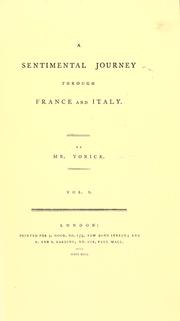
感伤旅行 (1768)
- 作者
- 劳伦斯·斯特恩
- 首版
- 1768 年
- 国家/地区
- 大不列颠王国
- Open Library
- 74 个版本
百科
这个词条暂时没有中文维基百科条目,下面是英文维基百科的内容(英文原文):
A Sentimental Journey Through France and Italy (1768) is a novel by Laurence Sterne. It follows the Reverend Mr. Yorick on a picaresque journey through France, narrated from a sentimental point of view. Yorick is a character from Sterne's bestselling previous novel Tristram Shandy (1759–1767) who also serves as Sterne's alter ego. The novel was planned as a four-volume work, but Sterne died in 1768 with only the first two volumes published; Yorick never makes it to Italy.
The book follows the genre conventions of a travel narrative, with a playful and fragmented writing style. A key theme is the interconnected nature of sympathy and sexual desire, which both inspire strong pro-social feelings. Analysis of the book often seeks to answer whether its depictions of extreme emotion are meant to be serious, or whether Yorick is an unreliable narrator intended to mock the eighteenth-century culture of sensibility.
At its first publication, A Sentimental Journey was widely praised for being more emotionally moving and less bawdy than Tristram Shandy. In the first decades after his death, A Sentimental Journey was Sterne's most popular work. Victorian readers disapproved more strongly of its sexual content, and its reputation declined. In the twentieth and twenty-first centuries, a rehabilitation of Sterne generated more interest in the novel, though it is often now overshadowed by Tristram Shandy.
Plot summary
Yorick's journey starts in Calais, where he meets a monk who begs for donations to his convent. Yorick initially refuses to give him anything, but later regrets his decision. He and the monk exchange their snuff-boxes as a gesture of friendship. He sees a woman, Madame L—, and is intrigued by her; he will continue to encounter her throughout the novel. Yorick buys a chaise to continue his journey. Yorick then inserts a preface cataloguing different kinds of travellers.
After some time in Calais, the next town he visits is Montreuil, where he hires a servant to accompany him on his journey, a young man named La Fleur. Along the way, they pass a man mourning for his dead ass; Yorick sympathizes with him, but his sympathy is interrupted by his carriage driving away too quickly. They travel through Nampont and Amiens before arriving in Paris.
In Paris, he is distracted by the beauty of a shop girl (grisette) when he asks her for directions to the Opera Comique. After the opera, Yorick is informed that the police inquired for his passport at his hotel. Without a passport at a time when England is at war with France, he risks imprisonment in the Bastille. He sees a starling in a cage, which seems to be repeating the phrase "I can't get out"; he is unable to free it and, dwelling on its captivity, becomes miserable imagining the suffering of a prisoner in the Bastille.
Yorick travels to Versailles to acquire a passport, and visits the Count de B****. When Yorick notices the count reads Hamlet, he points with his finger at Yorick's name, mentioning that he is Yorick. The count mistakes him for the king's jester and quickly procures him a passport. Yorick fails in his attempt to correct the count, and remains satisfied with receiving his passport so quickly.
Yorick returns to Paris and stays a few more days before continuing his voyage to Italy. He visits Maria—who was introduced in Sterne's previous novel, Tristram Shandy—in Moulins. Maria's mother tells Yorick that Maria has been struck with grief since her husband died. Yorick consoles Maria, and then leaves.
After having passed Lyon during his journey, Yorick spends the night in a roadside inn. The novel ends abruptly in the middle of a scene, with a double entendre.
Composition and publication
Development in response to Tristram Shandy
A Sentimental Journey was partly written in response to the declining public opinion of Sterne's previous novel, Tristram Shandy, which he had been publishing in instalments since 1762. Tristram Shandy was primarily a comic novel, with some passages of moral sentiments. It was most praised for its sentimentality, with some reviewers suggesting that Sterne was better at writing pathos than humour. As the 1760s went on, the general literary taste also grew more disapproving of lewd content, contributing to the declining appreciation for (and sales of) Tristram Shandy's ongoing instalments. In 1765, Ralph Griffiths reviewed the latest volumes of Tristram Shandy by saying that the public was no longer interested in that novel, directly advising Sterne to begin a new one focused on sentimentality. Griffiths later took credit for the publication of A Sentimental Journey, which he praised.
Concurrently with writing Tristram Shandy, Sterne travelled to Paris in January 1762, before the Seven Years' War ended. He visited France until 1764, followed by a trip through France and Italy from 1765 to 1766. These travels inspired a parodic account of the Grand Tour in volume 7 of Tristram Shandy in 1765. Still inspired, he decided to write a new book which would experiment with the genre of the travel narrative, and revive his literary reputation after the declining sales of Tristram Shandy.
以上文字摘自英文维基百科「A Sentimental Journey Through France and Italy」(有删节,去掉了参考文献等尾部小节),按 CC BY-SA 4.0 使用,作者为维基百科的各位编者。
资料卡
- 原题
- A Sentimental Journey Through France and Italy
- 原作语言
- 英语
- 首次出版
- 1768 年
- 作品形式
- 长篇小说
资料卡来自 Wikidata Q768792(CC0),众包数据,个别字段可能不全。