 书单
百科
这个词条暂时没有中文维基百科条目,下面是英文维基百科的内容(英文原文):
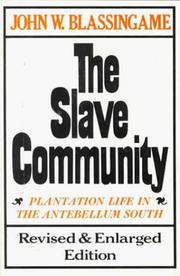
The Slave Community: Plantation Life in the Antebellum South is a book written by American historian John W. Blassingame. Published in 1972, it is one of the first historical studies of slavery in the United States to be presented from the perspective of the enslaved. The Slave Community contradicted those historians who had interpreted history to suggest that African-American slaves were docile and submissive "Sambos" who enjoyed the benefits of a paternalistic master–slave relationship on southern plantations. Using psychology, Blassingame analyzes fugitive slave narratives published in the 19th century to conclude that an independent culture developed among the enslaved and that there were a variety of personality types exhibited by slaves.
Although the importance of The Slave Community was recognized by scholars of American slavery, Blassingame's conclusions, methodology, and sources were heavily criticized. Historians criticized the use of slave narratives that were seen as unreliable and biased. They questioned Blassingame's decision to exclude the more than 2,000 interviews with former slaves conducted by the Works Progress Administration (WPA) in the 1930s. Historians argued that Blassingame's use of psychological theory proved unhelpful in his interpretation. Blassingame defended his conclusions at a 1976 meeting of the Association for the Study of Afro-American Life and History and in 1979 published a revised and enlarged edition of The Slave Community. Despite criticisms, The Slave Community is a foundational text in the study of the life and culture of slaves in the Antebellum South.
Historiographic background
Ulrich Bonnell Phillips wrote the first major historical study of the 20th century dealing with slavery. In American Negro Slavery (1918), Phillips refers to slaves as "negroes, who for the most part were by racial quality submissive rather than defiant, light-hearted instead of gloomy, amiable and ingratiating instead of sullen, and whose very defects invited paternalism rather than repression." American Negro Slavery is infused with racial rhetoric and upholds perceptions about the inferiority of black people common in the southern United States at the time. Although African American academics such as W. E. B. Du Bois criticized Phillips's depiction of slaves, the book was considered the authoritative text on slavery in America until the 1950s.
Phillips's interpretation of slavery was challenged by Kenneth M. Stampp in The Peculiar Institution: Slavery in the Ante-Bellum South (1956) and Stanley M. Elkins in Slavery: A Problem in American Institutional and Intellectual Life (1958). Stampp's study lacks the racist interpretation found in American Negro Slavery and approaches the issue from the position that there is no innate difference between blacks and whites. He questions the reality of plantation paternalism described by Phillips: "the reality of ante-bellum paternalism ... needs to be separated from its fanciful surroundings and critically analyzed." Elkins also dismisses Phillips's claim that African American slaves were innately submissive "Sambos". He argues that slaves had instead been infantilized, or "made" into Sambos, by the brutal treatment received at the hands of slaveowners and overseers. Elkins compares the process to the infantilization of Jews in Nazi concentration camps.
Like Phillips, Stampp and Elkins relied on plantation records and the writings of slaveowners as their main primary sources. Stampp admits that "few ask what the slaves themselves thought of bondage." Historians dismissed the written works of slaves such as the 19th century fugitive slave narratives as unreliable and biased because of their editing by abolitionists. Scholars also ignored the 2,300 interviews conducted with former slaves in the late 1930s by the WPA Federal Writers' Project. As historian George P. Rawick points out, more weight was often given to white sources: the "masters not only ruled the past in fact" but also "rule its written history."
The 1970s, however, witnessed the publication of revisionist studies that departed from the traditional historiography of slavery. Focusing on the perspective of the slave, new studies incorporated the slave narratives and WPA interviews: George Rawick's From Sunup to Sundown: The Making of the Black Community (1972), Eugene D. Genovese's Roll, Jordan, Roll: The World the Slaves Made (1974), Peter H. Wood, Black Majority: Negroes in Colonial South Carolina from 1670 Through the Stono Rebellion (1974), Leslie Howard Owens's This Species of Property: Slave Life and Culture in the Old South (1976), Herbert G. Gutman's The Black Family in Slavery and Freedom, 1750–1925 (1976), Lawrence W. Levine's Black Culture and Black Consciousness: Afro-American Folk Thought from Slavery to Freedom (1977), and Albert J. Raboteau's Slave Religion: The "Invisible Institution" in the Antebellum South (1978). One of the more controversial of these studies was John W. Blassingame's The Slave Community.
Blassingame's argument
In The Slave Community, Blassingame argues that "historians have never systematically explored the life experiences of American slaves." He asserts that by concentrating on the slaveowner, historians have presented a distorted view of plantation life that "strips the slave of any meaningful and distinctive culture, family life, religion, or manhood." Blassingame outlines that the reliance on planter sources led historians like Elkins to mimic planter stereotypes of slaves such as the "submissive half-man, half child" Sambo. Noting the agency slaves possessed over their lives, he contends, "Rather than identifying with and submitting totally to his master, the slave held onto many remnants of his African culture, gained a sense of worth in the quarters, spent most of his time free from surveillance by whites, controlled important aspects of his life, and did some personally meaningful things on his own volition."
以上文字摘自英文维基百科「The Slave Community」(有删节,去掉了参考文献等尾部小节),按 CC BY-SA 4.0 使用,作者为维基百科的各位编者。
资料卡
- 原题
- The Slave Community
- 原作语言
- 英语
- 首次出版
- 1979 年
- 首版出版社
- 牛津大学出版社
- 主题
- 美国奴隶制度
- 故事发生地
- 美国南部
资料卡来自 Wikidata Q3798099(CC0),众包数据,个别字段可能不全。