书单
百科
这个词条暂时没有中文维基百科条目,下面是英文维基百科的内容(英文原文):
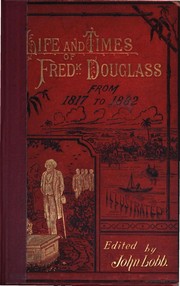
Life and Times of Frederick Douglass is Frederick Douglass's third autobiography, published in 1881 and revised in 1892. Because of the emancipation of American slaves during and following the American Civil War, Douglass gave more details about his life as a slave and his escape from slavery in this volume than he could in his two previous autobiographies (which would have put him and his family in danger). It is Douglass's only autobiography to discuss his life during and after the Civil War, including his encounters with American presidents such as Lincoln and Garfield, his account of the ill-fated "Freedman's Bank", and his service as the United States Marshall of the District of Columbia. Frederick Douglass shed light on his life as a slave. Although it is the least studied and analyzed of the autobiographies, Life and Times of Frederick Douglass allows readers to view his life as a whole.
The 1892 revision brought Douglass's story up to date with thirteen new chapters, the final three of which covered his experience in Haiti, to which he was U.S. minister from 1889 to 1891. Douglass also "lightly edited" the 1881 edition, according to Robert S. Levine.
The full title of both the 1881 and 1892 editions is Life and Times of Frederick Douglass, Written by Himself. His Early Life as a Slave, His Escape from Bondage, and His Complete History to the Present Time, Including His Connection with the Anti-slavery Movement; His Labors in Great Britain as Well as in His Own Country; His Experience in the Conduct of an Influential Newspaper; His Connection with the Underground Railroad; His Relations with John Brown and the Harper's Ferry Raid; His Recruiting the 54th and 55th Mass. Colored Regiments; His Interviews with Presidents Lincoln and Johnson; His Appointment by Gen. Grant to Accompany the Santo Domingo Commission—Also to a Seat in the Council of the District of Columbia; His Appointment as United States Marshal by President R.B. Hayes; Also His Appointment by President J.A. Garfield; with Many Other Interesting and Important Events of His Most Eventful Life; With an Introduction by Mr. George L. Ruffin, of Boston. Hartford, Conn.: Park Publishing Co., 1881; Boston: De Wolfe & Fiske Co., 1892.
The full title of the 1882 British edition is The Life and Times of Frederick Douglass, From 1817 to 1882, Written by Himself. Illustrated. With an Introduction by the Right Hon. John Bright, M.P. London: Christian Age Office, 1882.
Part I
Chapters 1–4
Douglass begins by describing his earliest childhood memories of living with his grandparents, Betsy and Isaac Bailey, until he was seven or eight years old. He was born enslaved in Talbot County on the Eastern Shore of Maryland. Douglass discusses how his grandmother was treated better than other Black people in the area. Douglass claims to know little about his parentage, as his mother was rarely able to see him as a "hired out" enslaved worker, and he is unsure of his father's identity. He recalls learning that he was enslaved when forced to leave his grandparents' cabin to live on the Lloyd plantation. Douglass details the cruelty he witnessed and experienced while living at the Lloyd plantation.
Chapters 5–8
Douglass details several cruel interactions he witnessed between Captain Anthony and slaves at the plantation. He is particularly descriptive of the Captain's interactions with enslaved women who had no control over what happened to them. Rape is described as a constant occurrence in an enslaved woman's life. In chapter seven, Douglass describes Colonel Lloyd's life and house, which he contrasts with the horrors of slavery. He also describes the peculiar characteristics of overseers at the plantation, including Austin Gore, Mr. Hopkins's successor. Douglass also details how slaves were murdered by their overseers, such as Bill Denby, whom Gore shot. The overseer received no punishment from his superiors.
Chapters 9–13
Douglass befriends two white people from the Colonel's family: Lucretia (Captain Anthony's daughter and Captain Thomas Auld's wife) and Daniel Lloyd (Colonel Lloyd's youngest son). Lucretia informs Douglass that he will be sent to live with Mr. Hugh Auld. His move to Baltimore, Maryland, is described as a turning point in Douglass's life. Douglass highlights how Baltimore was brutal in its slaveholding practices despite its proximity to a free state. Mrs. Auld and Douglass form a connection, and she gives him lessons on reading and writing. However, when Mr. Auld discovers this, he forbids her to continue the lessons. At this point, Douglass understands how knowledge is connected to freedom. Without Mrs. Auld's lessons, Douglass searches for different ways to educate himself, such as carrying a spelling book and purchasing The Colombian Orator. With the acquisition of knowledge, Douglass examines the morality of slavery. Charles Lawson, a Black man who resides near the Aulds, encourages Douglass to focus on Christianity. With Captain Anthony's death, all of his property, including his slaves, was divided between his children Andrew and Lucretia. Douglass becomes Lucretia and Captain Thomas Auld's property after the division. Douglass is taken from Baltimore after Lucretia's death.
Chapters 14–17
Captain Thomas Auld deprives his slaves of food and mistreats them. Auld believes that Douglass is spoiled and puts him under the control of Edward Covey, a cruel man known as a "slave-breaker". Covey severely whips, overworks, and abuses Douglass, who describes him as a hypocritical Christian. One day while working in the field, Douglass collapses because he has fallen ill from overwork, but Covey claims he is lying and savagely beats him. Douglass, covered with blood walks back to St. Michaels and begs Captain Thomas Auld not to send him back to Covey, but Auld refuses. When Douglass returns, Covey is set on whipping him; this time, however, Douglass resists and proves to be stronger than Covey. Covey never beats Douglass again.
以上文字摘自英文维基百科「Life and Times of Frederick Douglass」(有删节,去掉了参考文献等尾部小节),按 CC BY-SA 4.0 使用,作者为维基百科的各位编者。
资料卡
- 原题
- Life and Times of Frederick Douglass
- 体裁
- 自传
资料卡来自 Wikidata Q16386678(CC0),众包数据,个别字段可能不全。