书单
百科
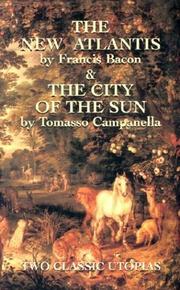
《新大西岛》(英语:New Atlantis,即新亚特兰蒂斯)是弗朗西斯·培根于1626年创作的一部不完整的乌托邦小说。在《新大西岛》中,培根提到人类的发现及知识的未来愿景,表达他对人类的抱负和理想。小说中提及一个乌托邦王国,在那里,居民普遍拥有“慷慨和启蒙、尊严和辉煌、虔诚和公共精神”的品格。作者对应用科学和纯科学领域的现代研究型大学也提出了构想,他在书中提到了他理想的大学——所罗门圣殿。
以上文字摘自维基百科「新大西島」(去掉了参考文献等尾部小节),按 CC BY-SA 4.0 使用,作者为维基百科的各位编者。
中文维基百科的条目比较短,下面附上英文维基百科的内容(英文原文):
New Atlantis is a utopian novel by Sir Francis Bacon, published posthumously in 1626. It appeared unheralded and tucked into the back of a longer work of natural history, Sylva Sylvarum ("Forest of Materials"). In New Atlantis, Bacon portrays a vision of the future of human discovery and knowledge, expressing his aspirations and ideals for humankind. The novel depicts the creation of a utopian land where "generosity and enlightenment, dignity and splendour, piety and public spirit" are the commonly held qualities of the inhabitants of the mythical Bensalem. The plan and organisation of his ideal college, Salomon's House (or Solomon's House), prefigured the modern research university in both applied and pure sciences.
Publication history
New Atlantis first appeared in the back of Sylva Sylvarum, a rather complex work of natural history that was published by William Rawley, Bacon's secretary, chaplain and amanuensis in 1626. When Sylva was entered into the Stationers' Register of July 4, 1626 (three months after Bacon's death), no mention was made of New Atlantis, and it was not until 1670 that it was included on Sylva's letterpress title page (unlike Historia vitae et mortis which received that accolade in 1651). It was not until 1676 that the two works were published with continuous signatures, with the first edition of the Sylva being "printed for J. H. for William Lee", while New Atlantis was, according to McKerrow, "perhaps printed by Mathewes". After New Atlantis was a two-page piece called Magnalia naturae, which most commentators tend to ignore, probably because it is difficult to link it to either Sylva or New Atlantis with any surety. It was published as an individual text by Thomas Newcomb in 1659, but in general New Atlantis appears to have been a text that no-one quite knew what to do with. Certainly Rawley's letter To The Reader indicates that he was less than clear as to its purpose, even though he later published it in Latin translation within the collection Operum moralium et civilium tomus (1638). In 1659 Thomas Bushell referred to the work in his Mineral Prosecutions, while in 1660 a certain R. H. published a continuation of New Atlantis and, in 1662, an explicitly Rosicrucian version appeared as the preface to John Heydon's Holy Guide.
Plot summary
The novel depicts a mythical island, Bensalem, which is discovered by the crew of a European ship after they have lost their way in the Pacific Ocean somewhere west of Peru. The minimal plot serves the gradual unfolding of the island, its customs, but most importantly, its state-sponsored scientific institution, Salomon's House, "which house or college ... is the very eye of this kingdom."
Many aspects of the society and history of the island are described, such as the Christian religion – which is reported to have been born there as a copy of the Bible and a letter from the Apostle Saint Bartholomew arrived there miraculously, a few years after the Ascension of Jesus; a cultural feast in honour of the family institution, called "the Feast of the Family"; a college of sages, the Salomon's House, "the very eye of the kingdom", to which order "God of heaven and earth had vouchsafed the grace to know the works of Creation, and the secrets of them", as well as "to discern between divine miracles, works of nature, works of art, and impostures and illusions of all sorts"; and a series of instruments, process and methods of scientific research that were employed in the island by the Salomon's House.
The interlocutors include the governor of the House of Strangers, Joabin the Jew, and the Head of Salomon's House.
The inhabitants of Bensalem are described as having a high moral character and honesty, as no official accepts any payment from individuals. The people are also described as chaste and pious, as said by an inhabitant of the island:
以上文字摘自英文维基百科「New Atlantis」(有删节,去掉了参考文献等尾部小节),按 CC BY-SA 4.0 使用,作者为维基百科的各位编者。
资料卡
- 原题
- New Atlantis
- 原作语言
- 新拉丁语、近代英语、英语
- 首次出版
- 1627 年
- 作品形式
- 长篇小说
- 体裁
- 哲学小说、奇幻、乌托邦小说、科学幻想
- 主题
- 乌托邦
资料卡来自 Wikidata Q1233830(CC0),众包数据,个别字段可能不全。