书单
百科
这个词条暂时没有中文维基百科条目,下面是英文维基百科的内容(英文原文):
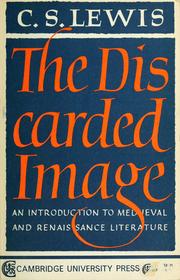
The Discarded Image: An Introduction to Medieval and Renaissance Literature is a non-fiction book by C. S. Lewis. It was his last book and deals with medieval cosmology and the Ptolemaic universe. It portrays the medieval conception of a "model" of the world, which Lewis described as "the medieval synthesis itself, the whole organization of their theology, science and history into a single, complex, harmonious mental model of the universe."
Synopsis
The book includes such concepts as the structure of the medieval universe, the nature of its inhabitants, the notion of a finite universe, ordered and maintained by a celestial hierarchy, and the ideas of nature. At the same time, Lewis takes his reader on a tour of some of the pinnacles of medieval thought (some of them inherited from Classical paganism) that have survived into the modern cultural and theological landscape.
The titles of the chapters are
The Medieval Situation
Reservations
Selected Materials: The Classical Period
Selected Materials: The Seminal Period
The Heavens
The "Longaevi"
Earth and Her Inhabitants
The Influence of the Model
"The Medieval Situation" and "Reservations"
Lewis begins by introducing the Middle Ages as a whole and by laying out the components that shaped their world view. This worldview, or "Model of the Universe", was shaped by two factors in particular: "the essentially bookish character of their culture, and their intense love of system". The bookish character combines with the need for order: "All the apparent contradictions must be harmonised. A Model must be built which will get everything in without a clash; and it can do this only by becoming intricate, by mediating its unity through a great, and finely ordered, multiplicity."
He is quick to point out the possible flaws he feels some may see in his conception. The "Model" is primarily based in art and literature. It does not account for historical changes in philosophic schools or serve as a general history of science or medicine. In addition, only bits and pieces of the Model served as part of the general backdrop of the age. And, above all, Lewis is clear to state that, "On the highest level, then, the Model was recognised as provisional. What we should like to know is how far down the intellectual scale this cautious view extended."
"Selected Materials: The Classical Period"
Lewis provides summaries of the classical texts he believes most informed the medieval Model. He excludes the Bible, Virgil, and Ovid as texts that a student of medieval literature should already be familiar with. Among the texts he covers are:
The Somnium Scipionis by Cicero
The works of Lucan
Statius' Thebaid
Apuleius' De Deo Socratis
"Selected Materials: The Seminal Period"
Lewis refers to the seminal period as a transitional stage stretching from around 205 to 533 A.D. He spends some time discussing the pagans and Christians of this time, and notes that both were monotheists.
As with the Classical period, he provides summaries of various texts, including:
Chalcidius' commentary on Plato's Timaeus
Macrobius' commentary on the Somnium Scipionis
The Celestial Hierarchies of Pseudo-Dionysius
Boethius' De Consolatione Philosophiae
He also mentions Isidore of Seville's Etymologiae and Vincent of Beauvais' Speculum Majus: "They are not, like those I have been describing, contributors to the Model, but they sometimes supply the handiest evidence as to what it was. Both are encyclopaedists."
"The Heavens"
"In medieval science the fundamental concept was that of certain sympathies, antipathies, and strivings inherent in the matter itself. Everything has its right place, its home, the region that suits it, and, if not forcibly restrained, moves thither by a sort of homing instinct", a "kindly enclyning" to their '"kindly stede".
In his exploration of the Heavens, Lewis works to explain much of the basics of medieval cosmology. He begins by explaining the phenomenon of "kindly enclyning": everything returns to the place from which it is drawn. Lewis goes on to answer the question that may arise in response to "kindly enclyning" and that is: "[Did] medieval thinkers really believe that what we now call inanimate objects [possess] sentient and purposive [qualities]"? The answer was "in general", no. Lewis says "in general" because "they attributed life and even intelligence to one privileged class of objects (the stars)...But full blown Panpsychism ... was not held by anyone before Camponella (1568–1639)". In support, Lewis describes the "four grades of terrestrial reality: mere existence (as in stones), existence with growth (as in vegetables), existence and growth with sensation (as in beasts), and all these with reason (as in men)". According to Lewis, "To talk as if inanimate bodies had a homing instinct is to bring them no nearer to us than pigeons; to talk as if they could 'obey' laws is to treat them like men and even like citizens". In the medieval conception, everything was made up of the Four Contraries: hot, cold, moist, and dry. These combine to give us the Four Elements: "The union of hot and dry becomes fire; that of hot and moist, air; of cold and moist, water; of cold and dry, earth." There is also a fifth element, aether, that humans do not experience. In the sublunary world, all the elements have sorted themselves out: "Earth, the heaviest, has gathered itself together at the centre. On it lies the lighter water; above that, the still lighter air. Fire, the lightest of all, whenever it was free, has flown up to the circumference of Nature and forms a sphere just below the orbit of the Moon."
以上文字摘自英文维基百科「The Discarded Image」(有删节,去掉了参考文献等尾部小节),按 CC BY-SA 4.0 使用,作者为维基百科的各位编者。
资料卡
- 原题
- The Discarded Image
- 原作语言
- 英语
- 首次出版
- 1964 年
- 体裁
- 非虚构作品
- 首版出版社
- 剑桥大学出版社
- 主题
- 文学批评
资料卡来自 Wikidata Q7730298(CC0),众包数据,个别字段可能不全。