书单
百科
这个词条暂时没有中文维基百科条目,下面是英文维基百科的内容(英文原文):
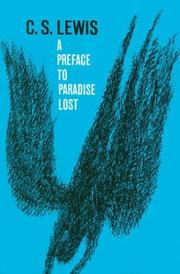
A Preface to Paradise Lost is one of C. S. Lewis's most famous scholarly works. The book had its genesis in Lewis's Ballard Matthews Lectures, which he delivered at the University College of North Wales in 1941. It discusses the epic poem Paradise Lost, by John Milton.
Lewis's work responds to Denis Saurat's work Milton: Man and Thinker, which had celebrated "Milton the man, as well as the centrality of the 'personal' (Milton's heresies), to an understanding of the epic". Lewis disagrees with this point of view:Lewis dismisses what he calls Milton's "private thoughts," "idiosyncratic and accidental as they are," as well as the "heresies" that "reduce themselves to something very small". Lewis's Paradise Lost rather is defined as "Augustinian and Hierarchical," and also, as he writes with a slight nudge and a wink, "Catholic" (although he does immediately acknowledge that he's using the term, in its ordinary sense, to mean "universal," not "Roman Catholic").
Summary
The book has no material before Chapter 1 besides a dedication to Charles Williams.
Epic genre and criticism
Chapter 1, "Epic Poetry", introduces the epic genre.
Chapter 2, "Is Criticism Possible?", is a digression that replies to a remark by T.S. Eliot in "A Note on the Verse of John Milton". Eliot had said:There is a large class of persons, including some who appear in print as critics, who regard any censure upon a 'great' poet as a breach of the peace, as an act of wanton iconoclasm, or even hoodlumism. The kind of derogatory criticism that I have to make upon Milton is not intended for such persons, who cannot understand that it is more important, in some vital respects, to be a good poet than to be a great poet; and of what I have to say I consider that the only jury of judgement is that of the ablest poetical practitioners of my own time.Lewis paraphrases the last clause and focuses on it, but interprets it rather as a representative of the idea "that poets are the only judges of poetry", meant in a general sense, rather than applying only to Eliot's specific criticism of Milton at that specific time. Lewis then critically examines this idea, believing that it leads to a situation where every poet would be trapped in a self-referential cycle, where their own judgment of being a poet is a necessary precondition for their critique to be valuable.
Chapters 3–5 are titled "Primary Epic", "The Technique of Primary Epic", and "The Subject of Primary Epic". They discuss Lewis's concept of "primary epic", the oldest kind of epic genre, represented by the epics of Homer and by Beowulf.
Chapter 6, "Virgil and the Subject of Secondary Epic", discusses the influence of Virgil's Aeneid on the secondary epic genre, which came after primary epic, primarily by introducing the idea that it should have a "great theme". It also introduces the importance of vocation, and the choice between vocation and happiness, as a typical trait of secondary epic.
Style
Chapter 7, "The Style of Secondary Epic", explains the peculiar style of Virgil and Milton as coming from the fact that epic is no longer recited but can only be read, and must give the effect of the performance entirely through the writing.
Lewis points out three main mechanisms through which Milton achieves his elevated style, namely the use of archaic and unfamiliar constructs, the use of proper names, and the constant allusion to sensory experiences.
Similes
Lewis explains Milton's unique approach to similes. Unlike traditional similes that draw clear analogies, Milton's similes often have superficial logical connections but profound emotional or thematic resonances. The "Miltonic simile" thus operates on two levels: a surface-level logical connection and a deeper, emotional or thematic linkage. This technique is shown by when "Paradise is compared to the field of Enna", with the primary connection being how both locations are "one beautiful landscape to another (IV, 268)". Beneath this surface connection, "the deeper value of the simile lies in the resemblance which is not explicitly noted as a resemblance at all, the fact that in both these places the young and the beautiful while gathering flowers was ravished by a dark power risen up from the underworld."
This simile neglects that Eve "is far more responsible for her own fall than was Proserpina and when expelled she will bring death and pain down upon herself, her spouse, and all their descendants to a degree that would seem to exceed Ceres's (Demeter's) terrible pain at Hades's abduction of her daughter", as Stephen Scully points out. Lewis himself notes that sometimes, the logical underpinning of Milton's similes can stretch thin, as in the case of Satan's association with the unpleasant smell of fish.
Description versus arousal
Focusing on Satan's approach to Paradise in book IV, lines 131–286, Lewis analyses how Milton's style does not describe events and landscapes in the narrative, but rather, "while seeming to describe", uses general language to arouse "the Paradisal idea" as it exists "in our own depth". Lewis "justly" observes that this is done by making the sequence of Satan's entering Paradise resemble a dream: as Satan approaches Paradise, Milton describes various tiers of the landscape, but just when it seems like we've reached the highest point, another layer or aspect is revealed, and "as in dream landscapes, we find that what seemed the top is not the top". Lewis perceptively observed that "we experience an almost kinesthetic sense of straining to look higher and higher so as to take in the full view."
Chapter 8, "Defence of this Style", defends the style of secondary epic against some objections.
Worldview
Chapter 9, "The Doctrine of the Unchanging Human Heart", criticizes the idea that readers should seek an "unchanging human heart" beneath all the theology of Milton, or, more generally, to "read past" the outmoded ideas of premodern literature.
以上文字摘自英文维基百科「A Preface to Paradise Lost」(有删节,去掉了参考文献等尾部小节),按 CC BY-SA 4.0 使用,作者为维基百科的各位编者。
资料卡
- 续作
- The Abolition of Man or Reflections on Education with Special Reference to the Teaching of English in the Upper Forms of Schools
资料卡来自 Wikidata Q4659003(CC0),众包数据,个别字段可能不全。