书单
百科
这个词条暂时没有中文维基百科条目,下面是英文维基百科的内容(英文原文):
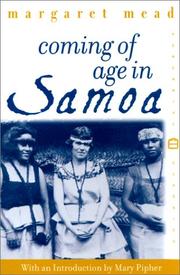
Coming of Age in Samoa: A Psychological Study of Primitive Youth for Western Civilisation is a 1928 book by American anthropologist Margaret Mead based upon her research and study of youth – primarily adolescent girls – on the island of Taʻū in American Samoa. The book details the sexual life of teenagers in Samoan society in the early 20th century, and theorizes that culture has a leading influence on psychosexual development.
First published in 1928, the book launched Mead as a pioneering researcher and as the most famous anthropologist in the world. Since its first publication, Coming of Age in Samoa was the most widely read book in the field of anthropology until Napoleon Chagnon's Yanomamö: The Fierce People overtook it. The book has sparked years of ongoing and intense debate and controversy on questions pertaining to society, culture, and science. It is a key text in the nature versus nurture debate, as well as in discussions on issues relating to family, adolescence, gender, social norms, and attitudes.
In the 1980s, Derek Freeman contested many of Mead's claims, and argued that she was hoaxed into counterfactually believing that Samoan culture had more relaxed sexual norms than Western culture. However, several members of the anthropology community have rejected Freeman's criticism, accusing him of cherry picking his data, and misrepresenting both Mead's research and the interviews that he conducted. Mead's field work for "Coming of Age" was also scrutinized, and major discrepancies were found between her published statements and her field data. Some Samoans are critical of what Mead wrote of their culture, especially her claim that adolescent promiscuity was socially acceptable in Samoa in the 1920s.
Coming of Age in Samoa entered the public domain in the United States in 2024.
Content
Foreword
In the foreword to Coming of Age in Samoa, Mead's advisor, Franz Boas, writes:
"Courtesy, modesty, good manners, conformity to definite ethical standards are universal, but what constitutes courtesy, modesty, good manners, and definite ethical standards is not universal. It is instructive to know that standards differ in the most unexpected ways."
Boas went on to point out that, at the time of publication, many Americans had begun to discuss the problems faced by young people (particularly women) as they pass through adolescence as "unavoidable periods of adjustment". Boas felt that a study of the problems faced by adolescents in another culture would be illuminating.
Introduction
Mead introduces the book with a general discussion of the problems facing adolescents in modern society and the various approaches to understanding these problems: religion, philosophy, educational theory, and psychology. She discusses various limitations in each approach and then introduces the new field of anthropology as a promising alternative science based on analyzing social structures and dynamics. She contrasts the methodology of the anthropologist with other scientific studies of behavior and the obvious reasons that controlled experiments are so much more difficult for anthropology than other sciences. For this reason her methodology is one of studying societies in their natural environment. Rather than select a culture that is fairly well understood such as Europe or America, she chooses South Sea island people because their culture is radically different from Western culture and likely to yield more useful data as a result. However, in doing so she introduces new complexity in that she must first understand and communicate to her readers the nature of South Sea culture itself rather than delve directly into issues of adolescence as she could in a more familiar culture. Once she has an understanding of Samoan culture she will delve into the specifics of how adolescent education and socialization are carried out in Samoan culture and contrast it with Western culture.
Mead described the goal of her research as follows:"I have tried to answer the question which sent me to Samoa: Are the disturbances which vex our adolescents due to the nature of adolescence itself or to the civilization? Under different conditions does adolescence present a different picture?"
To answer this question, she conducted her study among a small group of Samoans. She found a village of 600 people on the island of Ta'ū, in which, over a period of between six and nine months, she got to know, lived with, observed, and interviewed (having learnt some Samoan) 68 young women between the ages of 9 and 20. Mead studied daily living, education, social structures and dynamics, rituals, etiquette, etc.
Samoan life and education
Mead begins with the description of a typical idyllic day in Samoa. She then describes child education, starting with the birth of children, which is celebrated with a lengthy ritual feast. After birth, however, Mead describes how children are mostly ignored -- with girl children sometimes explicitly ritually ignored -- after birth up to puberty. She describes the various methods of disciplining children. Most involve some sort of corporal punishment, such as hitting with hands, palm fronds, or shells. However, the punishment is mostly ritualistic and not meant to inflict serious harm. Children are expected to contribute meaningful work from a very early age. Initially, young children of both sexes help to care for infants. As the children grow older, however, the education of the boys shifts to fishing, while the girls focus more on child care. However, the concept of age for the Samoans is not the same as in the West. Samoans do not keep track of birthdays, and they judge maturity not on actual number of years alive, but rather on the outward physical changes in the child.
以上文字摘自英文维基百科「Coming of Age in Samoa」(有删节,去掉了参考文献等尾部小节),按 CC BY-SA 4.0 使用,作者为维基百科的各位编者。
资料卡
- 原题
- Coming of Age in Samoa
- 原作语言
- 英语
- 首次出版
- 1928 年
- 体裁
- 民族志
- 首版出版社
- 威廉·莫罗出版社
资料卡来自 Wikidata Q5151979(CC0),众包数据,个别字段可能不全。