书单
百科
这个词条暂时没有中文维基百科条目,下面是英文维基百科的内容(英文原文):
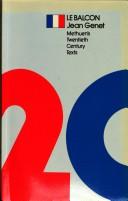
The Balcony (French: Le Balcon) is a play by the French dramatist Jean Genet. It is set in an unnamed city that is experiencing a revolutionary uprising in the streets; most of the action takes place in an upmarket brothel that functions as a microcosm of the regime of the establishment under threat outside.
Since Peter Zadek directed the first English-language production at the Arts Theatre Club in London in 1957, the play has been revived frequently (in various versions) and has attracted many prominent directors, including Peter Brook, Erwin Piscator, Roger Blin, Giorgio Strehler, and JoAnne Akalaitis. It has been adapted as a film and given operatic treatment. The play's dramatic structure integrates Genet's concern with meta-theatricality and role-playing, and consists of two central strands: a political conflict between revolution and counter-revolution and a philosophical one between reality and illusion. Genet suggested that the play should be performed as a "glorification of the Image and the Reflection."
Genet's biographer Edmund White wrote that with The Balcony, along with The Blacks (1959), Genet re-invented modern theatre. The psychoanalyst Jacques Lacan described the play as the rebirth of the spirit of the classical Athenian comic playwright Aristophanes, while the philosopher Lucien Goldmann argued that despite its "entirely different world view" it constitutes "the first great Brechtian play in French literature." Martin Esslin has called The Balcony "one of the masterpieces of our time."
Synopsis
Most of the action takes place in an upmarket brothel in which its madam, Irma, "casts, directs, and co-ordinates performances in a house of infinite mirrors and theaters." Genet uses this setting to explore roles of power in society; in the first few scenes patrons assume the roles of a bishop who forgives a penitent, a judge who punishes a thief, and a general who rides his horse. Meanwhile, a revolution is progressing outside in the city and the occupants of the brothel anxiously await the arrival of the Chief of Police. Chantal, one of the prostitutes, has quit the brothel to become the embodiment of the spirit of the revolution. An Envoy from the Queen arrives and reveals that the pillars of society (the Chief Justice, the Bishop, the General, etc.) have all been killed in the uprising. Using the costumes and props in Irma's "house of illusions", the patrons' roles are realised when they pose in public as the figures of authority in a counter-revolutionary effort to restore order and the status quo.
Textual history
The Balcony exists in three distinct versions, published in French in 1956, 1960, and 1962. The first version consists of two acts of fifteen scenes and includes a dream sequence in which Irma's dream of three wounded young men—who personify blood, tears, and sperm—is enacted immediately before Arthur returns to the brothel and is abruptly shot. The second version is the longest and most political. The third version is shorter and reduces the political content of the scene with the café revolutionaries. Bernard Frechtman's first English translation (published in 1958) was based on Genet's second version, while Frechtman's second, revised English translation (published in 1966) was based on Genet's third version. A translation by Barbara Wright and Terry Hands, which the RSC used in its 1987 production, incorporates scenes and elements from all three versions.
Genet wrote the first version of the play between January and September 1955, during which time he also wrote The Blacks and re-worked his screenplay The Penal Colony. Immediately afterwards, in October and November the same year, he wrote Her, a posthumously published one-act play about the pope, which is related to The Balcony. Genet took his initial inspiration for The Balcony from Franco's Spain, explaining in a 1957 article that:
My point of departure was situated in Spain, Franco's Spain, and the revolutionary who castrates himself was all those Republicans when they had admitted their defeat. And then my play continued to grow in its own direction and Spain in another.
Genet was particularly interested at the time in newspaper reports of two projects for massive tombs: the Caudillo's own colossal memorial near Madrid, the Valle de los Caídos ("Valley of the Fallen"), where he was buried in 1975, and the projected mausoleum of Aga Khan III in Aswan, Egypt. They provided the source for the Chief of Police's longing for a great mausoleum and the founding of a funerary cult around him in the play. The meditations on the contrast between Being and Doing that the Bishop articulates in the first scene recall the "two irreducible systems of values" that Jean-Paul Sartre suggested in Saint Genet (1952) Genet "uses simultaneously to think about the world."
Marc Barbezat's company L'Arbalète published the first version of The Balcony in June 1956; the artist Alberto Giacometti created several lithographs based on the play that appeared on its cover (including a tall, dignified Irma, the Bishop who was made to resemble Genet, and the General with his whip). Genet dedicated this version to Pierre Joly, a young actor and Genet's lover at the time. Genet began to re-write the play in late October 1959 and again in May 1960, the latter prompted by its recent production under the direction of Peter Brook. He worked on the third version between April and October 1961, during which time he also read Friedrich Nietzsche's The Birth of Tragedy (1872), a work of dramatic theory that was to become one of Genet's favourite books and a formative influence on his ideas about the role of myth and ritual in post-realist theatre.
以上文字摘自英文维基百科「The Balcony」(有删节,去掉了参考文献等尾部小节),按 CC BY-SA 4.0 使用,作者为维基百科的各位编者。
资料卡
- 原题
- Le balcon
- 译者
- Bernard Frechtman
- 原作语言
- 法语
- 作品形式
- 剧作
资料卡来自 Wikidata Q3026044(CC0),众包数据,个别字段可能不全。
改编作品
电影1
- 《阳台》The Balcony
舞台剧 / 歌剧 / 芭蕾1
名单来自 Wikidata(CC0):只列条目里写明「改编自 / 取材于」这本书的作品,不按名字猜;众包数据,可能不全。