书单
百科
这个词条暂时没有中文维基百科条目,下面是英文维基百科的内容(英文原文):
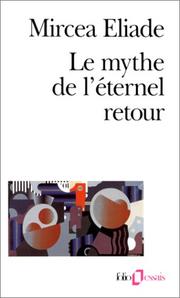
The "eternal return" is an idea for interpreting religious behavior proposed by the historian Mircea Eliade; it is the belief that through ritual practices (sometimes implicitly, but often explicitly) one is able to merge with or return to the "mythical age"—the actual time of one's myths. It should be distinguished from the philosophical concept of eternal return.
Sacred and profane
According to Eliade, all the definitions given up till now of the religious phenomenon have one thing in common: Each has its own way of showing that the sacred and the religious life are the opposite of the profane and secular life.
This concept had already been extensively formulated by the French sociologist Émile Durkheim in 1912.
The scholar Jack Goody posits that it may not be universal.
This sharp distinction between the sacred and the profane is Eliade's trademark theory. According to Eliade, traditional man distinguishes two levels of existence: (1) the Sacred, and (2) the profane world. (Here "the Sacred" can be God, gods, mythical ancestors, or any other beings who established the world's structure.) To traditional man, things "acquire their reality, their identity, only to the extent of their participation in a transcendent reality". Something in our world is only "real" to the extent that it conforms to the Sacred or the patterns established by the Sacred.
Hence, there is profane space, and there is sacred space. Sacred space is space where the Sacred manifests itself; unlike profane space, sacred space has a sense of direction:
In the homogeneous and infinite expanse, in which no point of reference is possible and hence no orientation is established, the hierophany [appearance of the Sacred] reveals an absolute fixed point, a center.
Where the Sacred intersects our world, it appears in the form of ideal models (e.g., the actions and commandments of gods or mythical heroes). All things become truly "real" by imitating these models. Eliade claims: "For archaic man, reality is a function of the imitation of a celestial archetype." As evidence for this view, in The Myth of the Eternal Return, he cites a belief of the Iranian Zurvanites. The Zurvanites believed that each thing on Earth corresponds to a sacred, celestial counterpart: for the physical sky, there is a sacred sky; for the physical Earth, there is a sacred Earth; actions are virtuous by conforming to a sacred pattern. These are some other examples Eliade gives:
According to Mesopotamian beliefs, the Tigris has its model in the star Anunit and the Euphrates in the star of the Swallow. A Sumerian text tells of the "place of the creation of the gods," where "the [divinity of] the flocks and grains" is to be found. For the Ural–Altaic peoples the mountains, in the same way, have an ideal archetype in the sky. In Egypt, places and nomes were named after the celestial "fields": first the celestial fields were known, then they were identified in terrestrial geography.
Further, there is profane time, and there is sacred time. According to Eliade, myths describe a time that is fundamentally different from historical time (what modern man would consider "normal" time). "In short," says Eliade, "myths describe ... breakthroughs of the sacred (or the 'supernatural') into the World". The mythical age is the time when the Sacred entered our world, giving it form and meaning: "The manifestation of the sacred ontologically founds the world". Thus, the mythical age is sacred time, the only time that has value for traditional man.
Origin as power
According to Eliade, in the archaic worldview, the power of a thing resides in its origin, so that "knowing the origin of an object, an animal, a plant, and so on is equivalent to acquiring a magical power over them". The way a thing was created establishes that thing's nature, the pattern to which it should conform. By gaining control over the origin of a thing, one also gains control over the thing itself.
Eliade concluded that, if origin and power are to be the same, "it is the first manifestation of a thing that is significant and valid". The Sacred first manifested itself in the events of the mythical age; hence, traditional man sees the mythical age as the foundation of value.
Sacred time
Eliade's theory implies that as the power of a thing lies in its origin, the entire world's power lies in the cosmogony. If the Sacred established all valid patterns in the beginning, during the time recorded in myth, then the mythical age is sacred time—the only time that contains any value. Man's life only has value to the extent that it conforms to the patterns of the mythical age.
The religion of the Australian Aboriginals is supposed to contain many examples of the veneration paid to the mythical age. Just before the dawn of the first day, the Bagadjimbiri brothers emerged from the Earth in the form of dingos, and then turned into human giants whose heads touched the sky. Before the Bagadjimbiri came, nothing had existed. But when the sun rose, and the brothers began naming things, the "plants and animals began really to exist". The brothers met a group of people and organized them into a civilized society. The people of this tribe—the Karadjeri of Australia—still imitate the two brothers in many ways:
One of the Bagadjimbiri stopped to urinate ... That is the reason why the Australian Karadjeri stop and take up a special position in order to urinate. ... The brothers stopped and ate a certain grain raw; but they immediately burst into laughter, because they knew that one ought not eat it so ... and since then men imitate them whenever they have this grain cooked. The Bagadjimbiri threw a primal (a kind of large baton) at an animal and killed it—and this is how men have done it ever since. A great many myths describe the manner in which the brothers Bagadjimbiri founded all the customs of the Karadjeri, and even their behavior.
以上文字摘自英文维基百科「Eternal return (Eliade)」(有删节,去掉了参考文献等尾部小节),按 CC BY-SA 4.0 使用,作者为维基百科的各位编者。
资料卡
- 原题
- Le mythe de l’éternel retour.
- 首次出版
- 1949 年
- 首版出版社
- 伽利玛出版社
资料卡来自 Wikidata Q3224928(CC0),众包数据,个别字段可能不全。