书单
百科
这个词条暂时没有中文维基百科条目,下面是英文维基百科的内容(英文原文):
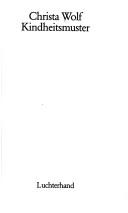
Patterns of Childhood, originally published in German as Kindheitsmuster, is a novel written by Christa Wolf and published in 1976. Christa Wolf was a prominent East German novelist known for works such as Der geteilte Himmel (Divided Heaven) and Kassandra.
Patterns of Childhood is a highly complex novel, set in multiple time periods and locations, with the primary narratives revolving around the narrator's childhood in Nazi Germany, her return to her hometown as an adult, and her reflections while writing. The novel explores themes of memory, Nazism, and guilt, thus providing insight into the upbringings of children under totalitarian regimes, and problems that arise from such a childhood. The novel's main settings relate to major historical events during and following World War II. At the end of the war, the German-speaking population, including the narrator and her family, were forced to leave due to the invading Soviet army, and the area became Polish territory as a part of the Potsdam settlement. The narrator then lived the socialist German Democratic Republic, from where, thirty years later, she returned with her husband, brother and daughter to visit her childhood haunts.
Title
The German title, Kindheitsmuster, could be either singular ("a childhood pattern", "model of a childhood") or plural ("childhood patterns", "models of childhood"), but in conversation with the French translator, Wolf later indicated she had intended it as singular. The novel follows the narrator on a search for the bigger picture - the pattern - of her own childhood. There is a scene in chapter 14 where she is playing with ideas for her title, exploring the possibilities of Grund-Muster (fundamental pattern) and Verhaltens-Muster (pattern of behaviour), when her husband, H., suggests Kindheitsmuster. The narrator then mulls over the etymology of Muster from Latin monstrum, which echoes both the idea of "specimen on display" and of "monstrosity".
The English translation first appeared under the title A Model Childhood, which was widely condemned as erroneous (in German this would be Musterkindheit), though one reviewer praised it as a creative way of showing that in the Nazi period Nelli's childhood was normative. The same translation was later reissued as Patterns of Childhood.
The narrator
The person of the narrator is central to the novel. The text alternates between scenes of the adult narrator's journey back to her childhood home and scenes of her childhood itself. In the former, she refers to herself in the second person, as though recording her thoughts for her own private use. In the latter, she refers to herself in the third person, and by name: she is Nelly Jordan.
Nelly is therefore the narrator as a young girl, coming of age in an area of Nazi Germany that fell to Poland at the end of the war. Her parents Charlotte and Bruno, owned a shop and lived a fairly comfortable lifestyle. Her father was also a member of the German military. In her youth she joined the League of German Girls (Bund Deutscher Mädel). While she was still in her youth her family, along with many other Germans, fled westward before the advancing Red Army.
The adult narrator is on a journey of self-discovery. Throughout the book, she reflects on the memory process both when she is writing as well as during visits to her hometown. The daughter's responses often prompt the narrator to reflect on her youth and how it was so unlike what young people of the current day experience. She also contrasts her recollections and emotions with that of her younger brother. In one section of the book, the narrator says her younger brother has “more reliable factual memory.” The brother also says his memory is less distracted by the inner life. This is one of the multiple ways the narrator contrasts her own recollections, and capacity to remember, with those around her.
Autobiographical Elements
Although the narrator cannot be equated to the author, autobiographical elements in the novel have frequently been commented on. Nelly's childhood is set in a town referred to simply as "L. (heute G.)", which we may recognize as Wolf's own childhood home, Landsberg an der Warthe, now Gorzów Wielkopolski in Poland. Wolf was 15 years old when, at the end of the war, her family fled west to Mecklenburg in East Germany. It was in 1971 that she first paid a return visit to Gorzów as an adult, and it seems to have been this visit that inspired the novel. Wolf has stated that her decision not to frame the novel as a first-person narrative reflects her estrangement from her childhood in the period of National Socialism.
The book is prefaced with the following disclaimer:"All characters in this book are the invention of the narrator. None is identical with any person living or dead. Neither do any of the described episodes coincide with actual events. Anyone believing that he detects a similarity between a character in the narrative and either himself or anyone else should consider the strange lack of individuality in the behavior of many contemporaries."
Themes
Vergangenheitsbewältigung
The German word Vergangenheitsbewältigung (from Vergangenheit, 'the past', and bewältigen, 'to manage', 'cope with', 'overcome'), refers to the psychological process of working through the trauma of historical events. This idea encompasses both literary and political efforts in post-war Germany to understand and acknowledge the horrors of the NS period, where possible to apologize and make reparation for them, and so to move forward to a healthier future based on honesty about the past.
Memory
From the first line of the novel Wolf focuses on the problem of memory. "What is past is not dead", she writes, "it is not even past." [Das vergangene ist nicht tot; es ist nicht einmal vergangen.] The introduction includes a reflection on issues of remembrance and childhood. She also addresses the narration and different voices present in the book.
以上文字摘自英文维基百科「Patterns of Childhood」(有删节,去掉了参考文献等尾部小节),按 CC BY-SA 4.0 使用,作者为维基百科的各位编者。
资料卡
- 原题
- Kindheitsmuster
- 原作语言
- 德语
- 首次出版
- 1976 年
- 作品形式
- 长篇小说
资料卡来自 Wikidata Q1741948(CC0),众包数据,个别字段可能不全。