书单
百科
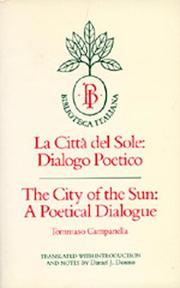
《太阳城》(意大利语:La città del Sole; 拉丁语:Civitas Solis)是意大利道明会修士、哲学家托马索·康帕内拉的一部哲学著作,在早期乌托邦思想中有重要地位。该著作最初于1602年以意大利语写成,拉丁语版于1623年在法兰克福出版。康帕内拉在这本书中借航海家与招待所管理员的对话,描绘了一个完全废除私有制的社会,启发了后来空想社会主义的众多理论与实践。
内容
康帕内拉虚拟了一名热那亚的航海家和朝圣招待所管理的对话,描绘了一个不为世人所知、按照根本不同于当时意大利和西欧各国社会制度的原则建立起来的新型理想社会。太阳城位于赤道的一座小山上,面积和一座城市相仿,这里没有私有财产,没有剥削,人人劳动,生产和消费由被称为“形而上学者”“威力”“智慧”和“爱”的四位领导人所管理,有机构统一组织安排,产品按公民需要分配,儿童由国家抚养和教育,教育与生产相联系。
以上文字摘自维基百科「太阳城 (著作)」(去掉了参考文献等尾部小节),按 CC BY-SA 4.0 使用,作者为维基百科的各位编者。
中文维基百科的条目比较短,下面附上英文维基百科的内容(英文原文):
The City of the Sun (Italian: La città del sole; Latin: Civitas solis) is a philosophical work by the Italian Dominican philosopher Tommaso Campanella. It is an important early utopian work. The work was written in Italian in 1602, shortly after Campanella's imprisonment for heresy and sedition. A Latin version was written in 1613–14 and published in Frankfurt in 1623.
Synopsis
The book is presented as a dialogue between "a Grandmaster of the Knights Hospitaller and a Genoese Sea-Captain". Inspired by Plato's Republic and the description of Atlantis in Timaeus, it describes a theocratic society where goods, women and children are held in common. It also resembles the City of Adocentyn in the Picatrix, an Arabic grimoire of astrological magic. In the final part of the work, Campanella prophesies—in the veiled language of astrology—that the Spanish kings, in alliance with the Pope, are destined to be the instruments of a Divine Plan: the final victory of the True Faith and its diffusion in the whole world. While one could argue that Campanella was simply thinking of the conquest of the New World, it seems that this prophecy should be interpreted in the light of a work written shortly before The City of the Sun, The Monarchy in Spain, in which Campanella exposes his vision of a unified, peaceful world governed by a theocratic monarchy.
The city
Protected and defended by seven circles of walls, the city is built on a hill, with a temple at the top. The walls of the city are painted with images representing different important fields of knowledge. These include illustrations of the heavens and the stars, of mathematical figures, of every country on earth and of all the marvels and secrets of the mineral, vegetable and animal worlds, until we arrive at mankind: on the internal wall of the sixth circle the mechanical arts and their inventors are represented. On the external wall legislators are depicted; and it is here, in "a place of great honor" — alongside Moses, Osiris, Jove, Mercury and Muhammad— that the Genoese sailor recognizes Christ and the twelve apostles.
Everyone must be acquainted with all lines of work, and then each person practices the one for which he shows the greatest aptitude. They have no servants, and no service is regarded as unworthy. The only thing that they consider to be despicable is idleness, and in this way they come to privilege the dignity of work and to overturn an absurd conception of nobility, linked to inactivity and vice.
As work is divided among all citizens, each spends only four hours a day working. The citizens possess nothing; instead, everything is held in common. The society uses many inventions, such as vessels able to navigate without wind and without sails, and stirrups that make it possible to guide a horse using only one's feet, leaving one's hands free.
A feature of the society that Campanella himself describes as "hard and arduous" is the community of wives. This is the solution adopted by the citizens to the problem of procreation. Sexual generation must obey strict rules regarding the physical and moral qualities of the parents and the choice of a propitious time for conception, determined by an astrologer. Such a union is not the expression of a personal, emotional or passionate relationship, but rather is connected to the social responsibility of generation and to love for the collective community.
以上文字摘自英文维基百科「The City of the Sun」(有删节,去掉了参考文献等尾部小节),按 CC BY-SA 4.0 使用,作者为维基百科的各位编者。
资料卡
- 原题
- La città del sole
- 原作语言
- 拉丁语、意大利语
- 首次出版
- 1623 年
- 体裁
- 知识性文学
- 主题
- 乌托邦
资料卡来自 Wikidata Q913656(CC0),众包数据,个别字段可能不全。
改编作品
取材于它的书1
名单来自 Wikidata(CC0):只列条目里写明「改编自 / 取材于」这本书的作品,不按名字猜;众包数据,可能不全。