书单
百科
这个词条暂时没有中文维基百科条目,下面是英文维基百科的内容(英文原文):
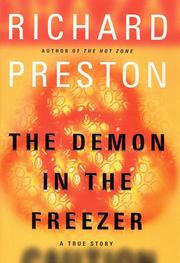
The Demon in the Freezer is a 2002 nonfiction book on the biological weapon agents smallpox and anthrax and how the American government develops defensive measures against them. It was written by journalist Richard Preston, also author of the best-selling book The Hot Zone (1994), about ebolavirus outbreaks in Africa and Reston, Virginia and the U.S. government's response to them. Preston decided to write the book following the 2001 anthrax attacks, discussing the two diseases together because both could be potentially used as biological weapons.
The book is primarily an account of the Smallpox Eradication Program (1967–1980), the ongoing belief of the U.S. government that smallpox is still a potential bioterrorism agent, and the controversy over whether or not the remaining samples of smallpox virus in Atlanta and Moscow (the "demon" in the freezer) should be finally destroyed. Many reviewers praised Preston's writing style, but some found the attempts to interweave the anthrax investigation with the smallpox material "klutzy" and "disjointed".
Synopsis
Section 1, "Something in the Air", begins with a day-by-day account of the anthrax letter attacks in Florida and Washington, D.C., for the period 2 to 15 October 2001. Robert Stevens, a photo retoucher for the tabloid The Sun, was a victim and US Senator Tom Daschle was an intended victim. The facts of the FBI, the CDC and the U.S. Army Medical Research Institute of Infectious Diseases (USAMRIID) are detailed.
Section 2, "The Dreaming Demon", looks back to an outbreak of smallpox at St Walburga Hospital in Meschede, Germany. The successful efforts organized by local public health authorities and the WHO—including a textbook example of ring vaccination containment—are described.
Section 3, "To Bhola Island", describes the varieties and evolution of poxviruses and the history of smallpox in particular. The story of the SEP, Smallpox Eradication Program, referred to throughout as "the Eradication", led by DA Henderson and others is recounted. The more personal story of physician, counterculture figure, and future virtual community pioneer Lawrence Brilliant is told as his Indian guru, Neem Karoli Baba, exhorts him in 1970 to join the SEP and "go eradicate smallpox". Brilliant ended up fighting the outbreak at the Tatanagar Railway Station in Bihar. The Maximum Containment Facility (MCF) of the CDC in Atlanta is described.
Section 4, "The Other Side of the Moon", begins with an account of the 1989 defection to the United Kingdom of Vladimir Pasechnik, the first Soviet bioweaponeer to flee to the West. Pasechnik described Biopreparat, the Soviet biological weapons program, to MI6, including their genetically modified, antibiotic resistant plague and their smallpox program at the site known as Vector. The fact that the Russians had ICBMs armed with both plague and smallpox is revealed. Various biological weapon facilities in Russia and Iraq are described. The history and work of the Ad Hoc Committee on Orthopox Infections is related. This group of the WHO has been hotly debated since 1980 over the fate of the remaining samples of smallpox in the last two official repositories. DA Henderson has been in favor of destruction. US Army scientist Peter Jahrling has been against it on the basis that further research is needed, since smallpox almost certainly exists, he believes, outside of the repositories.
Section 5, "A Woman with a Peaceful Life", tells the story of USAMRIID microbiologist and epidemiologist Dr. Lisa E. Hensley, who was originally recruited to do Ebola work. A January 2000 accident in the AA4 "Hot Suite" that Hensley experienced, along with the protocols that followed it, is described. The efforts of USAMRIID scientists to get approval to do smallpox research on animals is described including the FDA's "animal efficacy rule" and the WHO General Assembly's provisional permission to do research for three years (1999–2002). A "Monkey Cabinet" is designed at USAMRIID and CDC for use in the possible investigation of the question of whether animals can be infected with smallpox. The development of a lethal, genetically engineered mousepox virus (the Jackson-Ramshaw virus) and its implications for bioterrorism are described. The "awakening" of the smallpox at the CDC's MCF West in 2001 by US Army investigators to induce smallpox disease in monkeys for the first time is dramatically recounted.
Section 6, "The Demon's Eyes", continues the story of the induction of smallpox disease in monkeys at the CDC in 2001. It was determined that the Harper strain of smallpox kills monkeys slowly while the India strain kills them quickly. This was the first time that smallpox had ever been shown capable of infecting non-humans. Of eight monkeys infected, seven died—six of hemorrhagic smallpox and one of the classic pustular type. There follows a discussion of the need and justification for animal-use smallpox experiments. The emergency evacuation of the Army workers in the MCF West on 9/11 is described.
Section 7, "The Anthrax Skulls", relates the atmosphere at the Department of Health and Human Services and their actions at the time of the 9/11 attacks. The story of the Amerithrax investigations is picked up again in day-by-day detail for the period 16 to 25 October 2001. The response by the FBI, HHS, DOJ, CIA and the White House are detailed. Actions at USAMRIID and USAMRMC are also described. USAMRIID became the FBI's reference lab for forensic evidence related to the bioterror incident. The events leading to Dr. Steven Hatfill becoming a DOJ "person of interest" are related. The indignation of Alfred Sommer, dean of the Johns Hopkins School of Public Health, at the news of the Army animal smallpox experiments is described as well as a reiteration of DA Henderson's opposition to the same.
以上文字摘自英文维基百科「The Demon in the Freezer」(有删节,去掉了参考文献等尾部小节),按 CC BY-SA 4.0 使用,作者为维基百科的各位编者。
资料卡
- 原题
- The Demon in the Freezer
- 原作语言
- 英语
- 首次出版
- 2002 年
- 体裁
- 非虚构作品
资料卡来自 Wikidata Q7729713(CC0),众包数据,个别字段可能不全。