书单
百科
这个词条暂时没有中文维基百科条目,下面是英文维基百科的内容(英文原文):
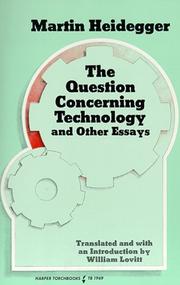
The Question Concerning Technology (German: Die Frage nach der Technik) is a work by Martin Heidegger, in which the author discusses the essence of technology. Heidegger originally published the text in 1954, in Vorträge und Aufsätze.
Heidegger initially developed the themes in the text in the lecture "The Framework" ("Das Gestell"), first presented on December 1, 1949, in Bremen. "The Framework" was presented as the second of four lectures, collectively called "Insight into what is." The other lectures were titled "The Thing" ("Das Ding"), "The Danger" ("Die Gefahr"), and "The Turning" ("Die Kehre").
Summary
The question concerning technology is asked, as Heidegger notes, "so as to prepare a free relationship to it." The relationship will be free "if it opens our human existence (Dasein) to the essence of technology." This is because "[o]nly the true brings us into a free relationship with that which concerns us from out of its essence." Thus, questioning uncovers the questioned in its (true) essence as it is, enabling it to be "experienced within its own bounds" by seeking "the true by way of the correct." This is akin to the Aristotelian way of advancing "from what is more obscure by nature, but clearer to us, towards what is more clear and more knowable by nature."
Heidegger begins the question by noting that "We ask the question concerning technology when we ask what it is." This stems from following an ancient doctrine to which "the essence of a thing is considered to be what the thing is." He starts from the correct or clear definition that "Everyone knows the two statements that answer our question," that is, that "[t]echnology is a means to an end [and] a human activity." The reason granted is that "to posit ends and procure and utilize the means to them is a human activity." If technology is a means to a human end, this conception can therefore be "called the instrumental and anthropological definition of technology." This raises the further question, "[w]hat is the instrumental itself?" This entails questioning the purview of instrumentality in which means and ends are subsumed, entailing the question, "[w]ithin what do such things as means and end belong?"
A means can be seen as that through and by which an end is effected. It is that "whereby something is effected and thus attained." In essence, it can be seen as a cause, for "Whatever has an effect as its consequence is called a cause." But an end is also a cause to the extent that it determines the kind of means to be used to actualize it. As noted, "The end in keeping with which the kind of means to be used is determined is also considered a cause." This conceptualization of instrumentality as means and ends leads the question further into causality, suggesting that "[w]herever ends are pursued and means are employed, wherever instrumentality reigns, there reigns causality."
To question causality, Heidegger starts from what "[f]or centuries philosophy has taught" regarding the traditional "four causes." These are traditionally enumerated as (1) the "causa materialis, the material, the matter out of which" something is made; (2) the "causa formalis, the form, the shape into which the material enters"; (3) the "causa finalis, the end, in relation to which [the thing] required is determined as to its form and matter"; and (4) the "causa efficiens, which brings about the effect that is the finished [thing]." Heidegger concludes that "[w]hat technology is, when represented as a means, discloses itself when we trace instrumentality back to fourfold causality." To explain this, Heidegger uses the example of a silver chalice. Each element works together to create the chalice in a different manner:
Thus four ways of owing hold sway in the sacrificial vessel that lies ready before us. They differ from one another, yet they belong together. ... The four ways of being responsible bring something into appearance. They let it come forth into presencing. They set it free to that place and so start it on its way, namely into its complete arrival.
When these four elements work together to create something into appearance, it is called bringing-forth. This bringing-forth comes from the Greek poiesis, which "brings out of concealment into unconcealment." This revealing can be represented by the Greek word aletheia, which in English is translated as "truth." This truth has everything to do with the essence of technology because technology is a means of revealing the truth.
Modern technology, however, differs from poiesis. Heidegger suggests that this difference stems from the fact that modern technology "is based on modern physics as an exact science." The revealing of modern technology, therefore, is not bringing-forth, but rather challenging-forth. To exemplify this, Heidegger draws on the Rhine River as an example of how our modern technology can change a cultural symbol.
To further his discussion of modern technology, Heidegger introduces the notion of standing-reserve. Modern technology places humans in standing-reserve. To explain this, Heidegger uses the example of a forester and his relationship to the paper and print industries, as he waits in standing reserve for their wishes.
Heidegger once again returns to discuss the essence of modern technology to name it Gestell. The original German meaning something more like scaffolding, he defines it primarily as a sort of enframing:
Enframing means the gathering together of that setting-upon that sets upon man, i.e., challenges him forth, to reveal the real, in the mode of ordering, as standing-reserve. Enframing means that way of revealing that holds sway in the essence of modern technology and that it is itself not technological.
以上文字摘自英文维基百科「The Question Concerning Technology」(有删节,去掉了参考文献等尾部小节),按 CC BY-SA 4.0 使用,作者为维基百科的各位编者。
资料卡
- 原题
- Die Frage nach der Technik
- 原作语言
- 德语
- 首次出版
- 1954 年
- 首版出版社
- 加兰出版社
- 前作
- Hölderlin's Hymn "The Ister"
- 续作
- 艺术作品的本源
- 主题
- 现象学
资料卡来自 Wikidata Q7759065(CC0),众包数据,个别字段可能不全。