书单
百科
这个词条暂时没有中文维基百科条目,下面是英文维基百科的内容(英文原文):
Omon Ra (Russian: «Омон Ра») is a short novel by Russian writer Victor Pelevin, published in 1992 by the Tekst Publishing House in Moscow. It was the first novel by Pelevin, who until then was known for his short stories.
Pelevin traces the absurd fate of the protagonist Omon, named by his policeman father (after OMON, Soviet and Russian special police forces, pronounced "Amon"), placing him in circumstances that are both fantastic and at the same time have recognizable everyday detail. Pelevin uses this story to illustrate the underlying absurdity of the Soviet establishment with its fixation on "heroic achievements", especially in those fields of human endeavor which could be favorably presented to the outside world—science, the military, and most significantly space exploration.
The book met with a significant success in the early post-Soviet cultural landscape and continues to be reprinted. An excerpt under the name "Lunokhod" was published in 1991 in the magazine Knowledge is Power and in the collection Blue Lantern. A variation of the book was published in the magazine The Banner in 1992. In 1993 the book was awarded with two literary prizes, the "Interpresson" and the "Bronze Snail".
Plot summary
The book is narrated in the first person. It is a coming-of-age story, or Bildungsroman. The protagonist is Omon Krivomazov, who was born in Moscow post-World War II. The plot traces his life from early childhood. In his teenage years, the realization strikes him that he must break free of Earth's gravity to free himself of the demands of the Soviet society and the rigid ideological confines of the state. After finishing high school, he immediately enrolls in a military academy. Omon soon finds that the academy does not, in fact, create future pilots, but instead exposes cadets to a series of treacherous trials, beginning with the amputation of both of their feet. The goal of the trials is to manifest Soviet heroism in the cadets. These amputations come as a reference to a famous Soviet ace-pilot Alexey Maresyev, who, despite being badly injured in a plane crash after a dogfight, managed to return to Soviet-controlled territory on his own. During his 18-day-long journey, his injuries deteriorated so badly that both of his legs had to be amputated below the knee. Desperate to return to his fighter pilot career, he subjected himself to nearly a year of physical therapy and exercise to master control of his prosthetic devices. He succeeded and returned to flying in June 1943.
Before any intentional amputation can occur, Omon and his friend are whisked out of the academy into a top-secret installation, located under KGB headquarters in Moscow. There, they start preparing for a supposedly uncrewed mission to the Moon. Omon is told that to substitute for researching, building and launching an automated probe, the Party prefers to use people, trained for "heroism", to fulfill the tasks nominally performed by machines, such as rocket stage separation, space vehicle course correction and so on.
Soon Omon indeed seems to be launched to the Moon, strapped into a seat inside a Lunokhod, which he is meant to drive like a bicycle on the lunar surface. He is the final piece in a multi-stage mission to deliver a radio beacon to a specific point on the Moon and activate it. This he does, even though once he leaves the confines of the hermetically sealed Lunokhod, his protection against the vacuum and the interstellar cold consists of a cotton-filled overcoat and "special hydrocompensatory tampons" (which are really just oiled cotton balls) stuffed up his nose. However, when the time comes for Omon to shoot himself after he places the beacon, according to his orders, the gun he was given for the purpose misfires. Omon finds himself not on the Moon at all, but in an abandoned subway tunnel, where he had been driving his Lunokhod all along, ignoring all signs which might have given him a clue as to his real whereabouts. He tries to escape and is chased and shot at, but he manages to find his way into the "normal" world again, coming up into one of the stations of the Moscow Metro.
One of Omon's "teachers" explains the idea behind the charade: even if the fact that the Soviet Union is a champion of peaceful space exploration holds true only inside a person's head (namely, the hero's; no one knows of him or his mission apart from its organizers), this is not any different from it being the reality. The reality, when it concerns subjects not capable of being experienced, is in fact only a perception formed in people's consciousness, and can be manipulated to the extent that the question of "true" version of events becomes meaningless.
Title
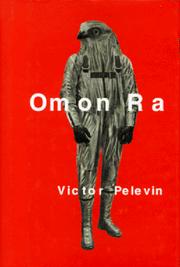
The title, Omon Ra, refers to the main character's given and chosen names. Omon's first name comes from the acronym for a branch of the Russian police force. It was given to him by his father. Ra is an allusion to the Egyptian Sun god, whose body is human and whose head is that of a falcon. Omon bestowed this surname upon himself, inspired by the fact that the word falcon was sometimes applied to cosmonauts and heroes. Ra is connected with the Egyptian myth of the Sun orbiting the Earth, which connects to Omon's obsession with spaceflight. Later, Ra becomes his call sign for the lunar mission. Together these names relate to Omon's dream of flight and the absurd military system he must go through to achieve it.
Major characters
Omon Ra (Omon Krivomazov)
以上文字摘自英文维基百科「Omon Ra」(有删节,去掉了参考文献等尾部小节),按 CC BY-SA 4.0 使用,作者为维基百科的各位编者。
资料卡
- 原题
- Омон Ра
- 译者
- Andrew Bromfield
- 原作语言
- 俄语
- 首次出版
- 1992 年
- 作品形式
- 长篇小说
- 首版出版社
- Text Publishers
- 续作
- The Life of Insects
资料卡来自 Wikidata Q4120736(CC0),众包数据,个别字段可能不全。