 书单
百科
这个词条暂时没有中文维基百科条目,下面是英文维基百科的内容(英文原文):
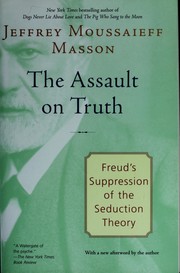
The Assault on Truth: Freud's Suppression of the Seduction Theory is a book by the former psychoanalyst Jeffrey Moussaieff Masson, in which the author argues that Sigmund Freud, the founder of psychoanalysis, deliberately suppressed his early hypothesis, known as the seduction theory, that hysteria is caused by sexual abuse during infancy, because he refused to believe that children are the victims of sexual violence and abuse within their own families. Masson reached this conclusion while he had access to several of Freud's unpublished letters as projects director of the Sigmund Freud Archives. The Assault on Truth was first published in 1984 by Farrar, Straus and Giroux; several revised editions have since been published.
The book prompted massive publicity and controversy. It received many negative reviews, several of which rejected Masson's reading of psychoanalytic history. It was condemned by reviewers within the psychoanalytic profession, and came to be seen as the latest in a series of attacks on psychoanalysis and an expression of a widespread "anti-Freudian mood". The book has received criticism from both supporters and critics of psychoanalysis. Its overall reception has been described as mixed. Some feminists endorsed Masson's conclusions, and other commentators have seen merit in his book. Masson has been criticized for supposedly 'misrepresenting' the seduction theory and maintaining that it was correct. He has also been criticized for his discussion of Freud's treatment of his patient Emma Eckstein, for suggesting that children are by nature innocent and asexual, and for taking part in a reaction against the sexual revolution.
Summary
Masson argues that the accepted account of the way in which, Sigmund Freud, the founder of psychoanalysis, abandoned his seduction theory is incorrect. In the Preface of 2012 edition, Masson stated that "when it comes to one major human experience, sexual trauma, Freud was right only briefly, and then, forevermore wrong." Freud initially proposed that his patients' mental illnesses were rooted in real-life sexual abuse as female patients told him in 1895 and 1896, but nine years later he shifted his stance, claiming these traumatic memories were actually internal sexual fantasies (known as the "Oedipus complex").
Masson argues that Freud was wrong to disbelieve his female patients and that the real reason Freud abandoned the seduction theory is that he could not accept that children are "the victims of sexual violence and abuse within their own families". He suggests that Freud's theories of "internal fantasy and of spontaneous childhood sexuality", which he developed after abandoning the seduction theory, allowed sexual violence to be attributed to the victim's imagination, and therefore posed no threat to the existing social order. Masson acknowledges the tentative nature of his reinterpretation of Freud's reasons for abandoning the seduction theory. He criticizes other accounts of Freud's work, including that provided by the psychoanalyst Ernest Jones in The Life and Work of Sigmund Freud (1953-1957). He also discusses Freud's 1896 essay "The Aetiology of Hysteria", which he provides in an appendix. He also discusses the work of the doctor Auguste Ambroise Tardieu, Freud's treatment of Emma Eckstein, Freud's theory of the Oedipus complex, and Freud's relationship with the psychoanalyst Sándor Ferenczi.
Background and publication history
According to the historian Roy Porter, Masson, formerly a Sanskrit professor, retrained as a psychoanalyst, and in the 1970s found support within the psychoanalytic profession in the United States. Masson's relationship with the psychoanalyst Kurt R. Eissler helped Masson become the projects director of the Freud Archives, where he was entrusted with publishing the authorized edition of the correspondence between Freud and Wilhelm Fliess. Masson aroused controversy after presenting his views about the origins of Freud's psychoanalytic theories in a paper delivered at a 1981 meeting of the Western New England Psychoanalytic Society. The New York Times printed two articles reporting Masson's views, as well as an interview with him. Eissler fired Masson, who retaliated with writs. The journalist Janet Malcolm published two articles about the controversy (later issued as a book, In the Freud Archives [1984]) in The New Yorker.
Many of Masson's conclusions had earlier been reached by Florence Rush, who made a public presentation of them in 1971 in New York (forming The Freudian Coverup theory).
The Assault on Truth was first published by Farrar, Straus and Giroux in 1984. Revised editions followed in 1985, 1992, 1998, and 2003.
Reception
Overview
The Assault on Truth provoked controversy and prompted massive publicity. The book received notice in publications such as Newsweek, Maclean's, The New York Times Book Review, and New Statesman and Society. In Maclean's, the book was described as the latest in a series of attacks on psychoanalysis, and Masson was quoted saying, "I think that as a result of my findings, we should give up on psychoanalysis as a means of helping people." In The New York Times Book Review, the critic Harold Bloom described the book as "dubious". In New Statesman and Society, Jenny Turner dismissed the book, accusing Masson of spite, misreadings, and making inept arguments.
以上文字摘自英文维基百科「The Assault on Truth」(有删节,去掉了参考文献等尾部小节),按 CC BY-SA 4.0 使用,作者为维基百科的各位编者。
资料卡
- 原题
- The Assault on Truth
- 原作语言
- 英语
- 首次出版
- 1984 年
- 体裁
- 心理学
- 首版出版社
- 法勒、施特劳斯和吉鲁出版社
- 主题
- 西格蒙德·弗洛伊德
资料卡来自 Wikidata Q7714703(CC0),众包数据,个别字段可能不全。