书单
百科
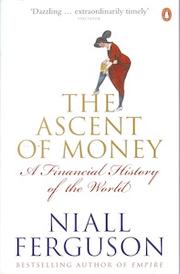
《金钱崛起》(英语:The Ascent of Money: A Financial History of the World)为哈佛经济学者尼尔·弗格森于2008年出版的书籍,是他的第十本出版著作。后来也改编成六集的电视纪录片(又译《金钱本色》)。这系列资料介绍货币的历史以及信贷机制与金融体系的脉络。
纪录片
此作品曾于2009年获得国际艾美奖的最佳电视纪录片奖。
第一集【贪婪之梦】:从古巴比伦时代的借贷关系,说明首次信用机制的出现。
第二集【人类枷锁】:金融市场的蓬勃发展,以债券市场开始,介绍意大利文艺复兴时期约翰·霍克伍德以及罗特席尔德家族的出现。
第三集【看穿泡沫】:介绍股票发明与股市崛起的影响。讨论史上第一次股市泡沫的密西西比泡沫到近日的安隆事件。
第四集【面对风险】:介绍现代的保险机制是如何演进的。卡崔娜飓风
第五集【房屋贷款】:抵押借款制度的介绍。
第六集【中美共同体】:介绍经济体合纵联合的关系。
以上文字摘自维基百科「金錢崛起」(去掉了参考文献等尾部小节),按 CC BY-SA 4.0 使用,作者为维基百科的各位编者。
中文维基百科的条目比较短,下面附上英文维基百科的内容(英文原文):
The Ascent of Money: A Financial History of the World is a 2008 book by then-Harvard professor Niall Ferguson, and an adapted television documentary for Channel 4 (UK) and PBS (US), which in 2009 won an International Emmy Award. It examines the long history of money, credit, and banking.
Book
The book deals with the rise of money as a trade form, and tracks its progression, development, and effects on society into the 21st Century. It also covers the importance of financial systems and the role they have played throughout historical events. In total there are six chapters covering various financial events along with an introduction and an afterword note included at the end. Each chapter covers a different aspect of the financial system.
Chapter one depicts the journey of Francisco Pizarro, a Spanish explorer, as an example of the establishment of gold and silver being used as currency. It also discusses the beginning of lending, or credit, and finally moving on to the foundational pieces of modern banking through the story of the Bank of England in the 19th century.
Chapter two discusses the bond market, focusing primarily on Italy during the Renaissance and their increased usage of the bond market, as well as the development of the Rothschild family's wealth in the 19th century.
Chapter three focuses on the stock market and the occurrence of bubbles. This chapter primarily focuses on the creation of the joint-stock company, the popping of the Mississippi Bubble, the Great Depression, and the Enron Bankruptcy.
Chapter four explores the concept of insurance through various examples such as Hurricane Katrina, describing the life insurance and marine insurance contracts in 14th century Italy, the founding of a fire insurance company by Nicholas Barbon after The Great Fire of London, the marine insurance market that developed around Lloyd's coffee house, the development of mathematical probability and its application by the life insurance fund for the Widows and Children of the Ministers of the Church of Scotland in 1748.
Chapter five discusses housing and the safety behind it being used as a form of investment.
Chapter six, discusses the idea of globalization and its recent implementation around the world, which leads to a discussion of the relationship between the United States and China.
In the afterword, Ferguson compares finance to the idea of evolution and addresses the 2008 financial crisis and the Great Recession.
Documentary
The book was adapted into a six-part television documentary with the new full title Ascent of Money: Boom and Bust for Channel 4 in the United Kingdom. It also aired on TVB Pearl in Hong Kong and ABC1 in Australia. In the United States, an edited two-hour version was aired in January 2009 by PBS.
A newer, reorganized four-hour version with the original full title The Ascent of Money: The Financial History of the World was aired in July 2009 by PBS. Both versions can still be viewed online.
Ep. 1: Dreams of Avarice
From Shylock's pound of flesh to the loan sharks of Glasgow, from the "promises to pay" on Babylonian clay tablets to the Medici banking system. Professor Ferguson explains the origins of credit and debt and why credit networks are indispensable to any civilization.
Ep. 2: Human Bondage
How did finance become the realm of the masters of the universe? Through the rise of the bond market in Renaissance Italy. With the advent of bonds, war finance was transformed and spread to north-west Europe and across the Atlantic. It was the bond market that made the Rothschilds the richest and most powerful family of the 19th century.
Ep. 3: Blowing Bubbles
Why do stock markets produce bubbles and busts? Professor Ferguson goes back to the origins of the joint stock company in Amsterdam and Paris. He draws telling parallels between the Great Recession and the 18th century Mississippi Bubble of Scottish financier John Law and the 2001 Enron bankruptcy. He shows why humans have a herd instinct when it comes to investment, and why no one can accurately predict when the bulls might stampede.
以上文字摘自英文维基百科「The Ascent of Money」(有删节,去掉了参考文献等尾部小节),按 CC BY-SA 4.0 使用,作者为维基百科的各位编者。
资料卡
- 原题
- The Ascent of Money
- 原作语言
- 英语
- 首次出版
- 2008 年 11 月 13 日
- 体裁
- 经济史
- 首版出版社
- 企鹅出版
- 主题
- 货币历史
资料卡来自 Wikidata Q7714645(CC0),众包数据,个别字段可能不全。
改编作品
电影1
名单来自 Wikidata(CC0):只列条目里写明「改编自 / 取材于」这本书的作品,不按名字猜;众包数据,可能不全。