书单
百科
这个词条暂时没有中文维基百科条目,下面是英文维基百科的内容(英文原文):
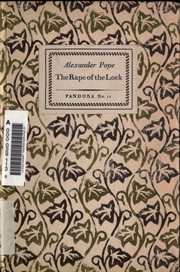
The Rape of the Lock is a mock-heroic narrative poem written by Alexander Pope. One of the most commonly cited examples of high burlesque, it was first published anonymously in Lintot's Miscellaneous Poems and Translations (May 1712) in two cantos (334 lines); a revised edition "Written by Mr. Pope" followed in March 1714 as a five-canto version (794 lines) accompanied by six engravings. Pope boasted that this sold more than three thousand copies in its first four days. The final form of the poem appeared in 1717 with the addition of Clarissa's speech on good humour. The poem was much translated and contributed to the growing popularity of mock-heroic in Europe.
Description
The poem of The Rape of the Lock satirises a minor incident of life, by comparing it to the epic world of the gods, and is based on an event recounted to Alexander Pope by his friend John Caryll. Arabella Fermor and her suitor, Lord Petre, were each a member of aristocratic recusant Catholic families, at a time in England when, under such laws as the Test Act, all denominations except Anglicanism suffered legal restrictions and penalties. (For example, Petre, being a Catholic, could not take the place in the House of Lords that would otherwise have been his.) Petre had cut off a lock of Arabella's hair without permission, and the consequent argument had created a breach between the two families. The poem's title does not refer to the extreme of sexual rape, but to an earlier definition of the word derived from the Latin rapere, "to snatch, to grab, to carry off"—in this case, the theft and carrying away of a lock of hair. In terms of the sensibilities of the age, however, even this non-consensual personal invasion might be interpreted as bringing loss of reputation and dishonour.
Pope, also a Catholic, wrote the poem at the request of friends in an attempt to "comically merge the two" worlds, the heroic with the social. He utilised the character Belinda to represent Arabella and introduced an entire system of "sylphs", or guardian spirits of virgins, a parodised version of the gods and goddesses of conventional epic. Pope derived his sylphs from the 17th-century French Rosicrucian novel Comte de Gabalis. Pope, writing pseudonymously as Esdras Barnivelt, also published A Key to the Lock in 1714 as a humorous warning against taking the poem too seriously.
Pope's poem uses the traditional high stature of classical epics to emphasise the triviality of the incident. The abduction of Helen of Troy becomes here the theft of a lock of hair; the gods become minute sylphs; the description of Achilles' shield becomes an excursus on one of Belinda's petticoats. He also uses the epic style of invocations, lamentations, exclamations and similes, and in some cases adds parody to imitation by following the framework of actual speeches in Homer's Iliad. Although the poem is humorous at times, Pope keeps a sense that beauty is fragile, and emphasises that the loss of a lock of hair touches Belinda deeply.
The humour of the poem comes from the storm in a teacup being couched within the elaborate, formal verbal structure of an epic poem. It is a satire on contemporary society which showcases the lifestyle led by some people of that age. Pope arguably satirises it from within rather than looking down judgementally on the characters. Belinda's legitimate rage is thus alleviated and tempered by her good humour, as directed by the character Clarissa.
Dedicatory letter
In the second edition Pope added a dedicatory letter to Mrs. Arabella Fermor:
Madam,
It will be in vain to deny that I have some regard for this piece, since I dedicate it to You. Yet you may bear me witness, it was intended only to divert a few young Ladies, who have good sense and good humour enough to laugh not only at their sex's little unguarded follies, but at their own. But as it was communicated with the air of a secret, it soon found its way into the world. An imperfect copy having been offered to a Bookseller, you had the good nature for my sake to consent to the publication of one more correct: This I was forced to, before I had executed half my design, for the Machinery was entirely wanting to complete it.
The Machinery, Madam, is a term invented by the Critics, to signify that part which the Deities, Angels, or Dæmons are made to act in a poem: For the ancient poets are in one respect like many modern ladies: let an action be never so trivial in itself, they always make it appear of the utmost importance. These Machines I determined to raise on a very new and odd foundation, the Rosicrucian doctrine of Spirits.
I know how disagreeable it is to make use of hard words before a lady; but 'tis so much the concern of a poet to have his works understood and particularly by your sex, that you must give me leave to explain two or three difficult terms.
The Rosicrucians are the people I must bring you acquainted with. The best account I know of them is in a French book called Le Comte de Gabalis, which both in its title and size is so like a novel, that many of the fair sex have read it for one by mistake. According to these gentlemen, the four elements are inhabited by spirits, which they call Sylphs, Gnomes, Nymphs, and Salamanders. The Gnomes or Dæmons of Earth delight in mischief; but the Sylphs, whose habitation is in the air, are the best-conditioned creatures imaginable. For they say, any mortals may enjoy the most intimate familiarities with these gentle spirits, upon a condition very easy to all true adepts, an inviolate preservation of Chastity.
As to the following Cantos, all the passages of them are as fabulous as the Vision at the beginning or the Transformation at the end; (except the loss of your Hair, which I always mention with reverence). The human persons are as fictitious as the airy ones, and the character of Belinda, as it is now managed, resembles you in nothing but in Beauty.
以上文字摘自英文维基百科「The Rape of the Lock」(有删节,去掉了参考文献等尾部小节),按 CC BY-SA 4.0 使用,作者为维基百科的各位编者。
资料卡
- 原题
- The Rape of the Lock
- 原作语言
- 英语
- 首次出版
- 1712 年
- 作品形式
- 诗作
- 体裁
- 诗歌
- 主要人物
- Belinda
资料卡来自 Wikidata Q1823920(CC0),众包数据,个别字段可能不全。