 书单
百科
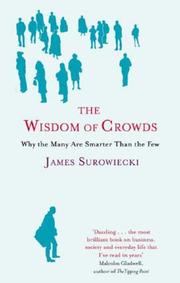
《群体的智慧:如何让个人、 团队、企业与社会变得更聪明》(The Wisdom of Crowds: Why the Many Are Smarter Than the Few and How Collective Wisdom Shapes Business, Economies, Societies and Nations)一书,首次出版于2004年,作者是詹姆斯·索诺维尔基(James Surowiecki)。在这本书中,作者阐述和主张这样一个观点:团体中,信息的集合往往有利于作出比每一个成员单独所做的决定要好得多的决策。作者在书中陈述大量实例研究和轶闻来说明观点,而且涉及到若干领域,其中主要的有经济学和心理学。
作者在本书开篇讲述了一个轶闻,是法兰西斯·高尔顿(Francis Galton)对所述观点的支持:一个郡县里,全体社区成员对公牛重量估测的平均数十分接近真实值甚至是相当准确无误的。而这个平均数要比大多数成员的估量更接近牛的真实重量,也比任何一个熟悉牛的行家所作的单独存在的推测接近真实量。
这本中所阐述的对单独的个人观点的多样化的收集,不同于传统意义上理解的集体心理学。它却与统计学上的抽样理论有着极为相似的地方——一个通过集合了那些单独存在的个人判断所得到的结论,似乎更能够具有典型性,这种典型性代表了全体人类所能够想到的可能的结果,从而得到较为恰切的预言。
这本书的题目暗讽了查尔斯·麦凯(Charles Mackay)在1843年出版的《大众错觉与群体狂热》(Extraordinary Popular Delusions and the Madness of Crowds)一书。
以上文字摘自维基百科「群体的智慧」(去掉了参考文献等尾部小节),按 CC BY-SA 4.0 使用,作者为维基百科的各位编者。
中文维基百科的条目比较短,下面附上英文维基百科的内容(英文原文):
The Wisdom of Crowds: Why the Many Are Smarter Than the Few and How Collective Wisdom Shapes Business, Economies, Societies and Nations, published in 2004, is a book written by James Surowiecki about the aggregation of information in groups, resulting in decisions that, he argues, are often better than could have been made by any single member of the group. The book presents numerous case studies and anecdotes to illustrate its argument, and touches on several fields, primarily economics and psychology.
The opening anecdote relates Francis Galton's surprise that the crowd at a county fair accurately guessed the weight of an ox when the median of their individual guesses was taken (the median was closer to the ox's true butchered weight than the estimates of most crowd members).
The book relates to diverse collections of independently deciding individuals, rather than crowd psychology as traditionally understood. Its central thesis, that a diverse collection of independently deciding individuals is likely to make certain types of decisions and predictions better than individuals or even experts, draws many parallels with statistical sampling; however, there is little overt discussion of statistics in the book.
Its title is an allusion to Charles Mackay's Extraordinary Popular Delusions and the Madness of Crowds, published in 1841.
Types of crowd wisdom
Surowiecki breaks down the advantages he sees in disorganized decisions into three main types, which he classifies as
Cognition
Thinking and information processing, such as market judgment, which he argues can be much faster, more reliable, and less subject to political forces than the deliberations of experts or expert committees.
Coordination
Coordination of behavior includes optimizing the utilization of a popular bar and not colliding in moving traffic flows. The book is replete with examples from experimental economics, but this section relies more on naturally occurring experiments such as pedestrians optimizing the pavement flow or the extent of crowding in popular restaurants. He examines how common understanding within a culture allows remarkably accurate judgments about specific reactions of other members of the culture.
Cooperation
How groups of people can form networks of trust without a central system controlling their behavior or directly enforcing their compliance. This section is especially pro free market.
Four elements required to form a wise crowd
Not all crowds (groups) are wise. Consider, for example, mobs or crazed investors in a stock market bubble. According to Surowiecki, these key criteria separate wise crowds from irrational ones:
Based on Surowiecki's book, Oinas-Kukkonen captures the wisdom of crowds approach with the following eight conjectures:
It is possible to describe how people in a group think as a whole.
In some cases, groups are remarkably intelligent and are often smarter than the smartest people in them.
The three conditions for a group to be intelligent are diversity, independence, and decentralization.
The best decisions are a product of disagreement and contest.
Too much communication can make the group as a whole less intelligent.
Information aggregation functionality is needed.
The right information needs to be delivered to the right people in the right place, at the right time, and in the right way.
There is no need to chase the expert.
Failures of crowd intelligence
Surowiecki studies situations (such as rational bubbles) in which the crowd produces very bad judgment, and argues that in these types of situations their cognition or cooperation failed because (in one way or another) the members of the crowd were too conscious of the opinions of others and began to emulate each other and conform rather than think differently. Although he gives experimental details of crowds collectively swayed by a persuasive speaker, he says that the main reason that groups of people intellectually conform is that the system for making decisions has a systemic flaw.
Causes and detailed case histories of such failures include:
以上文字摘自英文维基百科「The Wisdom of Crowds」(有删节,去掉了参考文献等尾部小节),按 CC BY-SA 4.0 使用,作者为维基百科的各位编者。
资料卡
- 原题
- The Wisdom of Crowds
- 原作语言
- 英语
- 首次出版
- 2004 年
- 体裁
- 非虚构作品
资料卡来自 Wikidata Q13417291(CC0),众包数据,个别字段可能不全。