书单
百科
这个词条暂时没有中文维基百科条目,下面是英文维基百科的内容(英文原文):
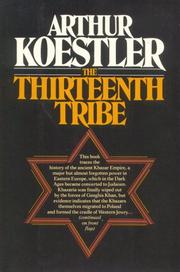
The Thirteenth Tribe is a 1976 book by Arthur Koestler advocating the Khazar hypothesis of Ashkenazi ancestry, the thesis that Ashkenazi Jews are not descended from the historical Judeans and Israelites of antiquity, but from Khazars, a Turkic people who allegedly mass-converted to Judaism. Koestler hypothesized that the Khazars after their conversion in the 8th century migrated westwards into Eastern Europe in the 12th and 13th centuries when the Khazar Empire was collapsing.
Koestler used previous works by Douglas Morton Dunlop, Raphael Patai and Abraham Polak as sources. His stated intent was to make antisemitism disappear by disproving its racial basis.
Popular reviews of the book were mixed, academic critiques of its research were generally negative, and Koestler biographers David Cesarani and Michael Scammell panned it. In 2018, the New York Times described the book as "widely discredited."
Summary
Contents
Koestler advances the thesis that Ashkenazi Jews are not descended from the historical Israelites of antiquity, but from Khazars, a Turkic people originating in and populating an empire north of and between the Black Sea and Caspian Sea. Koestler's hypothesis is that the Khazars – who converted to Judaism in the 8th century – migrated westwards into current Eastern Europe (primarily Ukraine, Poland, Belarus, Lithuania, Hungary and Germany) in the 12th and 13th centuries when the Khazar Empire was collapsing.
At the end of the book's last chapter, Koestler summarizes its content and his intentions as follows: "In Part One of this book I have attempted to trace the history of the Khazar Empire based on the scant existing sources. In Part Two, Chapters V-VII, I have compiled the historical evidence which indicates that the bulk of Eastern Jewry — and hence of world Jewry — is of Khazar-Turkish, rather than Semitic, origin. In the last chapter I have tried to show that the evidence from anthropology concurs with history in refuting the popular belief in a Jewish race descended from the biblical tribe."
Motive
Koestler biographer Michael Scammell writes that Koestler told French biologist Pierre Debray-Ritzen he "was convinced that if he could prove that the bulk of Eastern European Jews (the ancestors of today's Ashkenazim) were descended from the Khazars, the racial basis for anti-Semitism would be removed and anti-Semitism itself could disappear". According to George Urban, Koestler's desire to connect Ashkenazi Jews with Khazars was "based on a tacit belief that the intellectual brilliance of and international influence of Hungarians and Jews, especially Hungarian Jews or Jewish-Hungarians, was due to some unexplained but clearly ancient affinity between the two peoples".
Reception
In The Invention of the Jewish People, Shlomo Sand, historian of cinema, French intellectual history, and nationalism at Tel Aviv University, writes "while the Khazars scared off the Israeli historians, not one of whom has published a single paper on the subject, Koestler's Thirteenth Tribe annoyed and provoked angry responses. Hebrew readers had no access to the book itself for many years, learning about it only through the venomous denunciations". Writing in The Wall Street Journal, Chronicle of Higher Education editor Evan Goldstein states "Sand suggests that those who attacked Koestler's book did so not because it lacked merit, but because the critics were cowards and ideologues. 'No one wants to go looking under stones when venomous scorpions might be lurking beneath them, waiting to attack the self-image of the existing ethnos and its territorial ambitions.'"
In the Arab world the theory espoused in Koestler's book was adopted by persons who argued that if Ashkenazi Jews are primarily Khazar and not Semitic in origin, they would have no historical claim to Israel, nor would they be the subject of the Biblical promise of Canaan to the Israelites, thus undermining the theological basis of both Jewish religious Zionists and Christian Zionists. The Saudi Arabian delegate to the United Nations argued that Koestler's theory "negated Israel's right to exist". Koestler did not see alleged Khazar ancestry as diminishing the claim of Jews to Israel, which he felt was based on the United Nations mandate and not on Biblical covenants or genetic inheritance. In his view, "[t]he problem of the Khazar infusion a thousand years ago... is irrelevant to modern Israel."
Koestler's book was praised by the neo-Nazi magazine The Thunderbolt as "the political bombshell of the century", and it was enthusiastically supported by followers of the Christian Identity movement. According to Jeffrey Kaplan, The Thirteenth Tribe was "Identity's primary source for the Khazar theory"; they felt Koestler's book confirmed their own beliefs regarding Jews, and sold it "through their mail order services". Goldstein writes that "Koestler and the Khazar theory he advanced lives on in the fever swamps of the white nationalist movement". Michael Barkun writes that Koestler was apparently "either unaware of or oblivious to the use anti-Semites had made of the Khazar theory since its introduction at the turn of the century."
Assessment
After it was first published, Fitzroy Maclean in The New York Times Book Review called The Thirteenth Tribe excellent, writing "Mr. Koestler's book is as readable as it is thought-provoking. Nothing could be more stimulating than the skill, elegance and erudition with which he marshals his facts and develops his theories." Reviewing the work in the Washington Report on Middle East Affairs in 1991, journalist and author Grace Halsell described it as a "carefully researched book" that "refutes the idea of a Jewish 'race'."
以上文字摘自英文维基百科「The Thirteenth Tribe」(有删节,去掉了参考文献等尾部小节),按 CC BY-SA 4.0 使用,作者为维基百科的各位编者。
资料卡
- 原题
- The Thirteenth Tribe
- 原作语言
- 英语
- 首次出版
- 1976 年
- 首版出版社
- 哈奇森 (出版社)
- 主题
- 可萨人
资料卡来自 Wikidata Q1198458(CC0),众包数据,个别字段可能不全。
更多资料与书评
在哪读
阿瑟·库斯勒 的其他作品
作者页 ›