 书单
百科
这个词条暂时没有中文维基百科条目,下面是英文维基百科的内容(英文原文):
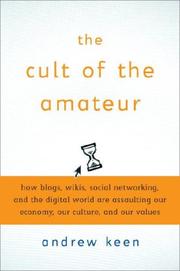
The Cult of the Amateur: How Today's Internet Is Killing Our Culture is a 2007 book written by entrepreneur and Internet critic Andrew Keen. Published by Currency, Keen's first book is a critique of the enthusiasm surrounding user-generated content, peer production, and other Web 2.0–related phenomena.
The book was based in part on a controversial essay Keen wrote for The Weekly Standard, criticizing Web 2.0 for being similar to Marxism, for destroying professionalism and for making it impossible to find high quality material amidst all of the user-generated web content.
Contents
Keen argues against the idea of a read-write culture in media, stating that "most of the content being shared – no matter how many times it has been linked, cross-linked, annotated, and copied – was composed or written by someone from the sweat of their creative brow and the disciplined use of their talent." As such, he contrasts companies such as Time Warner and Disney that "create and produce movies, music, magazines, and television" with companies such as Google. He calls the latter "a parasite" since "it creates no content of its own" and "in terms of value creation, there is nothing there apart from its links."
He elaborates on the point by saying, "Of course, every free listing on Craigslist means one less paid listing in a local newspaper. Every visit to Wikipedia's free information hive means one less customer for a professionally researched and edited encyclopedia such as Britannica." Thus, he concludes that "what is free is actually costing us a fortune." He also refers to changes such as downsizing of newspaper business and the closing of record labels as forms of economic loss caused by Internet-based social changes.
In her New York Times book review, Michiko Kakutani wrote:
Mr. Keen argues that the democratized Web's penchant for mash-ups, remixes and cut-and-paste jobs threaten not just copyright laws but also the very ideas of authorship and intellectual property. He observes that as advertising dollars migrate from newspapers, magazines and television news to the Web, organizations with the expertise and resources to finance investigative and foreign reporting face more and more business challenges. And he suggests that as CD sales fall (in the face of digital piracy and single-song downloads) and the music business becomes increasingly embattled, new artists will discover that Internet fame does not translate into the sort of sales or worldwide recognition enjoyed by earlier generations of musicians.
"What you may not realize is that what is free is actually costing us a fortune," Mr. Keen writes. "The new winners – Google, YouTube, MySpace, Craigslist, and the hundreds of start-ups hungry for a piece of the Web 2.0 pie – are unlikely to fill the shoes of the industries they are helping to undermine, in terms of products produced, jobs created, revenue generated or benefits conferred. By stealing away our eyeballs, the blogs and wikis are decimating the publishing, music and news-gathering industries that created the original content those Web sites 'aggregate'. Our culture is essentially cannibalizing its young, destroying the very sources of the content they crave."
Keen quotes social philosopher Jürgen Habermas about the Internet and related technologies: "The price we pay for the growth in egalitarianism offered by the Internet is the decentralized access to unedited stories. In this medium, contributions by intellectuals lose their power to create a focus." Keen states that most of modern social culture has existed with specific gatekeepers analyzing and regulating information as it reaches the masses. He views this expert-based filtering process as beneficial, improving the quality of popular discourse, and argues that it is being circumvented.
He also criticizes the ability of the Internet to promote social harms such as gambling and pornography. He writes, "It's hardly surprising that the increasingly tasteless nature of such self-advertisements have resulted in social networking sites becoming infested with anonymous sexual predators and pedophiles." He sees "cultural standards and moral values" as "at stake" due to new media innovations.
More broadly, Keen remarks that "history has proven that the crowd is not often very wise" and argues against the notion that mass participation in ideas improve their quality. He highlights that popular opinion has supported "slavery, infanticide, George W. Bush's war in Iraq, [and] Britney Spears" among other things. He warns against a future of "when ignorance meets egoism meets bad taste meets mob rule."
Reviews and reception
The book received mixed reviews. Some traditional sources gave the book positive or neutral reviews, while the book received generally negative reactions from bloggers. Michiko Kakutani's New York Times book review called it "a shrewdly argued jeremiad", saying that the book "is eloquent on the fallout that free, user-generated materials is having on traditional media." She wrote that the author "wanders off his subject in the later chapters of the book" but broadly "writes with acuity and passion".
Lawrence Lessig, who was criticized in both the original essay and in the book, wrote an extremely negative review of the book in which he listed what he stated were a multitude of errors in the book including mischaracterizations of Lessig's views and work. Lessig also set up a wiki where users could collaborate in listing problems with the book.
以上文字摘自英文维基百科「The Cult of the Amateur」(有删节,去掉了参考文献等尾部小节),按 CC BY-SA 4.0 使用,作者为维基百科的各位编者。
资料卡
- 原题
- The Cult of the Amateur
- 原作语言
- 英语
- 首次出版
- 2007 年 6 月 5 日
- 体裁
- 非虚构作品
- 主题
- 互联网、Web 2.0
资料卡来自 Wikidata Q83880(CC0),众包数据,个别字段可能不全。