书单
百科
这个词条暂时没有中文维基百科条目,下面是英文维基百科的内容(英文原文):
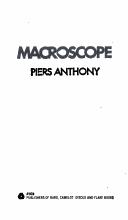
Macroscope is a science fiction novel by British-American writer Piers Anthony. It was nominated for the Hugo Award for Best Novel in 1970.
Macroscope was first published in 1969 and in some respects reflects the idealistic values of that time. The plot involves, among other things, an extension of the Peckham Experiment, mathematicians John Conway and Michael Paterson's game of sprouts, astrology, the poetry of Sidney Lanier, the history of Phoenicia, and commentary on the value of a dedicated teacher of a subject contrasted with a practicing engineer of that subject attempting to teach it, all in a kaleidoscopic combination. The book fills a unique place in Anthony's work as one that has garnered good reviews from hard-core science fiction fans as well as his usual audience of fantasy fans.
Plot
The central plot device is the "macroscope", a large crystal that can be used to focus a newly discovered type of particle, the "macron". Macrons are not subject to many of the effects that interfere with light, and as a result the macroscope can focus on any location in space-time with exceptional clarity, producing what is essentially a telescope of infinite resolution in the space-time continuum. The macroscope has been built into a solar-orbiting space station where scientists visit to book time on the device. Using it, they are able to explore space as never before. Among their many discoveries are numerous planets and two intelligent alien races. Using the macroscope, observers were able to look into one race's historical records, finding numerous parallels with human life on Earth. The race is now in social decline, and the implications are worrying.
The macroscope's clear view across space also makes it an ideal communications system for intelligent races, who broadcast signals by generating macrons, a technique not yet understood on Earth. However, over-riding all of these signals is another of enormous power, one of such strength that it must have been constructed by a Type II civilization. This signal repeats itself, starting with instructions on basic math and progressing to ever-more complex information. Viewers with high enough intelligence, an IQ of 150, reach a point where the information causes them to go insane or die. Those without the intelligence to understand the advanced portions of the signal are unaffected. The signal appears to be a deliberate attempt to "jam" macroscopic communications, blocking those with the ability to understand the other signals from being able to see them. They refer to the blocking signal simply as the "destroyer".
The protagonist of the story, Ivo Archer, is taken to the macroscope station on the invitation of a childhood friend, Brad Carpenter. Ivo has an unexplained link to a mysterious hyper-intelligent character, Schön, and Brad believes Schön may be able to break through the destroyer signal. Ivo is not so convinced, and is reluctant to ask for Schön's help. This reluctance is cause for some misunderstanding with Brad's girlfriend, Afra Summerfield, with whom Ivo falls hopelessly in love.
While inadvertently viewing the destroyer signal with Brad and a Senator visiting the project, only Ivo survives the experience. Afra concludes Ivo is not intelligent enough to be affected, and finds him somewhat beneath her as a result. The Senator's death sparks a series of events that lead to Ivo, Afra and two other station members, Harold and Beatryx, stealing the macroscope. Afra, still in love with Brad and hoping to find a cure, brings his body along, now in a vegetative state. They detach the macroscope from the station and fly off with it while United Nations ships give chase. With time on their hands, Ivo turns to the macroscope and finds a way to avoid being overwhelmed by the destroyer signal. This reveals a number of broadcasts from farther out in space. Ivo demonstrates this technique to the others, allowing Harold and Afra to view the signals formerly being hidden. Harold, a talented engineer, uses the information from one of the signals to build a device reducing their bodies to a liquid state, allowing them to accelerate at 10 g and escape the pursuing ships.
They travel to Neptune space, following a cryptic message left by Schön. Here they set up camp on Triton. Afra attempts to cure Brad by shocking him while he is being reconstituted from the liquid state, but the attempt fails and Brad is killed. Over time, and with further help from Ivo, the group watches a benign form of the entire broadcast, which they come to call "traveller". The liquefaction technique is only the first of many shown in the traveller signal, which describes an entire suite of technologies that allow interstellar travel. Using the instructions in the signal, they convert Neptune into an interstellar spaceship.
Schön briefly makes his first appearance during construction, revealing himself to be an alternate personality within Ivo's brain. Schön is ostensibly the body's "owner", having created the Ivo personality to avoid being the subject of experimentation. Schön has frightening intelligence, but having given over his body to Ivo at the age of five, is still a child and largely without morals. In an attempt to take control of the body, Schön traps Ivo in a historical drama running in his own brain. Over time, Ivo sees parallels between the characters in the drama and the group in the ship, and eventually escapes the illusion and re-asserts control.
以上文字摘自英文维基百科「Macroscope (novel)」(有删节,去掉了参考文献等尾部小节),按 CC BY-SA 4.0 使用,作者为维基百科的各位编者。
资料卡
- 原题
- Macroscope
- 原作语言
- 英语
- 首次出版
- 1969 年
- 作品形式
- 长篇小说
- 体裁
- 奇幻、科学幻想
- 首版出版社
- Avon图书
资料卡来自 Wikidata Q6725637(CC0),众包数据,个别字段可能不全。
更多资料与书评
在哪读
皮尔斯·安东尼 的其他作品
作者页 ›