书单
百科
这个词条暂时没有中文维基百科条目,下面是英文维基百科的内容(英文原文):
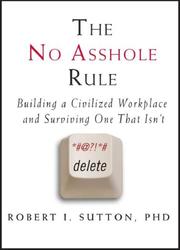
The No Asshole Rule: Building a Civilized Workplace and Surviving One That Isn't is a book by Stanford professor Robert I. Sutton. He initially wrote an essay for the Harvard Business Review, published in Breakthrough Ideas for 2004. Following the essay, he received more than one thousand emails and testimonies. Among other reasons disclosed in another article published at the Harvard Business Review, these letters led him to write the book, which sold more than 115,000 copies and won the Quill Award for best business book in 2007.
The theme of the book is that workplace bullying worsens morale and productivity. To screen out the toxic staff, it suggests the "no asshole rule". The author insists upon use of the word asshole since other words such as bully or jerk "do not convey the same degree of awfulness". In terms of using the word in the book's title, he said "There's an emotional reaction to a dirty title. You have a choice between being offensive and being ignored."
Recognition
Two tests are specified for recognition of the asshole:
After encountering the person, do people feel oppressed, humiliated, or otherwise worse about themselves?
Does the person target people who are less powerful?
Their unpleasant behaviors were catalogued by Sutton as The Dirty Dozen:
Insults
Personal space violation
Unsolicited touching
Threats
Sarcasm
Flames
Humiliation
Shaming
Interruption
Backbiting
Glaring
Snubbing
Sutton believes there is a difference between "temporary" assholes who might be having a bad moment or day and "certified" assholes who are "persistently nasty". He gives the example of when he sent a scornful email to a colleague because he wrongly believed she was trying to take an office away from his group. In this instance, he was acting like a temporary asshole and to be a certified asshole he would have to act like a jerk persistently. Famous bosses who Sutton cites as having weakened their position by bad behavior include Al Dunlap and Michael Eisner. Sutton also identifies Hollywood boss Scott Rudin as an example of a certified asshole. Rudin has fired 250 personal assistants for reasons such as bringing him the wrong muffin. Sutton asserts that Rudin also qualifies as an asshole as his targets are less powerful than him and are left humiliated.
Sutton makes the caveat that while it is essential to screen for assholes, a company should not recruit "spineless wimps". He believes constructive arguments benefit firms and help workers come up with better ideas. Sutton cites that Intel co-founder Andrew Grove believes workers should challenge each other's thoughts. Intel teaches employees "how to fight" and requires new employees to take classes in "constructive confrontation".
Cost and damage
The necessity of the No Asshole Rule and the damage assholes do is discussed by Sutton. He relays Bennett Tepper's research on 712 employees. Many of these workers had bosses who would oppress and belittle them, and Tepper studied the effect these bosses had on them. After six months he found workers with abusive bosses "quit their jobs at accelerated rates, and those still trapped in their jobs suffered from less work and life satisfaction, reduced commitment to employers, and heightened depression, anxiety, and burnout". Sutton relays even minor things such as treating someone as invisible and giving nasty stares can accumulate and adversely affect someone's mental health. Sutton describes how assholes not only affect victims themselves but also the bystanders and witnesses that see and hear about the abuse. Co-workers, family members, and friends are among those who are negatively affected. One British study of more than seven hundred employees in the public sector found "73 percent of the witnesses to bullying incidents experienced increased stress and 44 percent worried about becoming targets themselves". This shows assholes can harm and lessen the productivity of not only their victims but everyone in the workplace. Sutton states the assholes themselves also suffer from their actions in the form of "career setbacks and, at times, humiliation". Even when these jerks do their jobs well they can still be fired. He cites the example of the Indiana Hoosiers coach Bob Knight who despite all his achievements was fired for repeatedly losing his temper.
Sutton discusses the total cost of assholes or the 'TCA' for organizations. While it is impossible to calculate the exact TCA for an organization, Sutton believes it is instructive for companies to estimate how much assholes are costing them. Factors to consider include the number of hours managers and HR professionals devote to 'asshole management' and the costs of lost clients. Future legal costs resulting from lawsuits against assholes and the cost of recruiting and training new employees should also be considered. Researchers Charlotte Rayner and Loraleigh Keashly have used data based on studies in the UK to calculate a company's TCA. They estimate that "25 percent of bullying 'targets' and 20 percent of 'witnesses' leave their jobs, and that the 'average' bullying rate in the U.K. is 15 percent". This means if 25% of victims leave a company of 1,000 people the replacement cost is $20,000 and the annual replacement cost is $750,000. If 20% of victims leave and there is an average of two witnesses for each victim, the replacement cost is $1.2 million, and the total replacement cost is just shy of $2 million. A senior executive from Silicon Valley has previously calculated the cost of an employee Sutton calls Ethan. The expenses relating to Ethan's poor treatment of others totaled around $160,000, and his company deducted some of this money from his bonus.
以上文字摘自英文维基百科「The No Asshole Rule」(有删节,去掉了参考文献等尾部小节),按 CC BY-SA 4.0 使用,作者为维基百科的各位编者。
资料卡
- 原题
- The No Asshole Rule
- 原作语言
- 英语
- 首次出版
- 2007 年 2 月 22 日
- 体裁
- 随笔
资料卡来自 Wikidata Q3794667(CC0),众包数据,个别字段可能不全。