书单
百科
这个词条暂时没有中文维基百科条目,下面是英文维基百科的内容(英文原文):
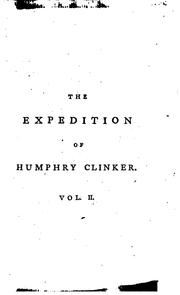
The Expedition of Humphry Clinker was the last of the picaresque novels of Tobias Smollett, published in London on 17 June 1771 (three months before Smollett's death), and is considered by many to be his best and funniest work. It is an epistolary novel, presented in the form of letters written by six characters: Matthew Bramble, a Welsh Squire; his sister Tabitha; their niece Lydia and nephew Jeremy Melford; Tabitha's maid Winifred Jenkins; and Lydia's suitor Wilson.
Much of the comedy arises from differences in the descriptions of the same events and places seen by the participants. Attributions of motives and descriptions of behaviour show wild variation and reveal much about the character of the teller. The setting, amidst the high-society spa towns, inns, and seaside resorts of the 18th century, provides his characters with many opportunities for satirical observations on English and Scottish life, manners, and politics. Smollett relies heavily on a scatological humour and references to the body. The net effect re-creates the messiness of 18th-century British novels that relied on the epistolary form.
The author's travels in Scotland, France, and Italy influenced his novel.
Plot summary
Matthew Bramble, his family and servants are traveling through England and Scotland. Although the primary motivation for the expedition is to restore the health of the gouty Matthew Bramble, each member of the family uses the excursion to achieve their ends. Leaving from Bramble's estate, Brambleton Hall, in Monmouthshire (there are frequent references to the family being Welsh, and the novel also contains individual Scottish and Irish characters), the family passes through many cities, making extended or significant stops at Gloucester, Bath, London, Harrogate, Scarborough and Edinburgh, with a tour of the Scottish Highlands including a visit to the country-house of Smollett's brother, Sir James, "on the banks of Lough-Lomond".
The splenetic patriarch, Matthew Bramble, visits various natural spas to alleviate his health problems, and he corresponds primarily with his physician, Dr. Lewis. Through his letters and those of Jeremy, it is revealed that Bramble is misanthropic and something of a hypochondriac. Despite his frequent complaints, he is generally reasonable and extremely charitable to the people he meets on his travels as well as to his servants and wards back at home. His letters introduce and ridicule significant 18th-century concerns such as medicine, the growth of urban life, class, the growth of the periodical press and the public sphere. His growing disillusionment at the changing moral and social landscape of Great Britain, particularly London, embodies his traditionalist perspective and reveals the absurdities of contemporary British culture.
His sister, Tabitha Bramble, is a foolish and cantankerous spinster who uses the expedition as an excuse to search for a husband. Through her correspondence with Mrs. Gwyllim, the house-keeper at Brambleton Hall, Tabitha reveals her selfishness and lack of generosity towards servants and the impoverished. Her social pretensions are rendered all the more comical by her frequent misunderstandings, misuse of common idioms, and atrocious spelling.
Tabitha's servant, Winifred or Win Jenkins, also corresponds with the servants at Brambleton Hall. As the only correspondent not related to Matthew Bramble, Ms. Jenkins offers a sympathetic and humorous perspective on the family and their travels. As a comic foil to Tabitha Bramble, Win Jenkins shares many of her misspellings and malapropisms, but demonstrates considerably more common sense and intuition in her observation of the family. At London, she becomes infatuated with Humphry Clinker and Methodism both.
Bramble's nephew, Jeremy Melford, is a young man looking for amusement. Corresponding primarily with Sir Watkin Phillips of Jesus College, Oxford, Jery also reflects upon issues of city life, class, and the growing public sphere, but often with a more progressive perspective than that of his rather traditional uncle. Despite his generously democratic views and his astute perceptions of the hypocrisy and absurdity of others, he is — as revealed through Bramble's letters — "hot-headed" and prone to rash anger and impulsive defenses of perceived slights to his family honor, especially when it relates to his sister's interest in a stage actor below her status. His introduction into society as a young gentleman often occurs during his socialising at the coffeehouse, a burgeoning social institution, especially in 18th-century London. His study of the places and people of his journey includes the members of his family, whom he comically sketches for the reader. His accounts help provide insight into Matthew Bramble's character.
Bramble's niece, Lydia Melford, is trying to recover from an unfortunate romantic entanglement with an actor named Wilson, who is later revealed to be a gentleman named George Dennison. Her letters to Letitia Willis at Gloucester reveal her struggles between familial duty and her affection for Wilson. She describes her secret communications with him, as well as her surprise encounter with the disguised Wilson in Bath. Lydia also reflects upon the wonders of city life, with astonishment and excitement. Lydia has spent most of her life at a boarding school for young women, so the expedition serves her as a debut into society (a cultural phenomenon with a long literary tradition).
以上文字摘自英文维基百科「The Expedition of Humphry Clinker」(有删节,去掉了参考文献等尾部小节),按 CC BY-SA 4.0 使用,作者为维基百科的各位编者。
资料卡
- 原题
- The Expedition of Humphry Clinker
- 原作语言
- 英语
- 首次出版
- 1771 年 6 月 17 日
- 作品形式
- 长篇小说
- 体裁
- 书信体小说
- 前作
- The History and Adventures of an Atom
- 故事发生地
- 大不列颠岛
- 主要人物
- Humphry Clinker、Matthew Bramble、Miss Tabitha
资料卡来自 Wikidata Q3203413(CC0),众包数据,个别字段可能不全。