书单
百科
这个词条暂时没有中文维基百科条目,下面是英文维基百科的内容(英文原文):
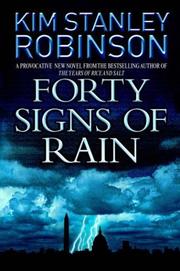
Forty Signs of Rain (2004) is the first novel in the hard science fiction trilogy Science in the Capital by Kim Stanley Robinson. The following two novels are Fifty Degrees Below (2005) and Sixty Days and Counting (2007).
Plot introduction
The novel focuses on the effects of global warming in the early decades of the 21st century. The characters are mostly scientists—conducting research on biotechnology, assisting members of the government, or doing administrative tasks at the US National Science Foundation (NSF). The novel also features several Buddhist monks who work for the embassy of the fictional island nation of Khembalung.
Characters
Anna Quibler – a hard-scientist administrator in charge of the Bioinformatics division of the NSF; part of her job entails distributing grant proposals from scientists and science students nationwide to program directors under her supervision. She befriends the Khembalis.
Charlie Quibler – Anna's husband, a stay-at-home dad for their young sons. He is the science policy advisor to Senator Phil Chase, and he works tirelessly to introduce Congessional bills for climate change mitigation.
Frank Vanderwal – a biomathematician at University of California, San Diego with an interest in sociobiology, working for a year at the NSF; he oversees the review of grant proposals in biology; a rock climbing hobbyist and co-founder of Torrey Pines Generique (a biotechnology start-up).
Drepung – a Tibetan Buddhist monk, he identifies himself to Anna as the assistant and translator for Rudra Cakrin; later in the trilogy, he is revealed to be the spiritual leader of the Khembalese group.
Rudra Cakrin – the ambassador from Khembalung to the United States; a Tibetan in exile, he pretends to be the spiritual leader of the Khembalese but is actually Drepung's assistant.
Leo Mulhouse – the chief science researcher at Torrey Pines Generique, working on gene therapy.
Senator Phil Chase – a Democratic Senator from California, he understands the need for both policy change and realpolitik; a character in the novel Antarctica.
Diane Chang – the Director of the National Science Foundation.
Plot
Frank Vanderwal, having spent a year at the National Science Foundation (NSF) in Washington, D.C., is impatient with what he sees as its passivity and its reluctance to demand serious political change in the face of severe climate change. He keeps an eye on environmental triggers such as climate change in the Arctic and thermohaline circulation. Though he likes his colleague, Anna Quibler, and much of her work, he misses his hometown, San Diego. An athletic man, he frequently goes climbing and canyoneering when he can. Interested in sociobiology, he views both his own behavior and others' as that of primates who evolved on the African savannahs and who are not entirely biologically prepared to live in the urban environment. He considers behaviors in ordinary situations, such as traffic, and in extraordinary situations in light of the game theory decision making strategy known as the prisoner's dilemma.
Anna's husband, Charlie Quibler, feels as urgently as Frank does about environmental issues. He juggles the raising of their two young sons, Nick and Joe, with encouraging Senator Phil Chase and Chase's chief of staff, Roy, to badger the conservatives in Congress about passing legislation to convert the United States to a non-anthropogenic global warming society, to construct carbon sinks, and to work for international cooperation for amelioration of climate change. (It is clear that the President, never named, is George W. Bush; we are told that his predecessor was Bill Clinton; he views climate change as a "downer" and refers to it as "climactic [not climatic] terrorism.")
Anna, a devoted wife and mother, is, in Frank's view, something of an ultra-rationalist; Charlie is amused by her constant search for quantifiable measurements in all parts of her life. She discovers the new Khembali embassy in the NSF building and invites Drepung and Rudra Cakrin to lunch. When they all get along well, and she becomes interested in their concern about the threat of rising sea levels to Khembalung, their small island nation in the Bay of Bengal, she invites them to come for dinner when they all have time.
Leo Mulhouse, a science director at Torrey Pines Generique, a biotechnology startup company in San Diego, searches for therapies for various human diseases. He is alarmed to learn that his boss, Derek, has spent $51 million to buy another company which might (and might not) work in tandem; Torrey Pines has not yet been able to show any profits, which puts them at risk for sale to investors who might care to purchase or even quash any patentable techniques they come up with. He turns out to be right when the company is sold some weeks later. Leo has another worry: his house, located on a cliff over the Pacific, is threatened by coastal erosion.
Frank, eager to return to California, writes an angry denunciation of NSF and leaves it in the in-box of the director, Diane Chang, for her to find the next morning. That evening, he unexpectedly has a romantic encounter with a beautiful woman in a Washington Metro subway elevator when the elevator is stuck between floors. They are released, and she disappears before he can learn her name. Invited to the Quiblers' house to meet the Khembalis, he tells Anna about the woman; she is pleased to find him so excited and talkative, and urges him to track her down.
以上文字摘自英文维基百科「Forty Signs of Rain」(有删节,去掉了参考文献等尾部小节),按 CC BY-SA 4.0 使用,作者为维基百科的各位编者。
资料卡
- 原题
- Forty Signs of Rain
- 原作语言
- 英语
- 首次出版
- 2004 年 1 月
- 作品形式
- 长篇小说
- 体裁
- 科学幻想
- 首版出版社
- 哈珀柯林斯
- 所属系列
- Kim Stanley Robinson bibliography
- 续作
- 降温五十度
资料卡来自 Wikidata Q5472993(CC0),众包数据,个别字段可能不全。