 书单
百科
这个词条暂时没有中文维基百科条目,下面是英文维基百科的内容(英文原文):
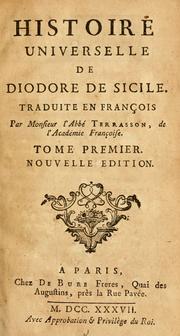
Bibliotheca Historica (Latin; Greek: Βιβλιοθήκη Ἱστορική, Bibliothḗkē Historikḗ), also known as the Historical Library or Library of History, is a work of universal history by Diodorus Siculus. It consisted of forty books, which were divided into three sections.
The first six books are geographical in theme and describe the history and culture of Egypt (Book I), of Mesopotamia, India, Scythia, and Arabia (II), of North Africa (III), and of Greece and Europe (IV–VI). In the next ten books, he recounts human history starting with the Trojan War (Book VII) down to the death of Alexander the Great (XVII). The final section concerns the historical events from the successors of Alexander (Book XVIII) down to the time of the First Triumvirate of the late Roman Republic (XL). The end of the work has been lost, and it is unclear whether Diodorus actually reached the beginning of Caesar's Gallic War in 59 BC (as he promises at the beginning of the work) or, as evidence suggests, he stopped short at 60 BC owing to old age and weariness from his labors.
He selected the name "Library" as an acknowledgement that he was assembling a composite work drawing from many sources. Of the authors he used, some who have been identified include Hecataeus of Abdera, Ctesias of Cnidus, Ephorus, Theopompus, Hieronymus of Cardia, Duris of Samos, Diyllus, Philistus, Timaeus, Polybius, and Posidonius.
Diodorus's immense work has not survived intact. Only Books I–V and Books XI–XX remain in their entirety. The rest exists only in fragments preserved in Photius and in the Excerpta of Constantine Porphyrogenitus.
Dating
The earliest date Diodorus mentions of his own labors is his visit to Egypt during the 180th Olympiad (60–56 BC). This visit was marked by his witnessing an angry mob demand the death of a Roman citizen who had accidentally killed a cat, an animal sacred to the ancient Egyptians. The latest contemporary event Diodorus mentions is Octavian's vengeance on the city of Tauromenium, whose refusal to help him led to Octavian's naval defeat nearby in 36 BC. Diodorus shows no awareness that Egypt became a Roman province—which transpired in 30 BC—so presumably he published his completed work before that event. Diodorus asserts that he undertook a number of dangerous journeys through Europe and Asia during his historical research and devoted thirty years to the composition of his history, suggesting his work was begun around the 70s BC.
One notable feature of Diodorus's writing is his tendency to provide unfulfilled cross-references, times where he includes notes similar to "we will cover this matter later in the work" or "see book X" but the topic is never addressed again in the surviving text. Catherine Rubicam suggests this is evidence of the author's change in temporal scope away from current events. In his preface, Diodorus writes that he will conclude with "the beginning of the war between the Romans and the Celts" in 58 BC. Nevertheless, Diodorus even discusses Caesar's 55 BC incursion into Britain and his subsequent 44 BC deification.
Structure
In the Bibliotheca Historica, Diodorus sets out to write a universal history, covering the entire world and all periods of time up to his present day. Each book opens with a table of its contents and a preface discussing the relevance of history, issues in the writing of history, or the significance of the events discussed in that book. These are now generally agreed to be entirely Diodorus's own work. The degree to which the text that follows is derived from earlier historical works is debated.
The first five books describe the history and culture of different regions, without attempting to determine the relative chronology of events. Diodorus expresses serious doubts that such chronology is possible for "barbarian" lands and the distant past. The resulting books have affinities with the genre of geography. Books VI to X, which covered the transition from mythical times to the archaic period, are almost entirely lost. By Book X, Diodorus had taken up an annalistic structure, narrating all the events throughout the world in each year before moving on to the next one. Books XI–XX, which are completely intact and cover events between 480 and 302 BC, maintain this annalistic structure. Books XI–XL, which brought the work down to Diodorus's own lifetime and terminated around 60 BC, are mostly lost.
Book I: Egypt
Book I opens with a prologue on the work as a whole, arguing for the importance of history generally and universal history in particular. The rest of the book is devoted to Egypt and is divided into two halves. In the first half he covers the origin of the world and the development of civilization in Egypt. A long discussion of the theories offered by different Greek scholars to explain the annual floods of the River Nile serves to showcase Diodorus's wide reading. In the second half of the book, he presents the history of Egypt, its customs and religion, in a highly respectful tone. His main sources are believed to have been Hecataeus of Abdera and Agatharchides of Cnidus.
Book II: Asia
This book has only a short prologue outlining its contents. The majority of the book is devoted to the history of the Assyrians, focused on the mythical conquests of Ninus and Semiramis, the fall of the dynasty under the effeminate Sardanapallus, and the origins of the Medes who overthrew them. This section is explicitly derived from the account of Ctesias of Cnidus. The rest of the book is devoted to describing the various other peoples of Asia. He first describes India, drawing on Megasthenes, then the Scythians of the Eurasian steppe, including the Amazons and the Hyperboreans, and Arabia Felix. He finishes the book with Iambulus's description of the "Islands of the Sun" in the Indian Ocean, presented as a traveller's account but seeming to be a Hellenistic utopian fiction.
以上文字摘自英文维基百科「Bibliotheca Historica」(有删节,去掉了参考文献等尾部小节),按 CC BY-SA 4.0 使用,作者为维基百科的各位编者。
资料卡
- 原题
- Βιβλιοθήκη ἱστορική
- 原作语言
- 古希腊语
- 体裁
- 历史编篆学
资料卡来自 Wikidata Q672803(CC0),众包数据,个别字段可能不全。
改编作品
取材于它的书1
名单来自 Wikidata(CC0):只列条目里写明「改编自 / 取材于」这本书的作品,不按名字猜;众包数据,可能不全。