书单
百科
这个词条暂时没有中文维基百科条目,下面是英文维基百科的内容(英文原文):
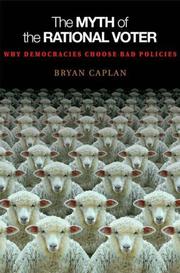
The Myth of the Rational Voter: Why Democracies Choose Bad Policies is a 2007 book by the economist Bryan Caplan, in which the author challenges the idea that voters are reasonable people whom society can trust to make laws. Rather, Caplan contends that voters are irrational in the political sphere and have systematically biased ideas concerning economics.
Summary
Throughout the book, Caplan focuses on voters' opinion of economics since so many political decisions revolve around economic issues (immigration, trade, welfare, economic growth, and so forth). Using data from the Survey of Americans and Economists on the Economy (SAEE), Caplan categorizes the roots of economic errors into four biases: anti-market, anti-foreign, make-work, and pessimistic.
Anti-market bias
Caplan refers to the anti-market bias as a "tendency to underestimate the benefits of the market mechanism." People tend to view themselves as victims of the market, rather than as participants in it, according to Caplan. He also categorises a few major misconceptions associated with this bias: (1) a view that market payments are transfers rather than incentives, (2) a belief in a monopoly theory of price, where firms impose prices on consumers without recourse.
In the first, he describes that "people tend to see profits as a gift to the rich" and that "limiting profits" permits pity to the poor. However, profits are seen by economists as means to promote trade in those sectors. Moreover, the historical attacks on usury and windfalls see interest as robbing the borrower. Yet, interest is in fact two things: the creditor delaying his own consumption for compensation (known as liquidity preference) and compensation for the risk of borrower defaults.
The second is where corporations, even small-scale suppliers, are seen as greedy monopolists that prey on the consumer. Caplan argues that all trade is a two-way street and that people like middlemen are not interposers attempting to fleece the people, but rather, making up for transportation, storage, and distribution costs. At a more broad level, cheating people is bad for business and the existence of multiple firms offering similar products implies competition, not monopoly power, which limits any firm's ability to increase prices.
Anti-foreign bias
Caplan refers to the anti-foreign bias as a "tendency to underestimate the economic benefits of interaction with foreigners." People systematically see their country of origin as in competition with other nations and so oppose free trade with them. Foreigners are seen as the "enemy" even if the two governments are at a lasting peace. The principles of comparative advantage allow two countries to benefit a great deal from trade, even if one is worse than the other in every single way. The degree of benefit is rarely equalized, but it is always positive for both parties. Caplan also notes how the anti-foreign bias can be rooted in pseudo-racist attitudes. For Americans, trading with Japan and Mexico is more controversial than trading with Canada and England, which are more linguistically and ethnically similar to the United States.
Make-work bias
Caplan refers to the make-work bias as a "tendency to underestimate the economic benefits from conserving labor." Caplan claims that there is a tendency to equate economic growth with job creation. However, that is not necessarily true, since real economic growth is a product of increases in the productivity of labor. Dislocation and unemployment can be caused by productivity gains making certain jobs no longer necessary. All things being equal, economic rationality would require that these people make use of their talents elsewhere. Caplan makes special emphasis of the movement away from farming over the past 200 years, from nearly 95% of Americans as farmers in 1800 to just 3% in 1999, as an illustrative example. As an economy industrialises, increased labor productivity in agriculture means less labor is needed to produce a given quantity of agricultural goods, freeing up labour (a scarce resource) to be employed in the production of "other" (than agricultural) goods and services. Those other marketable "things of value" might include manufactured goods, but they could instead take other forms, e.g. intellectual property (such as advice, or compiled data).
Pessimistic bias
Caplan refers to the pessimistic bias as a "tendency to overestimate the severity of economic problems and underestimate the (recent) past, present, and future performance of the economy." The public generally perceives economic conditions as declining or about to decline. Caplan alleges that there is often little or no evidence to back up such perceptions of imminent apocalypse. Among challengers Caplan cites is Julian Lincoln Simon and his book, The Ultimate Resource, which argues society continues to progress despite claims of environmental degradation and an increasing use of natural resources.
Survey of Americans and Economists on the Economy
The author pays special attention to the 1996 Survey of Americans and Economists on the Economy (SAEE), created by The Washington Post, the Kaiser Family Foundation, and Harvard University Survey Project. The SAEE asked 1,510 random members of the American public and 250 people with PhDs in economics the same questions concerning the economy. In addition to its 37 topical questions, the SAEE also inquired about the participant's income, income growth, education, and other demographic information.
The answers to the questions are often different: the public often blames technology, outsourcing, high corporate profits, and downsizing as reasons for why growth is lower than it could be. Economists, on the other hand, barely pay any heed to such arguments. Some 74% of the public blame greedy oil companies for high gas prices, but only 11% of economists do. The public tends to believe real incomes are decreasing while economists take the opposite stance.
以上文字摘自英文维基百科「The Myth of the Rational Voter」(有删节,去掉了参考文献等尾部小节),按 CC BY-SA 4.0 使用,作者为维基百科的各位编者。
资料卡
- 原作语言
- 英语
- 首次出版
- 2007 年
- 体裁
- 非虚构作品
- 首版出版社
- 普林斯顿大学出版社
- 主题
- 民主、非理性
资料卡来自 Wikidata Q16962759(CC0),众包数据,个别字段可能不全。