书单
百科
这个词条暂时没有中文维基百科条目,下面是英文维基百科的内容(英文原文):
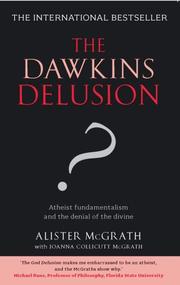
The Dawkins Delusion? Atheist Fundamentalism and the Denial of the Divine is a book by scientist, theologian and intellectual historian Alister McGrath and psychologist Joanna Collicutt McGrath. It is written from a Christian perspective as a response to arguments presented in The God Delusion by Richard Dawkins. The work was published in the United Kingdom in February 2007 by the Society for Promoting Christian Knowledge and in the United States in July 2007.
Synopsis
McGrath criticizes Dawkins for what he perceives to be "a dogmatic conviction" to "a religious fundamentalism which refuses to allow its ideas to be examined or challenged."
He objects to Dawkins' assertion that faith is a juvenile delusion, arguing that numerous reasonable persons chose to convert as adults. He cites himself and Antony Flew as two specific examples. Like Dawkins, McGrath rejects William Paley's watchmaker analogy as specious. To express his true feelings on the subject of irreducible complexity, McGrath instead cites the work of Richard Swinburne, remarking that the capacity of science to explain itself requires its own explanation – and that the most economical and reliable account of this explanatory capacity lies in the notion of the monotheistic God of Christianity. When considering the subject of Aquinas' Quinque viae, to which Dawkins devotes considerable attention, McGrath interprets the theologian's arguments as an affirmation of a set of internally consistent beliefs rather than as an attempt to formulate a set of irrefutable proofs.
McGrath proceeds to address whether religion specifically conflicts with science. He points to Stephen Jay Gould's supposition of non-overlapping magisteria (NOMA) as evidence that Darwinism is as compatible with theism as it is with atheism. With additional reference to the works of Sir Martin Rees, Denis Noble, and others, McGrath advocates a modified version of NOMA which he terms "partially-overlapping magisteria". He posits that science and religion co-exist as equally valid explanations for two partially overlapping spheres of existence, where the former concerns itself primarily with the temporal, and the latter concerns itself primarily with the spiritual, but where both can occasionally intertwine. McGrath confirms his position by noting that some prominent scientists are also theists (or at least sympathetic to theism, in Davies' case), citing Owen Gingerich, Francis Collins, and (atheist but critic of New Atheism) Paul Davies as examples.
McGrath criticizes Dawkins' portrayal of religion as both an evolutionary by-product and as a memetic virus. McGrath examines Dawkins' use of Bertrand Russell's teapot analogy as well as the basics of Dawkins' theory of memetics. McGrath criticizes Dawkins for referencing Sir James Frazer's The Golden Bough as an authority on anthropology, as he considers the work to be more of "a highly impressionistic early work" than a serious text. McGrath also points to Dawkins' lack of training in psychology as indicative of an inability to address the most important questions of faith.
Quoting Dawkins' description of the Old Testament God as "a petty, unjust, unforgiving control-freak; a vindictive, bloodthirsty ethnic cleanser; a misogynistic, homophobic, racist, infanticidal, genocidal, filicidal, pestilential, megalomanical, sadomasochistic, capriciously malevolent bully", McGrath counters that he does not believe in such a god and knows no one personally who does. Setting aside Dawkins' remarks, McGrath instead points to Jesus and the New Testament as superior examples of the true nature of Christianity. "Jesus", McGrath argues, "... was the object, not the agent, of violence". McGrath suggests that "far from endorsing 'out-group hostility', Jesus commanded an ethic of 'out-group affirmation' and Christians may certainly be accused of failing to live up to this command. But it is there, right at the heart of the Christian ethic". He believes that Dawkins is right when he argues that it is necessary to critique religion, and right to demand that there be an external criterion for interpreting texts; but argues that Dawkins appears unaware that religions and their texts possess internal means of reform and renewal, and that Dawkins seems unaware of the symbolism of several of the Bible passages which he quotes. McGrath cites the works of numerous authors, including Kenneth Pargament, Harold G. Koenig, and Terry Eagleton, to demonstrate how closely he feels religious faith to be tied to well-being.
The Dawkins Delusion? concludes with the suggestions that belief in God has "rebounded", that Dawkins' work is more theatre than scholarship, and that The God Delusion denotes little more than "panic" on the part of non-believers.
Critical reception
Publishers Weekly remarked,
... Dawkins's The Blind Watchmaker remains the finest critique of William Paley's naturalistic arguments for deism available ... [but] he can no longer say that Tertullian praised Christian belief because of its absurdity or that religion necessarily makes one violent. The McGraths are frustrated, then, that Dawkins continues to write on the a priori, nonscientific assumption that religious believers are either deluded or meretricious, never pausing to consider the evidence not in his favor or the complex beliefs and practices of actual Christians.
以上文字摘自英文维基百科「The Dawkins Delusion?」(有删节,去掉了参考文献等尾部小节),按 CC BY-SA 4.0 使用,作者为维基百科的各位编者。
资料卡
- 原题
- The Dawkins Delusion?
- 原作语言
- 英语
- 首次出版
- 2007 年
- 体裁
- 非虚构作品、随笔
- 首版出版社
- 促进基督知识团
- 页数
- 75
- 主题
- 宗教
资料卡来自 Wikidata Q2658974(CC0),众包数据,个别字段可能不全。