 书单
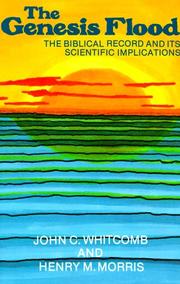
创世纪的洪水 (1961)
百科
这个词条暂时没有中文维基百科条目,下面是英文维基百科的内容(英文原文):
The Genesis Flood: The Biblical Record and its Scientific Implications is a 1961 book by young Earth creationists John C. Whitcomb and Henry M. Morris that, according to historian Ronald Numbers, elevated young Earth creationism "to a position of fundamentalist orthodoxy".
Background
By the late nineteenth century, geologists, physicists and biologists agreed that the age of the Earth was well over 20 million years. Prior to the use of radiometric dating, scientific estimates before 1900 ranged between 20 million and 3 billion years old. Most Christians "readily conceded that the Bible allowed for an ancient earth and pre-Edenic life." With very few exceptions they accommodated the new geological theories either with day-age creationism, the belief that the six days of Genesis represented vast ages, or by separating the original creation from a later Edenic creation: the so-called gap theory. The primary promoter of "flood geology" during the early twentieth century was George McCready Price, but he had comparatively little influence among evangelicals because he was a Seventh-day Adventist, a church treated warily by many conservative Protestants.
Origins
By the 1950s, most evangelical scientists scorned flood geology, and those who accepted the theory were increasingly marginalized within the American Scientific Affiliation (founded 1941), an evangelical organization that gradually shifted from strict creationism to progressive creationism and theistic evolution. In 1954, Bernard Ramm, an evangelical apologist and theologian closely associated with the ASA, published The Christian View of Science and Scripture, which attacked the notion that "biblical inspiration implied that the Bible was a reliable source of scientific data." Ramm ridiculed both flood geology and the gap theory, and one ASA member credited Ramm with providing a way for a majority of Christian biologists to accept evolution.
Ramm's book sparked a young Bible teacher and seminarian, John C. Whitcomb, Jr., to challenge what he considered its "absurdities". Whitcomb had earlier studied geology and paleontology at Princeton University, but by the 1950s, he was teaching the Bible at Grace Theological Seminary. At the 1953 ASA meeting, Whitcomb had been impressed by a presentation of Henry M. Morris—a hydraulic engineer with a PhD from the University of Minnesota—called "The Biblical Evidence for Recent Creation and Universal Deluge". Following publication of Ramm's book, Whitcomb decided to devote his Th.D. dissertation to defending flood geology.
Berated almost from the beginning of his project by influential evangelicals such as Edward John Carnell, the newly installed president of Fuller Theological Seminary, Whitcomb completed his dissertation in 1957 and began condensing it for publication. With no illusions about his scientific expertise, Whitcomb sought a collaborator who had a PhD in science. He could find no geologists who took Genesis seriously, and even teachers at evangelical schools at best expressed distaste for flood geology. Eventually, Henry Morris agreed to become Whitcomb's collaborator for the scientific portions of the book. Despite his heavy teaching load and administrative duties at Virginia Tech, where he had just become head of a large civil-engineering program, Morris made steady progress on his section of the book, eventually contributing more than twice as much material as Whitcomb.
As the manuscript neared completion, Moody Press, which had expressed initial interest, now hesitated. The proposed book was a long work that insisted on six literal days of creation and was certain to be criticized by segments of Moody's constituency. Whitcomb and Morris instead published with the smaller Presbyterian and Reformed Publishing Company, whose owner Charles H. Craig had long wanted to acquire a manuscript that supported catastrophism.
Contents
After opening with the declaration that "the Bible is the infallible Word of God", Whitcomb's section provides biblical arguments for a universal flood as well as attempting to refute non-geological difficulties with the biblical account. Whitcomb specifically addresses the local flood theories of Bernard Ramm—who has far more entries in the index than anyone else. Whitcomb concludes his section of the work with a review of how geological theories had influenced Christian views of the Flood since the beginning of the nineteenth century and draws the "one vitally important lesson", that the biblical doctrine of the Flood cannot be harmonized with "uniformitarian theories".
以上文字摘自英文维基百科「The Genesis Flood」(有删节,去掉了参考文献等尾部小节),按 CC BY-SA 4.0 使用,作者为维基百科的各位编者。
资料卡
- 原题
- The Genesis Flood: The Biblical Record and Its Scientific Implications
- 原作语言
- 英语
- 首次出版
- 1961 年
- 主题
- 创世记的洪水叙述
资料卡来自 Wikidata Q4186763(CC0),众包数据,个别字段可能不全。