书单
百科
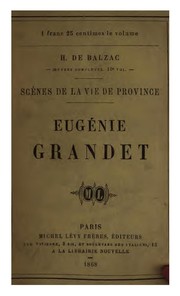
《欧也妮·葛朗台》(Eugénie Grandet),创作于1833年,作者是法国现实主义作家巴尔扎克,是巨著《人间喜剧》小说集中的一部代表作品,获誉为“最出色的人物描写之一”。在巴尔扎克的作品中,像《欧也妮·格朗台》这样结构简洁、主题完整的作品,并不多见。
内容
小说描写守财奴葛朗台的家庭生活,借着葛朗台的贪婪与吝啬,揭露了金钱所造成的人性毁灭、家庭破裂等悲剧。
法国大革命期间致富的守财奴葛朗台自私冷酷,他为了省钱,家里整年不买蔬菜和肉,楼梯坏了也不修理,为敛财把女儿当成诱饵,引诱那些向女儿求婚的男子,以便从中牟利,毫不理会独生女儿欧也妮·葛朗台的幸福;欧也妮温柔善良,为了爱情而反抗父亲的苛刻控制,葛朗台发现女儿把金币送给破产落魄的堂弟查理,大发雷霆,气得把她监禁起来,冬天没有火取暖,只给冷水和劣质面包。吓得贤淑的母亲从此一病不起。
1827年吝啬鬼葛朗台在金钱追逐的狂欲中死去,留下1800万法郎的遗产,欧也妮成了当地首富,人人向她求婚,却痴心等待查理,然而却被她的堂弟查理抛弃,只因为查理要去攀附豪门姻亲。欧也妮得到查理负心的消息之后,一气之下答应蓬风先生的求婚,她很慷慨,不仅帮查理的父亲还了负债,还捐赠了许多钱给教会和学校,查理知道欧也妮有如此多金钱时追悔莫及。欧也妮在33岁上就成了寡妇,城里人又开始追求这位有钱寡妇。
点评
《欧也妮·葛朗台》据说是其作者巴尔扎克与俄国贵妇韩斯卡夫人(后来成为他的妻子)热恋过程中的产物。初稿曾遥寄俄罗斯,中途竟未遗失。整部小说朴素有力,浅显易懂,人物性格鲜明,尤其是守财奴葛朗台被刻画得栩栩如生,在金钱主导下,老葛朗台时忧时喜,作者在塑造人物、描写环境、叙述故事等方面取得了惊人的成就,是巴尔扎克小说创作过程中的一次飞跃。老葛朗台也因此成为世界文学史上四大著名吝啬鬼形象之一。
以上文字摘自维基百科「欧也妮·葛朗台」(去掉了参考文献等尾部小节),按 CC BY-SA 4.0 使用,作者为维基百科的各位编者。
中文维基百科的条目比较短,下面附上英文维基百科的内容(英文原文):
Eugénie Grandet (French pronunciation: [øʒeni ɡʁɑ̃dɛ]) is a novel first serialised from 1833 to 1834, and published in book form in 1834 by French author Honoré de Balzac. While he was writing it he conceived his ambitious project La Comédie humaine and almost immediately prepared a second edition, revising the names of some of the characters so that Eugénie Grandet then fitted into the section: Scenes from provincial life (Scènes de la vie de province) in the Comédie. He dedicated the edition to Maria Du Fresnay, who was then his lover and was the mother of his daughter, Marie-Caroline Du Fresnay.
Background
Eugénie Grandet is set in the town of Saumur, which would have been familiar to Balzac since he grew up in Tours (about 35 miles away). The two towns are both on the Loire, with châteaux, and of similar size. Tours was much more important historically and politically, which may explain why Balzac allows the impression in the opening that the Grandet residence was Saumur's most important building. Though Balzac grew up in the aftermath of the Revolution, he came to adulthood in Paris under the restored Bourbon monarchy (Louis XVIII and Charles X) and wrote most of his oeuvre under the July Monarchy (1830–1848) of Louis Philippe I, which came to power when the revolution of 1830 deposed the Bourbon monarchy. Note, given the importance of money in the novel, that though the Republic had replaced the Livre with the Franc (of equivalent value), both currencies continued to circulate, as did the Louis (20 livres).
Balzac had been in a serious amount of debt in the 1820s and received a large loan from his tailor, Jean Buisson. In exchange for the loan, Balzac introduced Buisson to his readers and emphasized the quality of his work in this novel, as well as in Le Cabinet des Antiques and Étude de femme. This is arguably an early form of product placement.
Plot summary
Felix Grandet, master cooper, married the daughter of a wealthy timber merchant at a time when the French Republic had confiscated the lands of the Church in the district of Saumur. When the land was auctioned his wife's dowry and his existing savings enabled him to buy substantial property, including some of the best area under vines, all at a very satisfactory price. Though there was little sympathy locally for the Revolution, Grandet rose in esteem and became mayor, later yielding the post under the Empire only because Napoleon had no liking for republicans. At this time his only daughter was ten years old and in that same year more wealth fell into Grandet's lap by way of inheritance of the estates of his mother-in-law, grandfather-in-law, and grandmother.
We gradually learn of Grandet's miserly habits which included rarely admitting townspeople to his house. The principal exceptions were his banker des Grassins and his notary Cruchot, both of whom understood better than many the extent of Grandet's wealth and that since he was 60 in 1819 when much of the action is set, that the wealth must one day devolve on Eugénie. Naturally, they had candidates to marry her in the form of Cruchot's nephew President Cruchot de Bonfons who was president of the court of first instance, and the des Grassins son, Adolphe des Grassins. The townspeople take a lively interest in the competition, which is only natural since some sort of inheritance was the major route to prosperity in the early nineteenth century.
以上文字摘自英文维基百科「Eugénie Grandet」(有删节,去掉了参考文献等尾部小节),按 CC BY-SA 4.0 使用,作者为维基百科的各位编者。
资料卡
- 原题
- Eugénie Grandet
- 原作语言
- 法语
- 首次出版
- 1833 年
- 作品形式
- 长篇小说
- 所属系列
- 人间喜剧
- 前作
- Ursule Mirouët
- 故事发生地
- 索米尔
- 主要人物
- Félix Grandet、Eugénie Grandet、Charles Grandet、Madame des Grassins、Bonfons Cruchot
资料卡来自 Wikidata Q1373644(CC0),众包数据,个别字段可能不全。
改编作品
电影6
- Eugénie Grandet
- 《爱的力量》The Conquering Power
- Eugenia Grandet
- Cross of Gold
- Eugénie Grandet
- Eugénie Grandet
名单来自 Wikidata(CC0):只列条目里写明「改编自 / 取材于」这本书的作品,不按名字猜;众包数据,可能不全。