书单
百科
这个词条暂时没有中文维基百科条目,下面是英文维基百科的内容(英文原文):
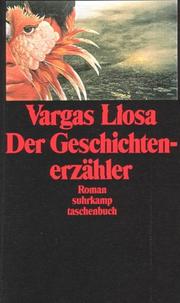
The Storyteller (Spanish: El Hablador) is a novel by Peruvian author and Literature Nobel Prize winner Mario Vargas Llosa. The story tells of Saúl Zuratas, a university student who leaves civilization and becomes a "storyteller" for the Machiguenga Native Americans. The novel thematizes the Westernization of indigenous peoples through missions and through anthropological studies, and questions the perceived notion that indigenous cultures are set in stone.
Plot
The plot develops an extended argument of two sides of what to do with Peru's native Amazonian populations. One side argues that tribes should be left alone to live as they have for millennia, leaving them full access and use of their ancient lands. The other side posits that such ancient ways cannot survive the exploitation of economic interests. In order to save them, natives must be protected by modern intervention of missionaries and government agencies. Through the book, each character seeks ways to protect these groups.
Except for Chapter 1, narrated by Mario Vargas Llosa (both a character and the author of the text), even-numbered chapters and narrated by him. These chapters are set at the National University of San Marcos, the radio station where Mario is employed, and several pubs around the city. Odd number chapters are narrated by Saúl Zaratas as the Storyteller for the Machiguenga and are devoted entirely to telling the history of the tribe and its methods of survival. Those chapters are set throughout the Amazon as the Storyteller travels from one group to another. The two characters meet only in the even chapters from time to time, debating politics, university life, and occasionally the rights of the native tribes to either exist as they have or be saved by modernization.
The narrator creates a commentary for public television to shed light on the plight of the Machiguenga, with the hope of convincing himself that the tribe is in better shape for the interventions of modern civilization imposed upon them. Saúl, for his part, fully integrates into the tribe, doffing his western ways and incorporating himself fully as a historian and communication link for the disparate members across the Amazon.
Main characters
Narrator
Middle-aged, Peruvian writer who is telling the story of the native Amazonian Indians through his experience and that of his friend Saúl, both of whom are obsessed, in different ways, with a particular tribe of Indians, the Machiguengas. At the time of the narrative he is living in Florence Italy and has lost all contact with Saúl. Based on hints, chance encounters and indirect evidence, the narrator comes to the conclusion that Saúl has not only disappeared into the Peruvian jungle but has, somehow, become a tribal storyteller of the Machiguengas.
Saúl Zuratas
Fellow student at San Marcos and friend of the overall narrator. To an increasing degree, he becomes a second narrator, though it is not clear to the reader whether it is the actual Saúl or the first narrator's idea of Saúl that is doing the second narration. Saúl is also called "Mascarita" because of the large birthmark "mask" that covers half of his face. Saúl develops a deep connection to and appreciation for the Machiguenga Indians during his time at college and apparently trades in his life in modern civilization in order to travel amongst the tribes as a storyteller or "hablador."
Machiguenga Tribe
The tribe of the Amazonian Natives whose stories and fate are the basis of the book.
Tasurinchi
Is a name used in the storytelling chapters throughout Vargas Llosa's book, one that can cause considerable confusion. Because the Machiguengas do not use personal names, "Tasurinchi" is not a consistent individual, but the name used for the person or god about whom someone is talking. It is used, roughly, to mean "revered male about whom we are speaking". Early in the book Saul defines Tasurinchi as "the god of good", but this is just one use of the name. During his storytelling, Mascarita uses "Tasurinchi" as a pronoun used to stand for oneself, other males, and even the sun. Later, as Mascarita goes more "native," he adopts the name as a person pronoun, referring to himself as "Tasurinchi."
Don Salomon Zuratas
Saúl Zuratas's father. After Don Salomon dies, Saul leaves the city to become the storyteller.
Major Themes, symbols, and motifs
To analyze the themes in a broader concept, Vargas asks the reader to think about the positive and negative effects of globalization, specifically through the roles of the Viracochas (White men, most typically used in negatively describing the ruthless rubber merchant of the rubber boom) and the missionaries. The Viracochas used the native Indians to harvest rubber, promising them food, shelter and goods to come work for them. The Viracochas treated the Indians horribly once they got to the camps and began pitting the tribes against each other once manpower became scarce. They would send Mashcos to capture three Machiguengas or vice versa to buy their "freedom." "They wanted to Bleed us like they bled the trees." The Viracochas shed a negative light on globalization by exploiting the land and people for profit. Regarding the missionaries and linguists at the Summer Institute, the line between negative and positive impacts are blurred. By studying the Machiguengas, learning their language, and teaching them English and religion, some may argue that the native Indians are being saved from extinction in modern civilization. Others argue that the linguists and missionaries are a "tentacle of American imperialism which, under the cover of doing scientific research, has been engaged in gathering intelligence and has taken the first steps toward a neocolonist penetration of the cultures of the Amazonian Indian." Through these examples of progress versus preservation, Vargas Llosa asks the reader, "which is more important?"
以上文字摘自英文维基百科「The Storyteller (Vargas Llosa novel)」(有删节,去掉了参考文献等尾部小节),按 CC BY-SA 4.0 使用,作者为维基百科的各位编者。
资料卡
- 原题
- El Hablador
- 原作语言
- 西班牙语
- 首次出版
- 1987 年
- 作品形式
- 长篇小说、记述文
- 体裁
- 历史小说
- 首版出版社
- 星球出版集团
- 续作
- In Praise of the Stepmother
- 故事发生地
- 利马
资料卡来自 Wikidata Q1193864(CC0),众包数据,个别字段可能不全。