书单
百科
这个词条暂时没有中文维基百科条目,下面是英文维基百科的内容(英文原文):
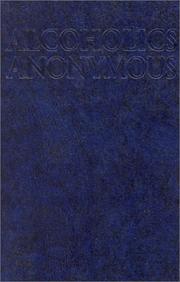
Alcoholics Anonymous: The Story of How More Than One Hundred Men and Women Have Recovered from Alcoholism (nicknamed "The Big Book" because of the thickness of the paper used in the first edition) is a 1939 basic text describing how to seek recovery from alcoholism. The Big Book was written by William G. Bill W." Wilson, one of the founders of Alcoholics Anonymous (AA or A.A.), with the help of various editors. The composition process was not collaborative other than editing. Bill W. wrote all the book's chapters except "To Employers", which was authored by Bill W.'s right-hand man, Hank Parkhurst. Parkhurst influenced the more liberal notions of "God as we understand him" and "your own conception of God." Bill W.'s group in New York and Robert Holbrook Smith (a.k.a. "Dr. Bob"), the other AA founder, in Akron, Ohio, exchanged drafts of sections. Dr. Bob made no major changes. It is the predecessor of the well-known "twelve-step method" widely used to treat various addiction conditions and behaviors, including alcoholism, narcotic addiction, and marijuana addiction, as well as overeating, sex addiction, and gambling addiction, with strong spiritual and pro-social emphases. It is one of the best-selling books of all time, having sold 30 million copies as of August 2009. In 2011, Time magazine placed the book on its list of the 100 best and most influential books written in English since 1923, the year in which the magazine was first published. In 2012, the Library of Congress designated it as one of 88 "Books that Shaped America."
History
Bill W. had been a successful Wall Street businessman, but his career was in shambles because of his chronic alcoholism. In 1934 he was invited by his friend and drinking buddy Ebby Thacher to join the Oxford Group, a spiritual movement based on the “Four Absolutes” of honesty, purity, unselfishness, and love. Bill W met Dr. Bob in May 1935, and the men shared their stories with one another. The two began to work on how to best approach alcoholics and began trying to help men recover from alcoholism. The idea for the book developed when Bill W. and Dr. Bob realized their system had helped over 40 men stay sober for more than 2 years. The book was meant to carry their message far and wide. Wilson started writing the book in 1938 with the financial support of Charles B. Towns (1862–1947), an expert on alcoholism and drug addiction who was a supporter and creditor of Alcoholics Anonymous and lent Wilson $2500 (equivalent to $57,181 in 2025).
Much of the book was written in 1938 at the Calumet Building in Newark, New Jersey (the site of the first headquarters of Alcoholics Anonymous), using the secretarial services provided by Ruth Hock.
The Big Book was originally published in 1939, and serves as the basic text of AA. It has been reprinted and revised many times, and translated into dozens of languages. The second edition (1955) consisted of 1,150,000 copies. Alcoholics Anonymous World Services publishes the book, and it is available through AA offices and meetings, as well as through booksellers. The 4th edition (2001) is also available online for free. Marty Mann (1904–1980) wrote the chapter "Women Suffer Too" in the second through fourth editions of the Big Book.
U.S. President Richard Nixon received the millionth copy of the book. The 25-millionth copy of the Big Book was presented to Jill Brown, the warden of San Quentin State Prison, at the International Convention of Alcoholics Anonymous in Toronto, Ontario to commemorate the first prison meeting of Alcoholics Anonymous taking place at San Quentin in 1941. The 30-millionth copy of the book was presented to the American Medical Association in 2010, which declared alcoholism an illness in 1956.
Synopsis
The book consists of over 400 pages. Bill W.'s Story and Dr. Bob's Nightmare and the personal experiences of some alcoholics are detailed as well as the series of solutions which evolved to become the twelve-step program. How to use the twelve steps is explained using examples and anecdotes. Some chapters target a specific audience. One chapter is devoted to agnostics, and another is named "To Wives" (most of the first AA members were men), and still another is for employers. The second part of the book (whose content varies from edition to edition) is a collection of personal stories, in which alcoholics tell their stories of addiction and recovery.
Frequently mentioned sections are:
the "Twelve Steps", at the beginning of Chapter 5, "How It Works"
the "Twelve Traditions", in the Appendix the "Ninth Step Promises", in Chapter 6, "Into Action" preceding the discussion of the 10th Step.
The main goal of the book is to make it possible for the reader to find a power greater than himself to solve his problem. The writers indicate that an alcoholic "of our type" can under no circumstances become a moderate drinker: only abstinence and the understanding of the community of alcoholics can lead to recovery. By way of anecdotal evidence, the example is provided of a man who, after 25 years sobriety, began to drink moderately and within two months landed in hospital. The reasoning is that once an alcoholic, always an alcoholic.
以上文字摘自英文维基百科「The Big Book (Alcoholics Anonymous)」(有删节,去掉了参考文献等尾部小节),按 CC BY-SA 4.0 使用,作者为维基百科的各位编者。
资料卡
- 原题
- The Big Book
- 原作语言
- 英语
- 首次出版
- 1939 年 4 月 10 日
- 体裁
- 自助书籍
- 主题
- 酗酒
资料卡来自 Wikidata Q882773(CC0),众包数据,个别字段可能不全。