书单
百科
这个词条暂时没有中文维基百科条目,下面是英文维基百科的内容(英文原文):
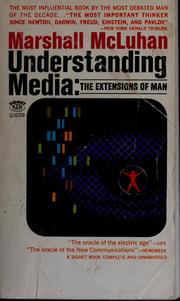
Understanding Media: The Extensions of Man is a 1964 book by Marshall McLuhan, in which the author proposes that the media, not the content that they carry, should be the focus of study. He suggests that the medium affects the society in which it plays a role mainly by the characteristics of the medium rather than the content. The book is considered a pioneering study in media theory.
McLuhan pointed to the light bulb as an example. A light bulb does not have content in the way that a newspaper has articles or a television has programs, yet it is a medium that has a social effect; that is, a light bulb enables people to create spaces during nighttime that would otherwise be enveloped by darkness. He describes the light bulb as a medium without any content. McLuhan states that "a light bulb creates an environment by its mere presence".
More controversially, he postulated that content had little effect on society—in other words, it did not matter if television broadcasts children's shows or violent programming. He noted that all media have characteristics that engage the viewer in different ways; for instance, a passage in a book could be reread at will, but a movie had to be screened again in its entirety to study any individual part of it.
The book is the source of the well-known phrase "the medium is the message". It was a leading indicator of the upheaval of local cultures by increasingly globalized values. The book greatly influenced academics, writers, and social theorists. The book discussed the radical analysis of social change, how society is shaped, and reflected by communications media.
Summary
Throughout Understanding Media, McLuhan uses historical quotes and anecdotes to probe the ways in which new forms of media change the perceptions of societies, with specific focus on the effects of each medium as opposed to the content that is transmitted by each medium. McLuhan identified two types of media: "hot" media and "cool" media, drawing from French anthropologist Lévi-Strauss's distinction between hot and cold societies.
This terminology does not refer to the temperature or emotional intensity, nor some kind of classification, but to the degree of participation. Cool media are those that require high participation from users, due to their low definition (the receiver/user must fill in missing information). Since many senses may be used, they foster involvement. Conversely, hot media are low in audience participation due to their high resolution or definition. Film, for example, is defined as a hot medium, since in the context of a dark movie theater, the viewer is completely captivated, and one primary sense—visual—is filled in high definition. In contrast, television is a cool medium, since many other things may be going on and the viewer has to integrate all of the sounds and sights in the context.
In Part One, McLuhan discusses the differences between hot and cool media and the ways that one medium translates the content of another medium. Briefly, "the content of a medium is always another medium".
In Part Two, McLuhan analyzes each medium (circa 1964) in a manner that exposes the form, rather than the content of each medium. In order, McLuhan covers:
The Spoken Word;
The Written Word (i.e., manuscript or incunabulum);
Roads and Paper Routes;
Numbers;
Clothing;
Housing;
Money;
Clocks;
The Print (i.e., pictorial lithograph or woodcut);
Comics;
The Printed Word (i.e., typography);
The Wheel;
The Bicycle and Airplane;
The Photograph;
The Press;
The Motorcar;
Ads;
Games;
The Telegraph;
The Typewriter;
The Telephone;
The Phonograph;
Movies;
Radio;
Television;
Weapons; and
Automation.
Concept of "media"
McLuhan uses interchangeably the words medium, media, and technology.
For McLuhan a medium is "any extension of ourselves" or, more broadly, "any new technology". Contrastly, in addition to forms such as newspapers, television, and radio, McLuhan includes the light bulb, cars, speech, and language in his definition of media: all of these, as technologies, mediate our communication; their forms or structures affect how we perceive and understand the world around us.
McLuhan says that conventional pronouncements fail in studying media because they focus on content, which blinds them to the psychic and social effects that define the medium's true significance. McLuhan observes that any medium "amplifies or accelerates existing processes", introducing a "change of scale or pace or shape or pattern into human association, affairs, and action", which results in "psychic, and social consequences". This is the real "meaning or message" brought by a medium, a social and psychic message, and it depends solely on the medium itself, regardless of the 'content' emitted by it. This is basically the meaning of "the medium is the message".
To demonstrate the flaws of the common belief that the message resides in how the medium is used (the content), McLuhan provides the example of mechanization, arguing that regardless of the product (e.g., corn flakes or Cadillacs), the impact on workers and society is the same.
In a further exemplification of the common unawareness of the real meaning of media, McLuhan says that people "describe the scratch but not the itch". As an example of "media experts" who follow this fundamentally flawed approach, McLuhan quotes a statement from "General" David Sarnoff (head of RCA), calling it the "voice of the current somnambulism". Each medium "adds itself on to what we already are", realizing "amputations and extensions" to our senses and bodies, shaping them in a new technical form. As appealing as this remaking of ourselves may seem, it really puts us in a "narcissistic hypnosis" that prevents us from seeing the real nature of the media. McLuhan also says that a characteristic of every medium is that its content is always another (previous) medium. For an example in the new millennium, the Internet is a medium whose content is various media which came before it—the printing press, radio and the moving image.
以上文字摘自英文维基百科「Understanding Media」(有删节,去掉了参考文献等尾部小节),按 CC BY-SA 4.0 使用,作者为维基百科的各位编者。
资料卡
- 原题
- Understanding Media
- 原作语言
- 英语
- 首次出版
- 1964 年
- 体裁
- 随笔
- 首版出版社
- 标普全球
- 主题
- 媒体研究
资料卡来自 Wikidata Q363912(CC0),众包数据,个别字段可能不全。