书单
人口论 (1798)
百科
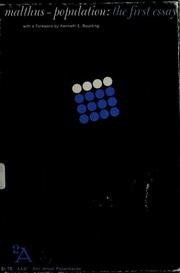
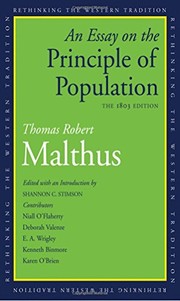
《人口论》(英语:An Essay on the Principle of Population)首先于1798年匿名发表,后得知其作者为人口学家托马斯·罗伯特·马尔萨斯。该书警告,若人口数量以指数形式增长而粮食生产以线性增长的情况下,除非出生率下降,否则二者的差距将导致粮食匮乏和饥荒。
基本思想
人口学原理的基本思想是:
如没有限制,人口是指数增长(即指数:2,4,8,16,32,64,128等)。
而食物供应呈现等差(即:1,2,3,4,5,6,7等)增长。
食物为人类生存的最重要之条件。
只有自然原因(事故和衰老),灾难(战争,瘟疫,及各类饥荒),道德限制和罪恶(马尔萨斯所指包括杀婴,谋杀,节育和同性恋)能够限制人口的过度增长。
马尔萨斯注意到许多人误用他的理论,痛苦地阐明他没有仅仅预测未来的大灾难。他辩解道,“......周期性灾难持续存在的原因自人类有史以来就已经存在,目前仍然存在,并且将来会继续存在,除非我们的大自然的物理结构发生决定性的变化。”因此,马尔萨斯认为他的《人口论》是对人类过去和目前状况的解释,以及对我们未来的预测。
人口论的论点为粮食增加仅会呈等差数列,而人口的增加却会呈现等比数列。所以他觉得人类必须顾虑食物的缺乏,而减少结婚的预防限制,以及受现实穷困的折磨、对已生人口所加压迫积极限制。
以上文字摘自维基百科「人口論」(去掉了参考文献等尾部小节),按 CC BY-SA 4.0 使用,作者为维基百科的各位编者。
中文维基百科的条目比较短,下面附上英文维基百科的内容(英文原文):
The book An Essay on the Principle of Population was first published anonymously in 1798, but the author was soon identified as Thomas Robert Malthus. The book warned of future difficulties, on an interpretation of the population increasing in geometric progression (so as to double every 25 years) while food production increased in an arithmetic progression, which would leave a difference resulting in the want of food and famine, unless birth rates decreased.
While it was not the first book on population, Malthus's book fuelled debate about the size of the population in Britain and contributed to the passing of the Census Act 1800. This Act enabled the holding of a national census in England, Wales and Scotland, starting in 1801 and continuing every ten years to the present. The book's 6th edition (1826) was independently cited as a key influence by both Charles Darwin and Alfred Russel Wallace in developing the theory of natural selection.
A key portion of the book was dedicated to what is now known as the Malthusian Law of Population. The theory claims that growing population rates contribute to a rising supply of labour and inevitably lowers wages. In essence, Malthus feared that continued population growth lends itself to poverty.
In 1803, Malthus published, under the same title, a heavily revised second edition of his work. His final version, the 6th edition, was published in 1826. In 1830, 32 years after the first edition, Malthus published a condensed version entitled A Summary View on the Principle of Population, which included responses to criticisms of the larger work.
Overview
Between 1798 and 1826 Malthus published six editions of his famous treatise, updating each edition to incorporate new material, to address criticism, and to convey changes in his own perspectives on the subject. He wrote the original text in reaction to the optimism of his father and his father's associates (notably Rousseau) regarding the future improvement of society. Malthus also constructed his case as a specific response to writings of William Godwin (1756–1836) and of the Marquis de Condorcet (1743–1794).
Malthus regarded ideals of future improvement in the lot of humanity with scepticism, considering that throughout history a segment of every human population seemed relegated to poverty. He explained this phenomenon by arguing that population growth generally expanded in times and in regions of plenty until a relatively large size of population, relative to a more modest supply of primary resources, caused distress:
Yet in all societies, even those that are most vicious, the tendency to a virtuous attachment [i.e., marriage] is so strong, that there is a constant effort towards an increase of population. This constant effort as constantly tends to subject the lower classes of the society to distress and to prevent any great permanent amelioration of their condition.
以上文字摘自英文维基百科「An Essay on the Principle of Population」(有删节,去掉了参考文献等尾部小节),按 CC BY-SA 4.0 使用,作者为维基百科的各位编者。
资料卡
- 原题
- An Essay on the Principle of Population
- 原作语言
- 英语
- 首次出版
- 1798 年
- 体裁
- 随笔
- 主题
- 经济
资料卡来自 Wikidata Q851988(CC0),众包数据,个别字段可能不全。