书单
百科
这个词条暂时没有中文维基百科条目,下面是英文维基百科的内容(英文原文):
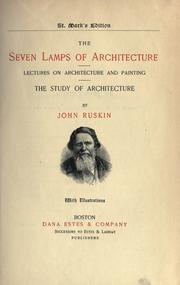
The Seven Lamps of Architecture is an extended essay, first published in May 1849 and written by the English art critic and theorist John Ruskin. The 'lamps' of the title are Ruskin's principles of architecture, which he later expanded in the three-volume The Stones of Venice. To an extent, they codified some of the contemporary thinking behind the Gothic Revival. At the time of its publication, A. W. N. Pugin and others had already advanced the ideas of the Revival and it was well under way in practice. Ruskin offered little new to the debate, but the book helped to capture and summarise the thoughts of the movement. The Seven Lamps also proved a great popular success, and received the approval of the ecclesiologists typified by the Cambridge Camden Society, who criticised in their publication The Ecclesiologist lapses committed by modern architects in ecclesiastical commissions.
The 'Lamps'
The essay was published in book form in May 1849 and is structured with eight chapters; an introduction and one chapter for each of the seven 'Lamps', which represent the demands that good architecture must meet, expressed as directions in which the association of ideas may take the observer:
Sacrifice – dedication of man's craft to God, as visible proofs of man's love and obedience
Truth – handcrafted and honest display of materials and structure. Truth to materials and honest display of construction were bywords since the serious Gothic Revival had distanced itself from the whimsical "Gothick" of the 18th century; it had been often elaborated by Pugin and others.
Power – buildings should be thought of in terms of their massing and reach towards the sublimity of nature by the action of the human mind upon them and the organization of physical effort in constructing buildings.
Beauty – aspiration towards God expressed in ornamentation drawn from nature, his creation
Life – buildings should be made by human hands, so that the joy of masons and stonecarvers is associated with the expressive freedom given them
Memory – buildings should respect the culture from which they have developed
Obedience – no originality for its own sake, but conforming to the finest among existing English values, in particular expressed through the "English Early Decorated" Gothic as the safest choice of style.
Writing within the essentially British tradition of the associational values that inform aesthetic appreciation, Ruskin argued from a moral stance with polemic tone, that the technical innovations of architecture since the Renaissance and particularly the Industrial Revolution, had subsumed its spiritual content and sapped its vitality. He also argued that no new style was needed to redress this problem, as the appropriate styles already existed. The 'truest' architecture was therefore the older Gothic of medieval cathedrals and Venice. The essay sketched out the principles which Ruskin later expounded upon in the three-volume The Stones of Venice published between 1851 and 1853. Practically, he suggested an 'honest' architecture with no veneers, finishes, hidden support nor machined mouldings and that beauty must be derived from nature and crafted by man.
Ruskin drew upon Archibald Alison's Essays on the Nature and Principles of Taste (1790–1810) for some of his principles, such as the requirement of leisured poise as the best state for appreciating beauty, the thought that the natural countryside is more conducive to producing an artist than the city, that the glory of architecture lies in its age. The Seven Lamps was reduced to the status of a "moral gloss on Alison" by George L. Hersey, in High Victorian Gothic.
He had an abiding confidence in the natural, untutored instinct for rightness and beauty in the average person: "all men have sense of what is right in this matter, if they would only use and apply this sense; every man knows where and how beauty gives him pleasure, if he would only ask for it when he does so, and not allow it to be forced upon him when he does not want it." Ruskin saw no beauty in well-designed tools: beauty is out of place where there is not serene leisure, or "if you thrust it into the places of toil. Put it in the drawing-room, not into the workshop; put it on domestic furniture, not upon tools of handicraft." For Ruskin, Beauty was not an inherent characteristic but a thing that could be applied to an object or withheld from it.
Ruskin's choice of examples
Though Ruskin expressly disavowed any attempt to present an essay in the course of European architecture, he noted that "The reader will perhaps be surprised by the small number of buildings to which reference has been made." His nine pencil drawings that illustrate the principles he examines are all Tuscan and Venetian Romanesque and Gothic and northern French Gothic examples and the example in his text range to the north of England, following his experience and affection, avoiding the "impure schools" of Spain and of Germany. By the time of the second edition (1855), Ruskin had fixed his exemplars more certainly:
I have now no doubt that the only style proper for modern northern work, is the Northern Gothic of the thirteenth century, as exemplified, in England, pre-eminently by the cathedrals of Lincoln and Wells, and, in France, by those of Paris, Amiens, Chartres, Rheims, and Bourges, and by the transepts of that of Rouen.
The importance of authentic detail to Ruskin is exemplified in the daguerreotypes from which he made drawings of details too high to see clearly, and his urgent plea to amateur photographers in the Preface to the Second Edition, which presages the formative role that photography of architectural details was to play during the next decades, not only in Gothic Revival buildings:
...while a photograph of landscape is merely an amusing toy, one of early architecture is a precious historical document; and that this architecture should be taken, not merely when it presents itself under picturesque general forms, but stone by stone, and sculpture by sculpture.
以上文字摘自英文维基百科「The Seven Lamps of Architecture」(有删节,去掉了参考文献等尾部小节),按 CC BY-SA 4.0 使用,作者为维基百科的各位编者。
资料卡
- 原题
- The Seven Lamps of Architecture
- 插图
- 约翰·拉斯金
- 原作语言
- 英语
- 首次出版
- 1849 年
- 体裁
- 非虚构作品
- 首版出版社
- Smith, Elder & Co.
- 续作
- 威尼斯之石
- 主题
- 建筑
资料卡来自 Wikidata Q218578(CC0),众包数据,个别字段可能不全。