书单
百科
这个词条暂时没有中文维基百科条目,下面是英文维基百科的内容(英文原文):
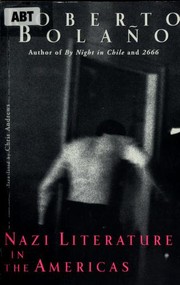
Nazi Literature in the Americas (Spanish: La literatura nazi en América) is a work of fiction by the Chilean author Roberto Bolaño. It was published in 1996, being later republished by Anagrama. Chris Andrews’ English translation was published in 2008 by New Directions and was shortlisted for the 2008 Best Translated Book Award.
Summary
Nazi Literature in the Americas presents itself as an encyclopedia of right-wing writers. The book is composed of short biographies of imaginary Pan-American authors. The literary Nazis—fascists and ultra-right sympathizers and zealots, most from South America, a few from North America—portrayed in that book are a gallery of self-deluded mediocrities, snobs, opportunists, narcissists, and criminals. About Nazi Literature in the Americas, Bolaño told an interviewer:
(Its) focus is on the world of the ultra right, but much of the time, in reality, I'm talking about the left... When I'm talking about Nazi writers in the Americas, in reality I'm talking about the world, sometimes heroic but much more often despicable, of literature in general.
Although the writers are invented, they are all carefully situated in real literary worlds: Bolaño's characters rebuff Allen Ginsberg’s advances in Greenwich Village, encounter Octavio Paz in Mexico City, and quarrel with José Lezama Lima in Cuba.
Forerunners to this type of fictional writer biographies can be seen in the short stories of Jorge Luis Borges, particularly "Pierre Menard, Author of the Quixote" and "An Examination of the Work of Herbert Quain". Bolaño has also praised the work of J. Rodolfo Wilcock, a member of Borges' cohort, whose "La Sinagoga de Los Iconoclastas" (Temple of the Iconoclasts) similarly consists of short biographies of imaginary figures, in Wilcock's case, crackpot scholars and inventors.
Contents
The Mendiluce Clan
Presents the Argentinian poet Edelmira Thompson de Mendiluce, her son Juan Mendiluce Thompson, and her daughter Luz Mendiluce Thompson. Edelmira, a wealthy widow, among other ventures, attempts to create a room based on Edgar Allan Poe's essay "Philosophy of Furniture" and founds The Fourth Reich in Argentina, a literary magazine and publishing house which publish works by several of the writers appearing later in the book. Juan is a novelist and politician while Luz is a talented but troubled poet who suffers failed marriages, struggles with alcoholism and overweight, and is eventually doomed by her love for a much younger woman.
Itinerant Heroes or the Fragility of Mirrors
Ignacio Zubieta, the young scion of a wealthy Bogota family, and his frenemy Jesús Fernández-Gómez, a poor novelist from Cartagena, migrate to Spain just before the Civil War. After making a name in the Spanish cultural life, they enlist in the Blue Division and fight for the German Army until the Battle of Berlin, where both die. Most of their work is posthumous.
Forerunners and Figures of the Anti-Enlightenment
Mateo Aguirre Bengoechea
Silvio Salvático
Luiz Fontaine Da Souza
Ernesto Pérez Masón
Poètes Maudits
Pedro González Carrera
Andres Cepeda Cepeda, known as The Page
Wandering Women of Letters
Irma Carrasco
Daniela de Montecristo
Two Germans at the Ends of the Earth
Franz Zwickau
Willy Schürholz
Speculative and Science Fiction
J.M.S. Hill
Zach Sodenstern
Gustavo Borda
Magicians, Mercenaries and Miserable Creatures
Segundo José Heredia
Amado Couto
Carlos Hevia
Harry Sibelius
The Many Masks of Max Mirebalais
Max Mirebalais, alias Max Kasimir, Max von Hauptman, Max Le Gueule, Jacques Artibonito
North American Poets
Jim O'Bannon
Rory Long
The Aryan Brotherhood
Thomas R. Murchison, alias The Texan
John Lee Brook
The Fabulous Schiaffino Boys
Italo Schiaffino
Argentino Schiaffino, alias Fatso
The Infamous Ramírez Hoffman
This section differs in tone from the rest of the book, rather than being delivered as a dry encyclopedic entry it is narrated by a character, named Bolaño, who was a witness to some of the events. The story was later expanded into the novella Distant Star, with the name of the protagonist changed to Alberto Ruiz-Tagle. This is explained in the introduction to the novel thus:
In the final chapter of my novel Nazi Literature in the Americas I recounted, in less than twenty pages and perhaps too schematically, the story of Lieutenant Ramirez Hoffman of the Chilean Air Force, which I heard from a fellow Chilean, Arturo B. [...] He was not satisfied with my version [...] So we took that final chapter and shut ourselves up for a month and a half in my house in Blanes, where, guided by his dreams and nightmares, we composed the present novel.
Epilogue for Monsters
Secondary Figures
Publishing Houses, Magazines, Places...
Books
Critical reception
Stacey D'Erasmo, in a review for The New York Times, describes Nazi Literature in the Americas as:
“a wicked, invented encyclopedia of imaginary fascist writers and literary tastemakers, is Bolaño playing with sharp, twisting knives. As if he were Borges’s wisecracking, sardonic son, Bolaño has meticulously created a tightly woven network of far-right littérateurs and purveyors of belles lettres for whom Hitler was beauty, truth and great lost hope."
Michael Dirda, of The Washington Post found that the novel, "very much deserves reading: It is imaginative, full of a love for literature, and, unlikely as it may seem, exceptionally entertaining." John Brenkman of The Village Voice sees the book as both a satire and an elegy, stating,
"Nazi Literature in the Americas is first of all a prank, an act of genius wasting its time in parodic attacks on a hated sort of writer. But beyond that, it produces an unsettling mix of overt satire and covert elegy. The reductive force of summary after summary starts to have an effect that transcends the satire; the book begins to convey a sense of the vanity of human endeavor and the ease with which a lifetime's work might be flicked into oblivion by a witty remark."
Giles Harvey, writing for The New Yorker, included the novel in his list of Bolaño's best work, explaining that:
以上文字摘自英文维基百科「Nazi Literature in the Americas」(有删节,去掉了参考文献等尾部小节),按 CC BY-SA 4.0 使用,作者为维基百科的各位编者。
资料卡
- 原题
- La literatura nazi en América
- 译者
- Chris Andrews
- 原作语言
- 西班牙语
- 首次出版
- 1996 年
- 作品形式
- 长篇小说
- 首版出版社
- 塞依斯-巴拉尔出版社
资料卡来自 Wikidata Q6983393(CC0),众包数据,个别字段可能不全。