 书单
百科
这个词条暂时没有中文维基百科条目,下面是英文维基百科的内容(英文原文):
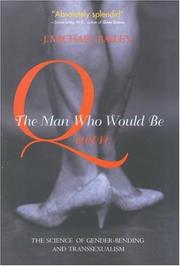
The Man Who Would Be Queen: The Science of Gender-Bending and Transsexualism is a 2003 book by the American psychologist J. Michael Bailey, published by Joseph Henry Press.
In the first section of the book, Bailey discusses gender-atypical behavior and gender dysphoria in children, emphasizing the biological determination of gender. In the second section, he deals primarily with gay men, including the link between childhood gender dysphoria and male homosexuality later in life. Bailey reviews evidence that male homosexuality is congenital (a result of genetics and prenatal environment), and he argues for the accuracy of some gay stereotypes. In the third section, Bailey summarizes evidence for the Blanchard typology of transsexualism that claims there are two forms of transsexualism that affect transgender women: one as an extreme type of male homosexuality and one that is a sexual interest in having a female body, called autogynephilia.
The book caused considerable controversy, which led to complaints and a formal investigation by Northwestern University, where Bailey was chair of the psychology department until shortly before the investigation concluded. Northwestern ultimately found no basis for the complaints, and a university spokesperson said that his departure from the department chairmanship had nothing to do with the investigation. According to Bailey, some of his critics were motivated by a desire to suppress discussion of the book's ideas about the autogynephilia theory of transgender women.
Summary
The Man Who Would Be Queen is divided into three sections: "The Boy Who Would Be Princess", "The Man He Might Become", and "Women Who Once Were Boys".
It starts with an anecdote about a child Bailey calls "Danny". Bailey writes of Danny's mother, who has been frustrated by other therapists she has seen about her son's "feminine" behavior. Bailey discusses psychologist and sexologist Kenneth Zucker's work with children whose parents have noticed significant gender-atypical behaviors. Bailey uses the anecdote about Danny to describe gender identity disorder, a label applied to males with significant feminine behaviors and females with significant masculine behaviors, such as cross-dressing. For example, this class includes boys that prefer to play with dolls and regularly identify with female characters in stories or movies, and girls that prefer to play with toy cars and identify with male characters. This section of the book also discusses some case studies of men who were, for varying reasons, reassigned to the female sex shortly after their birth, and emphasizes the fact that, despite this, they tended to exhibit typically male characteristics and often identified as men.
The second section deals primarily with gay men, including a suggested link between childhood gender identity disorder and male homosexuality later in life. Bailey discusses whether homosexuality is a congenitally or possibly even genetically related phenomenon. This discussion includes references to Bailey's studies as well as those of neuroscientist Simon LeVay and geneticist Dean Hamer. He also discusses the behavior of gay men and its stereotypically masculine and feminine qualities.
In the third section, Bailey summarizes a taxonomy of trans women that was proposed by Ray Blanchard about fifteen years earlier. According to Blanchard, there are two types of trans women: one described as an "extreme form of male homosexuality", the other being motivated by a sexual interest in having a female body. Bailey also discusses the process by which transition from male to female occurs.
Reception
The book elicited both strongly supportive and strongly negative reactions. The controversial aspects included the contents of the book, whether the research was conducted ethically, whether it should have been published by the National Academies Press, and whether it should have been promoted as a scientific work. According to Benedict Carey's story in The New York Times, "To many of Dr. Bailey's peers, his story is a morality play about the corrosive effects of political correctness on academic freedom." Interviewed by Carey, bioethicist Alice Dreger argues that "what happened to Bailey is important, because the harassment was so extraordinarily bad and because it could happen to any researcher in the field. If we're going to have research at all, then we're going to have people saying unpopular things, and if this is what happens to them, then we've got problems not only for science but free expression itself."
However, critics such as Deirdre McCloskey think that the pointed criticism, including filing charges, was warranted: "Nothing we have done, I believe, and certainly nothing I have done, overstepped any boundaries of fair comment on a book and an author who stepped into the public arena with enthusiasm to deliver a false and unscientific and politically damaging opinion". The concern over academic freedom was dismissed by Charles Allen Moser, who wrote: "The death of free speech and academic freedom has been highly exaggerated. Science is not free of politics, never has been, and never will be."
以上文字摘自英文维基百科「The Man Who Would Be Queen」(有删节,去掉了参考文献等尾部小节),按 CC BY-SA 4.0 使用,作者为维基百科的各位编者。
资料卡
- 原题
- The Man Who Would Be Queen
- 原作语言
- 英语
- 首次出版
- 2003 年
- 体裁
- 大众科学、LGBT文学
- 首版出版社
- 约瑟夫·亨利出版社、国家学术出版社
- 主题
- 同性恋、性别认同障碍
资料卡来自 Wikidata Q7749992(CC0),众包数据,个别字段可能不全。