书单
百科
这个词条暂时没有中文维基百科条目,下面是英文维基百科的内容(英文原文):
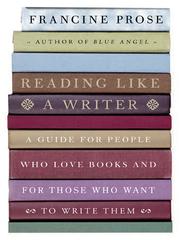
Reading Like a Writer is a writing guide by American writer Francine Prose, published in 2006.
Background
Subtitled "A Guide for People Who Love Books and for Those Who Want to Write Them", — Prose shares how she developed her writing craft through writing and reading. She uses examples from literature to demonstrate how fictional elements, such as character and dialogue, can be mastered.
Summary
Chapter One: Close Reading
Prose discusses the question of whether writing can be taught. She answers the question by suggesting that although writing workshops can be helpful, the best way to learn to write is to read. Closely reading books, Prose studied word choice and sentence construction. Close reading helped her solve difficult obstacles in her own writing.
Chapter Two: Words
Prose encourages the reader to slow down and read every word. She reminds the reader that words are the "raw material out of which literature is crafted." Challenging the reader to stop at every word, she suggests the following question be asked: "What is the writer trying to convey with this word?"
Chapter Three: Sentences
Prose discusses how "the well made sentence transcends time and genre." She believes the writer who is concerned about what constitutes a well-constructed sentence is on the right path. Prose mentions the importance of mastering grammar and how it can improve the quality of a writer's sentence. In this chapter, she also discusses the use of long sentences, short sentences, and rhythm in prose.
Chapter Four: Paragraphs
Prose discusses that, just as with sentence construction, the writer who is concerned about paragraph construction is stepping in the right direction. She states that the writer who reads widely will discover there are no general rules for building a well-constructed paragraph, but "only individual examples to help point [the writer] in a direction in which [the writer] might want to go."
Chapter Five: Narration
When determining point of view, Prose says audience is an important factor. She gives examples from literature of point-of-view variations. First person and third person are discussed, and even an example of writing fiction in second person is given.
Chapter Six: Character
Using examples from the works of Heinrich von Kleist and Jane Austen, Prose discusses how writers can develop characterization. She mentions that Kleist, in his "The Marquise of O—" ignores physical description of the characters, but instead "tells us just as much as we need to know about his characters, then releases them into the narrative that doesn't stop spinning until the last sentence . . ." Excerpts from other pieces of literature are used to show how action, dialogue and even physical description can help develop characterization.
Chapter Seven: Dialogue
Prose begins this chapter by dispelling the advice that writers should improve and clean up dialogue so it sounds less caustic than actual speech. She believes this idea on dialogue can be taken too far and that dialogue can be used to reveal not only the words on the surface, but the many motivations and emotions of the characters underneath the words.
Chapter Eight: Details
Using examples from literature, Prose explains how one or two important details can leave a more memorable impression on the reader than a barrage of description.
Chapter Nine: Gestures
Prose argues that gestures performed by fictional characters should not be "physical clichés" but illuminations that move the narrative.
Chapter Ten: Learning from Chekhov
Prose gives examples of what she has learned from reading Anton Chekhov. As a creative writing teacher, she would disseminate advice to her students after reading their stories. As a fan of Chekhov, she would read his short stories and find examples of how he would successfully break the "rules" of fiction writing, contradicting something she recently told her students to do in their writing projects. Prose also discusses how Chekhov teaches the writer to write without judgment; she tells how Chekhov practiced not being the "judge of one's characters and their conversations but rather the unbiased observer."
Chapter Eleven: Reading for Courage
Prose discusses the fears writers may have: revealing too much of themselves in their writing; resisting the pressures that writers must write a certain way; determining whether or not the act of writing is worth it when one considers the state of the world. She concludes her book by stating that the writer may fear creating "weeds" instead of "roses." Continuing the metaphor, she says reading is a way for the writer to see how other gardeners grow their roses.
Books to Be Read Immediately
Prose includes a list of book recommendations, many of which have selections from those that are used as examples for the concepts she discusses.
Books to be Read
Here are the books in mostly chronological order. The chapters in which they are discussed are in italics.
Sophocles (trans. Sir George Young) Oedipus Rex
Anonymous (trans. Dorothy L. Sayers) The Song of Roland
Miguel de Cervantes (trans. Tobias Smollett) Don Quixote
William Shakespeare King Lear
John Milton Paradise Lost
Samuel Richardson Pamela: Or Virtue Rewarded
Samuel Johnson The Life of Savage Sentences
Edward Gibbon Decline and Fall of the Roman Empire
Jane Austen Sense and Sensibility Paragraphs Character
Jane Austen Pride and Prejudice Paragraphs Character
Heinrich von Kleist (trans. Martin Greenberg) The Marquise of O---- and Other Stories Sentences Character
Stendhal (trans. Roger Gard) The Red and the Black Paragraphs
Honoré de Balzac (trans. Kathleen Raine) Cousin Bette
Nikolai Gogol (trans. Richard Pevear and Larissa Volokhonsky) Dead Souls: A Novel Courage
Charles Dickens Dombey and Son Narration
Charles Dickens Bleak House
Emily Bronte Wuthering Heights
Ivan Turgenev (trans. Isaiah Berlin) First Love
George Eliot Middlemarch Character
Herman Melville Bartleby, the Scrivener Paragraphs
Herman Melville Moby Dick
Herman Melville Benito Cereno
Gustave Flaubert (trans. Geoffrey Wall) Madame Bovary Courage
以上文字摘自英文维基百科「Reading Like a Writer」(有删节,去掉了参考文献等尾部小节),按 CC BY-SA 4.0 使用,作者为维基百科的各位编者。
资料卡
- 原题
- Reading Like a Writer
- 原作语言
- 英语
- 首次出版
- 2006 年
- 体裁
- 非虚构作品
- 首版出版社
- 哈珀柯林斯
资料卡来自 Wikidata Q7300524(CC0),众包数据,个别字段可能不全。