书单
百科
这个词条暂时没有中文维基百科条目,下面是英文维基百科的内容(英文原文):
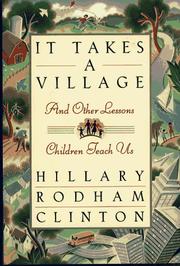
It Takes a Village: And Other Lessons Children Teach Us is a book published in 1996 by the then First Lady of the United States Hillary Clinton. In it, Clinton presents her vision for the children of America. She focuses on the impact individuals and groups outside the family have, for better or worse, on a child's well-being, and advocates a society which meets all of a child's needs. The book was written with uncredited ghostwriter Barbara Feinman.
The book was republished as a Tenth Anniversary Edition in 2006 and saw publication as a picture book in 2017.
History
Publishers had approached Clinton since the spring of 1994 with the idea of writing a book, and announcement of the upcoming book came in April 1995 from the publisher she chose, Simon & Schuster. It came in the wake of the Clinton health care plan of 1993, which she had led the effort for and which had suffered its final collapse in September 1994, and the book was seen by some observers as an effort to help reshape Clinton's image. It was not unusual for a First Lady to write a book while still in office, with Barbara Bush's children-aimed Millie's Book the most recent prior example. Eleanor Roosevelt was the first First Lady to write books while still in office, with the publication of It's Up to the Women in 1933, This Troubled World in 1938, and The Moral Basis of Democracy in 1940, among others. Carolyn Reidy, head of Simon & Schuster's trade books division, said: "We have all known that Hillary Rodham Clinton has devoted most of her career to issues of children. But outside of a handful of articles and speeches, her thoughts on these issues have not been available to everyone in an easily readable format. I think it will be an inspiring book." The book was originally intended to come out in September 1995 but delays on the part of Clinton resulted in publication being delayed until January 1996.
It was stated that Clinton would take no payments from the writing other than those to cover expenses, and that royalties from the book's sales would go to charity. In January 1996, Clinton went on a ten-city book tour and made numerous television appearances to promote the book, although she was frequently hit with questions about her involvement in the Whitewater and Travelgate controversies.
The book spent 18 weeks on the New York Times Best Seller List during 1996 including three weeks at number one. By 2000 it had sold 450,000 copies in hardcover and another 200,000 in paperback.
The theme of the book, at least as perceived from its title, aroused immediate opposition within the United States. A well known instance of this occurred during the 1996 presidential election when, during his acceptance speech at the Republican National Convention, Republican Party nominee Bob Dole said that with all due respect, I am here to tell you, it does not take a village to raise a child. It takes a family to raise a child." Criticism of Clinton's notion would continue to be made by American conservatives, including Rush Limbaugh, Andrea Tantaros, and Jonah Goldberg, through the next two decades.
In 1997, Clinton received a Grammy Award for Best Spoken Word Album for her audio recording of the book. The book appears in Clinton’s official First Lady portrait; this portrait was painted by Simmie Knox and unveiled in 2004. In it the book is depicted on a table next to a framed picture of the White House. In 2005, Senator Rick Santorum wrote a rebuttal to the book, It Takes a Family: Conservatism and the Common Good.
Contents
Introduction
It Takes a Village
No Family Is an Island
Every Child Needs a Champion
The Bell Curve Is a Curve Ball
Kids Don't Come with Instructions
The World Is in a Hurry, Children Are Not
An Ounce of Prevention Is Worth a Pound of Intensive Care
Security Takes More Than a Blanket
The Best Tool You Can Give Your Child Is a Shovel
Children Are Born Believers
Childhood Can Be a Service Academy
Kids Are an Equal Employment Opportunity
Child Care Is Not a Spectator Sport
Education = Expectations
Seeing Is Believing
Every Business Is a Family Business
Children Are Citizens Too
Let Us Build a Village Worthy of Our
Synopsis
The book emphasizes the shared responsibility that society has for successfully raising children, by looking at a number of angles as indicated in the chapter titles noted above. Clinton describes herself in the book as a Moderate, which is evidenced by a combination of advocating for government-driven social reforms while also espousing conservative values. Clinton observes in the book many institutions responsible in some way for raising children, including: direct family, grandparents, neighbors, teachers, ministers, doctors, employers, politicians, nonprofits, faith communities, businesses, and international governmental groups. Some of the goals and institutions that Clinton advocates for in the book include: the Family and Medical Leave Act of 1993, the Violent Crime Control and Law Enforcement Act, Community Policing, the Brady Bill, Amber alerts, immunizations, State Children's Health Insurance Program, financial regulation, expanded Child Tax Credits, Minimum Wage increases, Universal health care, personal responsibility, uniforms in schools, Goals 2000 academic framework, music warning labels, sexual abstinence, Plan B contraception, family planning, and marriage.
Proverb question
The book's title is attributed to the African proverb "It takes a village to raise a child". The saying and its attribution as an "African" proverb were in circulation before it was adopted by Clinton as the source for the title of her book. The saying previously provided the source for the title of a children's book entitled It Takes a Village by Jane Cowen-Fletcher, published in 1994.
以上文字摘自英文维基百科「It Takes a Village」(有删节,去掉了参考文献等尾部小节),按 CC BY-SA 4.0 使用,作者为维基百科的各位编者。
资料卡
- 原题
- It Takes a Village
- 原作语言
- 英语
- 首次出版
- 1996 年 1 月
- 首版出版社
- 西蒙与舒斯特
- 续作
- Stronger Together
资料卡来自 Wikidata Q6092095(CC0),众包数据,个别字段可能不全。