书单
百科
这个词条暂时没有中文维基百科条目,下面是英文维基百科的内容(英文原文):
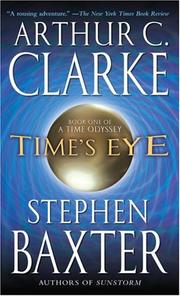
Time's Eye is a 2003 science fiction novel co-written by British writers Arthur C. Clarke and Stephen Baxter. It is the first book in the A Time Odyssey series. The next book in the series is Sunstorm.
Plot
The story begins with a series of individuals from different time periods encountering motionless, hovering spheres—and each other—in the region of the Northwest Frontier. Two early hominins, a mother and daughter, are the first. They lack a language, but are referred to in the narration as "Seeker" and "Grasper". Just after encountering a sphere, they are captured by strange creatures in red, later revealed to be British Redcoats.
In the year 2037, a UN peacekeeper helicopter is badly damaged by an R.P.G. It crashes near Jamrud Fort, which is defended by British soldiers and sepoys from 1885—including the same redcoats who captured Seeker and Grasper, which the British call "man-apes". Also present at the fort are the factor Cecil de Morgan, and two journalist observers, the American Josh White and the Anglo-Indian "Ruddy"—a young and as-yet unknown Rudyard Kipling.
The helicopter crew comprises an American pilot, Chief Warrant Officer Casey Othic; a British Indian observer, Lieutenant Bisesa Dutt; and Chief Warrant Officer Abdikadir Omar, an Afghan Pashtun with blue eyes and strawberry blond hair, which he claims is inherited from soldiers in the army of Alexander the Great. All three survive the helicopter crash, and they are taken prisoner by the British. Both sides soon realise that they are from different time periods, brought together by an event they name the "Discontinuity", and begin working together.
Abdikadir investigates one of the spheres, located near the fort, which the British call an "Eye". He determines that it possesses inexplicable properties; among other things, its circumference and volume are not related to its radius by a factor of pi, as in ordinary geometry, but by a factor of exactly 3. The 19th-century British, however, have become accustomed to the sphere, and use a camouflage net draped over it as a cage for the "man-apes".
Also beginning in 2037, a Soyuz capsule departs the International Space Station to return to Earth. Aboard are two Russians, Musa Ivanov and Kolya Krivalapov, and an American, Sable Jones. Sable is abrasive and ambitious, which Kolya believes has helped her succeed in her field, but she especially irritates Musa. The Soyuz loses contact with ground control, and takes up orbit rather than re-entering the atmosphere. They manage to establish radio contact with the "moderns" in Jamrud, and through the cosmonauts' observations, the characters learn that the Earth has become a patchwork conglomerate of terrain, and people, from different time periods spanning two million years ago up to the 21st century. Aside from Jamrud, and a site in North America that might be 19th-century Chicago, the cosmonauts' observations find no signs of industrial civilisation at all. They do, however, detect one other radio signal: a beacon of unknown origin located at the site of Babylon.
After weeks of orbiting, the cosmonauts decide to bring the Soyuz down in central Asia, where their observations have noted signs of extensive, but still pre-industrial, habitation. From there they hope to make their way to Jamrud. Before re-entry, Musa suggests that calling this patchwork world "Earth" is inappropriate, and proposes the name "Mir" instead; not for the "antique Russian space station", but for the Russian word мир, meaning both "peace" and "world".
The Soyuz lands successfully, but upon exiting the craft, Musa is decapitated by a Mongol warrior. Kolya, remembering a few words of Mongolian, manages to convince the Mongols that they are "emissaries of Heaven", and Sable and Kolya are loaded onto a cart heading east. They have arrived in the Mongol Empire of the 13th century, during the reign of Genghis Khan, to whom the "emissaries" are brought.
At the Khan's court, Kolya lays plans to use the Mongol army to enter China and rebuild the trading posts and towns that were lost in the Discontinuity. Sable disagrees, and instead proposes to take the army to Babylon. She hopes to find the unexplained radio beacon, believing it connected to whatever inconceivable event caused the Discontinuity, and thus the centre of power in "Mir". When Sable saves the Khan's life by shooting dead a sabre-toothed cat with her hidden side arm, Genghis accepts her as truly an emissary of Heaven, takes her to his bed, and agrees to her plan to take Babylon.
Meanwhile, the British have encountered the army of Alexander the Great, on the march down the Indus after the revolt that ended Alexander's eastward expansion. Alexander is suffering from his injury in the Mallian Campaign, but recovers, and the British and Macedonian forces form an alliance. Their goal, too, is Babylon; Alexander wishes to return to the capital of his Persian empire, and the "moderns" wish to locate the radio beacon. Alexander's army arrives at Babylon before the Khan, and has time to explore it. A sphere at least three times larger than those previously seen is discovered in the Temple of Marduk, and is found to be the source of the radio signals.
Meanwhile, the Khan's army reaches and sacks 19th-century Bishkek, massacring almost the entire population. Seeing this, Kolya plots against the Khan and Sable. As they near Babylon, he uses the radio equipment from the Soyuz to contact Casey and warn him of the coming Mongols. Sable catches Kolya in the act, but since the Mongols refuse to spill the "royal blood" of an emissary of Heaven, they blind and deafen him and throw him, alive, into a boarded-over pit.
以上文字摘自英文维基百科「Time's Eye」(有删节,去掉了参考文献等尾部小节),按 CC BY-SA 4.0 使用,作者为维基百科的各位编者。
资料卡
- 原题
- Time's Eye
- 原作语言
- 英语
- 首次出版
- 2003 年 3 月 3 日
- 作品形式
- 长篇小说
- 体裁
- 科学幻想
- 首版出版社
- 哈珀柯林斯
- 所属系列
- A Time Odyssey
资料卡来自 Wikidata Q785354(CC0),众包数据,个别字段可能不全。