书单
百科
这个词条暂时没有中文维基百科条目,下面是英文维基百科的内容(英文原文):
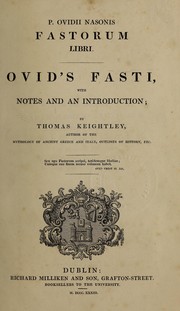
The Fasti (Latin: Fasti [ˈfaːstiː], "the Calendar"), sometimes translated as The Book of Days or On the Roman Calendar, is a six-book Latin poem written by the Roman poet Ovid and made public in AD 8. Ovid is believed to have left the Fasti incomplete when he was exiled to Tomis by the emperor Augustus in 8 AD. Written in elegiac couplets and drawing on conventions of Greek and Latin didactic poetry, the Fasti is structured as a series of eye-witness reports and interviews by the first-person vates ("poet-prophet" or "bard") with Roman deities, who explain the origins of Roman holidays and associated customs—often with multiple etiologies. The poem is a significant, and in some cases unique, source of fact in studies of religion in ancient Rome. Each book covers one month, January through June, of the Roman calendar, and was written several years after Julius Caesar replaced the old system of Roman time-keeping with what would come to be known as the Julian calendar.
The popularity and reputation of the Fasti has fluctuated more than that of any of Ovid's other works. The poem was widely read in the 15th–18th centuries, and influenced a number of mythological paintings in the tradition of Western art. In 1931, it was translated and annotated by the influential anthropologist and ritualist J.G. Frazer for the Loeb Classical Library series. However, as scholar Carole E. Newlands has observed, throughout the 20th century "anthropologists and students of Roman religion … found it full of errors, an inadequate and unreliable source for Roman cultic practice and belief. Literary critics have generally regarded the Fasti as an artistic failure." In the late 1980s, however, the poem enjoyed a revival of scholarly interest and a subsequent reappraisal; it is now regarded as one of Ovid's major works, and has been published in several new English translations. Ovid was exiled from Rome for his subversive treatment of Augustus, yet the Fasti continues this treatment—which has led to the emergence of an argument in academia for treating the Fasti as a politically weighted work.
Composition
Only the six books which concern the first six months of the year are extant. It may be that Ovid never finished it, that the remaining half is simply lost, or that only six books were intended. Ovid apparently worked on the poem while he was in exile at Tomis. The Tristia, a collection of elegiac letters on the poet's exile, mentions the Fasti, and that its completion had been interrupted by his banishment from Rome. Ovid also mentions that he had written the entire work, and finished revising six books. However, no ancient source quotes even a fragment from the supposedly six missing books.
Modern scholars believe that the Fasti was revised during Ovid's exile. In book 1, for example, he refers to Livia as Iulia Augusta, a title she only received in A.D. 14, and in line 63 there is a reference to Germanicus's triumph of A.D. 17. Other revisions appear to have been made in books 4, 5, and 6.
The Fasti is dedicated to Germanicus, a high-ranking member of the emperor Augustus's family. These circumstances have led some to speculate that the poem was written on religious, patriotic, and antiquarian themes in order to improve Ovid's standing with the rulers of Rome and secure his release from exile.
Poetic models
The earliest classical calendrical poem which might have inspired Ovid is the Works and Days of Hesiod, which includes mythological lore, astronomical observations, and an agricultural calendar. For the astronomical sections, Ovid was preceded by Aratus' Phaenomena as well as lost poetry on constellations and probably Germanicus' adaptation of Aratus (Fasti 1.17–27). The most significant influence on Ovid were the Roman fasti, the Roman calendrical lists, which included dates, notices of festivals, ritual prohibitions and proscriptions, anniversaries of important events, and sometimes aetiological material. Ovid often mentions consulting these calendars, such as his reference at 1.11 to pictos fastos and his references to the actual annotation marks of the calendar. The most important of these calendars for Ovid were probably the Fasti Praenestini, a contemporary calendar constructed and annotated by the grammarian Verrius Flaccus, whose fragments include much ritual material that can be found in Ovid's poem. The concept of putting these calendars into verse however, seems to be a uniquely Ovidian concept.
Besides his use of calendars and astronomical poetry, Ovid's multi-generic, digressive narrative and learned poem depends on the full range of ancient poetry and prose. In this, one of the most important works for Ovid was Callimachus' Aetia; the use of divine interlocutors, elegiac meter, various generic registers, and a focus on explaining the origins of customs and festivals are all significant features of Callimachus' work. The Fourth Book of Propertius, who claimed to be the Roman Callimachus, might also be a model since it also deals with aetiologies of Roman customs and myths. His etymologizing implies an interest in Roman antiquarianism, particularly the works of Varro on etymology and Roman religion. He similarly makes use of much Roman history writing, which must include lost historical poetry as well as the annal tradition (Ovid says in the prologue that one of his sources are ancient annals (annalibus ... priscis (1.7)). In his longer narrative sections, Ovid makes use of tragedy, epic poetry, elegy, and Hellenistic mythological poems. For some episodes, the sources Ovid used are untraceable. On the Roman side, Ovid particularly focuses on and employs Virgil's Aeneid and Eclogues, most notably in the long section on Anna in Book 3. As in the Metamorphoses, Ovid's use of Virgil is multifaceted; he often prefers to invert or abbreviate Virgil's episodes. Ovid will regularly deliberately pass over material covered in the Aeneid and expand a small section or a neglected episode into an elaborate narrative.
以上文字摘自英文维基百科「Fasti (poem)」(有删节,去掉了参考文献等尾部小节),按 CC BY-SA 4.0 使用,作者为维基百科的各位编者。
资料卡
- 原作语言
- 古典拉丁语
- 体裁
- 史诗
资料卡来自 Wikidata Q1236235(CC0),众包数据,个别字段可能不全。
改编作品
舞台剧 / 歌剧 / 芭蕾2
名单来自 Wikidata(CC0):只列条目里写明「改编自 / 取材于」这本书的作品,不按名字猜;众包数据,可能不全。