书单
百科
这个词条暂时没有中文维基百科条目,下面是英文维基百科的内容(英文原文):
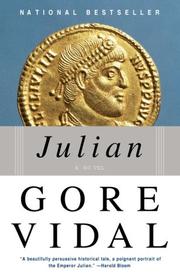
Julian is a 1964 novel by Gore Vidal, a work of historical fiction dealing with the life of the Roman emperor Flavius Claudius Julianus (known to Christians as Julian the Apostate), who reigned briefly from 361 to 363 A.D.
Synopsis
The book takes the form of the correspondence between two Hellenistic pagans: Libanius, who is considering writing a biography of Julian; and Priscus, who possesses Julian's personal memoir. The novel—told mostly in the first person—begins on March of AD 380, nearly 20 years after the death of Julian. Libanius and Priscus of Epirus exchange a series of letters, in which the two former confidantes of Julian discuss their respective lives, and in particular the recent events involving an imperial edict of Theodosius involving the Nicene Creed of Christianity. In his first letter to Priscus, Libanius proposes to write a biography of Julian; eventually, Priscus agrees to send a manuscript written by Julian himself to Libanius, along with his own comments (written in the margins thereof).
The memoir relates Julian's life from the time so many members of his family were purged by his cousin, the emperor Constantius II (whom he succeeded on the throne); his "exile", during childhood, to spend in libraries that time in which other boys might instead have been playing together outside; and his subsequent negative childhood experiences with Christian hypocrisy and conflict over dogma (see Arianism). As he matures, a rift forms between Julian and his disturbed half-brother Constantius Gallus, who is made Caesar (heir to the purple) by Constantius II; Julian claims, for his safety, to have no interest but philosophy, and so undertakes a journey to Athens to study under the city's greatest teachers. Here, he first sees Libanius, the book's narrator, and has an affair with a female philosopher (Macrina). He also comes to know some of the early Church Fathers in their formative years, including the agreeable Basil of Caesarea and the abrasive and dishonest Gregory of Nazianzus. Julian becomes a lector—a minor office in the Christian church—but continues to learn about the traditional religions: he studies Neoplatonism under Aedesius in Asia Minor, and is initiated into the Eleusinian Mysteries (which he would later try to restore) in Athens.
Julian is eventually made Caesar in place of Gallus, who was executed by Constantius II for cruelty and debauchery, as well as to satisfy Constantius' legendary insecurity and paranoia. This leaves Julian the successor to Constantius II, and he is given (at first nominal) command of Gaul as it is under attack by the Alamanni. Subsequently, Julian seizes hands-on military and administrative control from his 'advisors,' and, against expectations, experiences overwhelming military success over the Germans at Strasbourg. Upon the death of Helena (Julian's wife, and Constantius' sister), and in the face of Constantius' ever-increasing manic paranoia, Julian undertakes a short rebellion against Constantius, which ends—bloodlessly and in victory—with Constantius' natural death during the journey to confront Julian, and Julian's accession to the title of Augustus.
Julian's early reign is successful, with the removal from office of court eunuchs, whose true role Julian sees as being to drag on the state coffers and to isolate the emperors from real-world concerns. He also undertakes attempts to prevent the spread of Christianity; referring to the religion throughout the novel as 'back-country' and a 'death-cult' (and churches as 'charnel-houses', for their reverence of relics), Julian sees the best means to do this as to block Christians from teaching classical literature, thus relegating their religion to non-intellectual audiences and thwarting attempts by Christians to develop the sophisticated rhetoric and intellectualism of traditional Roman and Hellenistic religions. Here, Julian's headstrong nature begins to affect his ability to know his own capabilities, evident in several clashes with the Trinitarian clergy and with advisors. Nonetheless, Julian takes the opportunity to outline his arguments against Christianity, and to lay out his vision for reforming and restoring Roman civic life. His reforms are under way when, in spite of his own faith in prophecy, Julian undertakes an ill-omened campaign to reclaim Roman Mesopotamia from the Sassanid Empire.
以上文字摘自英文维基百科「Julian (novel)」(有删节,去掉了参考文献等尾部小节),按 CC BY-SA 4.0 使用,作者为维基百科的各位编者。
资料卡
- 原题
- Julian
- 原作语言
- 英语
- 首次出版
- 1964 年
- 作品形式
- 长篇小说
- 体裁
- LGBT文学
- 首版出版社
- 利特尔-布朗公司
资料卡来自 Wikidata Q16237781(CC0),众包数据,个别字段可能不全。