书单
百科
这个词条暂时没有中文维基百科条目,下面是英文维基百科的内容(英文原文):
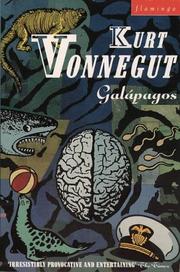
Galápagos is a 1985 satirical science fiction novel by the American author Kurt Vonnegut, his eleventh published novel. Set in the Galápagos Islands after a global financial disaster, the novel questions the merit of the human brain from an evolutionary perspective. The title is both a reference to the islands on which part of the story plays out, and a tribute to Charles Darwin, on whose theory Vonnegut relies to reach his own conclusions. It was published by Delacorte Press.
Plot summary
Galápagos is the story of a small band of mismatched humans who are shipwrecked on the fictional island of Santa Rosalia in the Galápagos Islands after a global financial crisis cripples the world's economy. Shortly thereafter, a disease renders all humans on Earth infertile, with the exception of the people on Santa Rosalia, making them the last specimens of humankind. Over the next million years, their descendants, the only fertile humans left on the planet, eventually evolve into a furry species resembling sea lions: though possibly still able to walk upright (it is not explicitly mentioned, but it is stated that they occasionally catch land animals), they have a snout with teeth adapted for catching fish, a streamlined skull and flipper-like hands with rudimentary fingers (described as "nubbins").
The story's narrator is a spirit who has been watching over humans for the last million years. This particular ghost is the immortal spirit of Leon Trotsky Trout, son of Vonnegut's recurring character Kilgore Trout. Leon is a Vietnam War veteran who is affected by the massacres in Vietnam. He goes AWOL and settles in Sweden, where he works as a shipbuilder and dies during the construction of the ship, the Bahía de Darwin. This ship is used for the "Nature Cruise of the Century". Planned as a celebrity cruise, it was in limbo due to the economic downturn, and due to a chain of unconnected events, the ship ends up allowing humans to reach and survive in the Galápagos. A group of girls from a cannibal tribe living in the Amazon rainforest, called the Kanka-bono girls, also end up on the ship, eventually having children with sperm obtained from the ship's captain.
The deceased Kilgore Trout makes four appearances in the novel, urging his son to enter the "blue tunnel" that leads to the afterlife. When Leon refuses for the fourth time, Kilgore pledges that he, and the blue tunnel, will not return for one million years, which leaves Leon to observe the slow process of evolution that transforms the humans into aquatic mammals. The process begins when a Japanese woman on the island, the daughter of a Hiroshima survivor, gives birth to a fur-covered daughter.
Trout maintains that all the sorrows of humankind were caused by "the only true villain in my story: the oversized human brain". Natural selection eliminates this problem, since the humans best fitted to Santa Rosalia were those who could swim best, which required a streamlined head, which in turn required a smaller brain.
Main characters
Leon Trout, dead narrator and son of Kilgore Trout
Hernando Cruz, first mate of the Bahía de Darwin
Mary Hepburn, an American widow who teaches at Ilium High School the Kanka-bono girls, a group of young girls from a cannibal tribe living in the Amazon rainforest
Roy Hepburn, Mary's husband who died in 1985 from a brain tumor
Akiko Hiroguchi, the daughter of Hisako that will be born with fur covering her entire body
Hisako Hiroguchi, a teacher of ikebana and Zenji's pregnant wife
Zenji Hiroguchi, a Japanese computer genius who invented the voice translator Gokubi and its successor Mandarax
Bobby King, publicity man and organizer of the "Nature Cruise of the Century"
Andrew MacIntosh, an American financier and adventurer of great inherited wealth
Selena MacIntosh, Andrew's blind daughter, eighteen years old
Jesús Ortiz, a talented Inca waiter who looks up to wealthy and powerful people
Adolf von Kleist, captain of the Bahía de Darwin, who does not really know how to steer the ship
Siegfried von Kleist, brother of Adolf and carrier of Huntington's chorea, who temporarily takes care of the reception at hotel El Dorado
James Wait, a 35-year-old American swindler
Pvt. Geraldo Delgado, an Ecuadorian soldier
Mandarax, a fictional voice translation device that is treated in some ways as a character
Literary techniques
Form
The main story is told a-chronologically with a framing story told by a narrator from a point a million years in the future, interspersed with flashbacks and commentary about the outcomes of future events of the main storyline. As a gimmick, an asterisk is placed in front of a character's name if they will die before sunset.
Quotations
The novel contains a large number of quotations from other authors. They are related to the story itself and are functionally inserted through Mandarax, a fictional voice translator that is also able to provide quotations from literature and history. The following authors are quoted (in order of their appearance in the book): Anne Frank, Alfred Tennyson, Rudyard Kipling, John Masefield, William Cullen Bryant, Ambrose Bierce, Lord Byron, Noble Claggett, John Greenleaf Whittier, Benjamin Franklin, John Heywood, Cesare Bonesana Beccaria, Bertolt Brecht, Saint John, Charles Dickens, Isaac Watts, William Shakespeare, Plato, Robert Browning, Jean de La Fontaine, François Rabelais, Patrick R. Chalmers, Michel de Montaigne, Joseph Conrad, George William Curtis, Samuel Butler, T. S. Eliot, A. E. Housman, Oscar Hammerstein II, Edgar Allan Poe, Charles E. Carryl, Samuel Johnson, Thomas Carlyle, Edward Lear, Henry David Thoreau, Sophocles, Robert Frost, and Charles Darwin.
Adaptations
In 2009, Audible.com produced an audio version of Galapagos, narrated by Jonathan Davis, as part of its Modern Vanguard line of audiobooks.
以上文字摘自英文维基百科「Galápagos (novel)」(有删节,去掉了参考文献等尾部小节),按 CC BY-SA 4.0 使用,作者为维基百科的各位编者。
资料卡
- 原题
- Galápagos
- 原作语言
- 英语
- 首次出版
- 1985 年
- 作品形式
- 长篇小说
- 体裁
- 科学幻想、喜剧、末日后幻想
- 首版出版社
- 戴尔出版社
- 故事发生地
- 加拉帕戈斯群岛
资料卡来自 Wikidata Q2527126(CC0),众包数据,个别字段可能不全。