书单
百科
这个词条暂时没有中文维基百科条目,下面是英文维基百科的内容(英文原文):
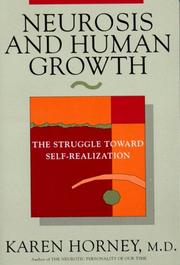
Neurosis and Human Growth: The Struggle Toward Self-Realization is a 1950 book by the German-American psychoanalyst Karen Horney. It was the last book she published and the major work of her later years. In it she gives the fullest statement of the theory of neurosis she had been developing since The Neurotic Personality of Our Time (1937); her biographer Bernard J. Paris treats it as the centrepiece of what he calls her "mature theory".
For Horney, the difference between neurotic and healthy development lies in what drives a person: compulsive action rooted in anxiety, or spontaneous action arising out of the whole range of a person's feelings. A person who keeps that spontaneity grows through a process she calls self-realization, the unfolding of the individual's given potentialities. She likens it to an acorn growing into a tree in fertile soil. Where a child's early circumstances make the world look hostile, spontaneity gives way to strategies for allaying anxiety, and the child's energies go into building a self adjusted to those dangers. That development, and what it does to the adult personality, is what Horney means by neurosis.
The centre of the book is the "pride system" that takes shape along the way. Unable to feel safe or loved as it is, the child begins to idealize itself, and the idealized image hardens into a self the person believes it ought to be. What follows are the neurotic's claims on other people, a "tyranny of the should", a brittle neurotic pride, and finally self-hate turned against everything in the person that falls short of the ideal. Thirteen chapters are given to the workings of this development, one to its undoing in therapy, and a final chapter to the differences between her position and classical psychoanalytic theory.
Background
Horney had broken with orthodox Freudian theory during the 1930s. Personality, she argued, is shaped less by instinctual drives than by the culture and the social relationships a child grows up in. The Neurotic Personality of Our Time (1937) and New Ways in Psychoanalysis (1939) set out that case, and Self-Analysis (1942) asked how far a patient could get alone. The position cost her the New York Psychoanalytic Institute, which she left in 1941 with Clara Thompson and others to found the Association for the Advancement of Psychoanalysis, the American Institute for Psychoanalysis, and the journal The American Journal of Psychoanalysis. Our Inner Conflicts (1945) had described three broad ways a neurotic person tries to manage other people: moving toward them, moving against them, and moving away from them.
Neurosis and Human Growth returns to those three positions, now presented as "solutions" a person settles into, and supplies the theory of the self they rest on. Horney wrote the book while serving as dean of the American Institute for Psychoanalysis. In December 1950, the journal Pastoral Psychology printed an article of hers called "The Search for Glory". She died in December 1952, two years after the book appeared.
The argument of the book
Self-realization and the real self
Horney begins from a contrast rather than a definition. Every person, she holds, has a "real self": a set of potentialities that unfold when the conditions for growth are good enough. Health, on this view, is a direction of movement rather than a fixed state, and she describes it with the image of an acorn that becomes an oak when it has soil to grow in. The idea belongs to the same family as self-actualization. Later commentators treat self-realization as the axis on which the whole book turns.
Growth is blocked by a climate rather than by a single trauma. A child whose surroundings are unreliable, indifferent, or actively harmful cannot take its own feelings as a guide, and develops instead what Horney had earlier called basic anxiety: a sense of being isolated and helpless in a world that may do it harm. Since the child cannot change its environment, it changes itself, and the strategies it adopts are the ones that later harden into neurosis.
The pride system
The book's distinctive move is to describe what happens next as an act of imagination. The child who cannot be loved for what it is begins to idealize itself, building up an "idealized self" of unlimited powers and virtues, until the gap between that picture and the actual self becomes the organizing fact of the person's life. Horney calls the resulting constellation the pride system and the pursuit of the idealized self the search for glory. The first half of the book sets out its parts:
Neurotic claims: the unspoken expectation that the world, and other people in particular, owe the idealized self the recognition and treatment it deserves.
The tyranny of the should: the idealized self experienced as a body of commands about what one must feel, do, and be. The phrase has outlived the book, and it still turns up in clinical writing about conformity and self-punishment.
Neurotic pride: pride that has lost its object, since it rests on the idealized image rather than on anything the person has done; permanently vulnerable, it takes any criticism as an attack.
Self-hate: the counterpart of the inflated self. The real self can never match the ideal, so the energy that built the ideal turns against the person. Horney describes a self-contempt that runs from nagging self-accusation to active self-destruction, and a person caught between a "despised self" and an ideal it cannot reach.
Alienation from the self: the end point of the process, at which a person no longer knows what it feels, wants, or believes, and experiences its own life as something conducted at a distance.
Horney treats pride and self-hate as two faces of one system, not as separate faults, and she insists throughout that the neurotic's suffering is real even where the person's outward competence is high.
以上文字摘自英文维基百科「Neurosis and Human Growth: The Struggle Toward Self-Realization」(有删节,去掉了参考文献等尾部小节),按 CC BY-SA 4.0 使用,作者为维基百科的各位编者。
资料卡
- 原作语言
- 英语
- 首次出版
- 1950 年
- 首版出版社
- 威廉·沃德尔·诺顿公司
- 主题
- 心理学
资料卡来自 Wikidata Q17114218(CC0),众包数据,个别字段可能不全。