书单
百科
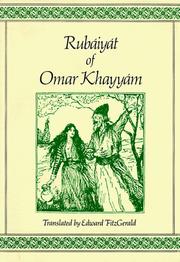
《鲁拜集》(普什图语:رباعیات)又译《柔巴依集》,是11世纪波斯诗人欧玛尔·海亚姆的四行诗集。四行诗的特征是每首四行,一、二、四行押韵,第三行通常不押韵,这和中国古代的绝句比较相似。
版本
在全世界最为流行的版本是爱德华·菲茨杰拉德的英文译本。爱德华·菲茨杰拉德翻译诗歌并不完全拘泥于原文,还将多首诗杂糅为一,其他语言译本也多从该翻译本译出。
郭沫若、黄杲炘、黄克孙、张鸿年等人都曾将《鲁拜集》译为中文,钱钟书也曾翻译过其中的《树荫下》。
以上文字摘自维基百科「鲁拜集」(去掉了参考文献等尾部小节),按 CC BY-SA 4.0 使用,作者为维基百科的各位编者。
中文维基百科的条目比较短,下面附上英文维基百科的内容(英文原文):
The Rubáiyát of Omar Khayyám is an 1859 translation from Persian to English by Edward FitzGerald of a selection of quatrains (rubāʿiyāt) attributed to Omar Khayyam (1048–1131), dubbed "the Astronomer-Poet of Persia".
Although commercially unsuccessful at first, FitzGerald's work was popularised from 1861 onward by Whitley Stokes, and the work came to be greatly admired by the Pre-Raphaelites in England. FitzGerald had a third edition printed in 1872, which increased interest in the work in the United States. By the 1880s, the book was extremely popular throughout the English-speaking world, to the extent that numerous "Omar Khayyam clubs" were formed and there was a "fin de siècle cult of the Rubaiyat".
FitzGerald's work has been published in several hundred editions and has inspired similar translation efforts in English, Hindi and many other languages.
Scepticism vs. Sufism debate
The extreme popularity of FitzGerald's work led to a prolonged debate on the correct interpretation of the philosophy behind the poems. FitzGerald emphasized the religious scepticism he found in Omar Khayyam. In his preface to the Rubáiyát, he describes Omar's philosophy as Epicurean and claims that Omar was "hated and dreaded by the Sufis, whose practice he ridiculed and whose faith amounts to little more than his own when stripped of the Mysticism and formal recognition of Islamism under which Omar would not hide". Richard Nelson Frye also emphasizes that Khayyam was despised by a number of prominent contemporary Sufis. These include figures such as Shams Tabrizi, Najm al-Din Daya, Al-Ghazali, and Attar, who "viewed Khayyam not as a fellow-mystic, but a free-thinking scientist". The sceptical interpretation is supported by the medieval historian Al-Qifti (c. 1172–1248), who in The History of Learned Men reports that Omar's poems were only outwardly in the Sufi style but were written with an anti-religious agenda. He also mentions that Khayyam was indicted for impiety and went on a pilgrimage to avoid punishment.
Critics of FitzGerald, on the other hand, have accused the translator of misrepresenting the mysticism of Sufi poetry by an overly literal interpretation. Thus, the view of Omar Khayyam as a Sufi was defended by Bjerregaard (1915). Dougan (1991) likewise says that attributing hedonism to Omar is due to the failings of FitzGerald's translation, arguing that the poetry is to be understood as "deeply esoteric". Idries Shah (1999) similarly says that FitzGerald misunderstood Omar's poetry.
The Sufi interpretation is the view of a minority of scholars. Henry Beveridge states that "the Sufis have unaccountably pressed this writer [Khayyam] into their service; they explain away some of his blasphemies by forced interpretations, and others they represent as innocent freedoms and reproaches". Aminrazavi (2007) states that "Sufi interpretation of Khayyam is possible only by reading into his Rubaiyat extensively and by stretching the content to fit the classical Sufi doctrine".
Modern scholars still defend FitzGerald's "scepticist" reading of the poetry. Sadegh Hedayat (The Blind Owl, 1936) was the most notable modern proponent of Khayyam's philosophy as agnostic scepticism. In his introductory essay to his second edition of the Quatrains of the Philosopher Omar Khayyam (1922), Hedayat states that "while Khayyam believes in the transmutation and transformation of the human body, he does not believe in a separate soul; if we are lucky, our bodily particles would be used in the making of a jug of wine". He concludes that "religion has proved incapable of surmounting his inherent fears; thus Khayyam finds himself alone and insecure in a universe about which his knowledge is nil". In his later work (Khayyam's Quatrains, 1935), Hedayat further maintains that Khayyam's usage of Sufic terminology such as "wine" is literal, and that "Khayyam took refuge in wine to ward off bitterness and to blunt the cutting edge of his thoughts."
以上文字摘自英文维基百科「Rubaiyat of Omar Khayyam」(有删节,去掉了参考文献等尾部小节),按 CC BY-SA 4.0 使用,作者为维基百科的各位编者。
资料卡
- 译者
- 爱德华·菲茨杰拉德
- 原作语言
- 波斯语
- 作品形式
- 诗集
- 体裁
- 鲁巴依
资料卡来自 Wikidata Q1059358(CC0),众包数据,个别字段可能不全。
改编作品
电影1
音乐1
名单来自 Wikidata(CC0):只列条目里写明「改编自 / 取材于」这本书的作品,不按名字猜;众包数据,可能不全。