书单
百科
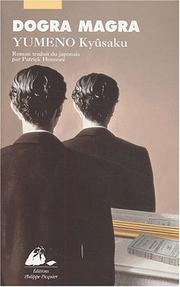
《脑髓地狱》(ドグラ・マグラ,Dogura Magura)为日本作家梦野久作的长篇推理小说,与小栗虫太郎的《黑死馆杀人事件》和中井英夫(署名塔晶夫)的《献给虚无的供物》被称为日本三大推理奇书(亦有日本四大推理奇书的提法,即在最后加上了竹本健治的《匣中失乐》)。久作早于1927年已经完成此早品的初稿——狂人解放治疗(狂人の解放治疗),不过经过十年的修缮,才以“脑髓地狱”之名于1935年发行。
书名ドグラ・マグラ是长崎地区的方言,在作品中被解释为基督教传教士的咒语;或者是“困惑、仓皇”“眼花缭乱”等意思。确实有佐贺的女性表示儿时曾经使用过这个词。
故事简介
一名青少年在精神病院醒来,发觉忘了自己是谁,九州帝国大学的若林教授告诉这名青少年,他与一宗离奇的凶杀案有关,只要他恢复记忆,就能明白一切,于是将另一位精神病学教授正木教授有关心理遗传的论文及凶案调查报告交予他阅读,希望能协助他恢复记忆。这名青少年在阅读之后,发现凶杀案的原因和正木教授研究的“心理遗传”有关,而一幅神秘的绘卷是一切的起因。
结构特点
本书结构上有别于一般小说分为多个章节,全书的所有情节﹑场景交换以至人物的回想之间皆无明显分隔。日本著名推理小说家横沟正史曾表示,读完《脑髓地狱》头脑朦胧想要自杀。
电影
1988年,日本导演松本俊夫将故事改编成电影搬上大萤幕,由松田洋治饰演主角吴一郎。
以上文字摘自维基百科「腦髓地獄」(去掉了参考文献等尾部小节),按 CC BY-SA 4.0 使用,作者为维基百科的各位编者。
中文维基百科的条目比较短,下面附上英文维基百科的内容(英文原文):
Dogra Magra (ドグラ・マグラ, Dogura Magura) is a novel considered the masterpiece of mystery writer Yumeno Kyusaku. Published in 1935 after more than 10 years of planning and writing, it is noted as one of Japan's "three strange mysterious novels", alongside Oguri Mushitaro's The Black Death Mansion Murders and Nakai Hideo's An Offering to Nothingness. It formed the basis of a 1988 film of the same name.
In the story, the original meaning of "Dogura Magura" is explained as a dialect of the Nagasaki region, referring to the magic of Christians, priests, or as a corrupted version of "confused, taken aback" or "dōmawari, mekurami," but the details are unclear. Before this work, it was used as ruby for phantom magic and illusion in Dr. Inugami. Additionally, a woman from Saga prefecture testified that she knew that Dogura Magura was actually used as a child.
Overview
Dogra Magra was published as a newly written work by Shohakukan Shoten in January 1935 (Showa 10), with the tagline "A mysterious and mysterious detective novel." In 1926, the year he made his debut as a writer, Yumeno Kyusaku began writing a novel about the mentally ill, Madman's Release Treatment. This would later become Dogura Magura, after he spent nearly 10 years thoroughly revising it. Yumeno died the year after it was published.
The story (or so it seems) is about a young, amnesiac mental patient who is locked in a cell in the Department of Psychiatry at Kyushu University's School of Medicine in 1926 (Taisho 15), and is told by him in the first person. He has some kind of connection to several incidents that occurred in the past, and as the story progresses, a culprit, motive, and modus operandi of a mysterious series of incidents are gradually revealed.
At first glance, it appears to follow the established formula of existing detective fiction, and so for convenience is often classified as a "detective novel", but insofar as it deviates from the mould has become exemplary of an "anti-mystery". The murder itself is rather simple, but the structure is complex, with a nested structure of academic papers such as "The Dream of a Fetus" (based on Ernst Haeckel's theory of repetition), a grandiose treatise about the billion-year long evolutionary nightmare that a fetus experiences during the 10 months it is developing inside the womb, "The Brain Theory," which claims that "the brain is not the place for thinking," and "The Hellish Prayer of the Crazy One," which describes the horror of mental hospitals where you cannot leave until you die. There are also metafictional elements in the work, such as the appearance of a book called "Dogura Magura," which "is so complex that the reader is forced to reread it at least twice." The culprit and the truth are never revealed, and the logical solution that is naturally found in detective novels and mysteries is foreclosed.
It is said that it is difficult to understand the truth and content of the work in one reading, but many readers give up midway due to its complex, insane, and difficult content and structure. It is also often said that "Anyone who reads this book from start to finish will definitely become mentally unstable at least once." In a conversation with Kobayashi Nobuhiko in 1977, Yokomizo Seishi said that he reread it for the conversation and became so upset that he went crazy in the middle of the night, and his wife, who was also there, agreed.
Adaptations
An adaptation of the novel, directed by Toshio Matsumoto, was released in October 1988.
In 2008, a manga adaptation was released. An animated adaptation of the manga was released in 2012.
以上文字摘自英文维基百科「Dogra Magra」(去掉了参考文献等尾部小节),按 CC BY-SA 4.0 使用,作者为维基百科的各位编者。
资料卡
- 原作语言
- 日语
- 首次出版
- 1935 年
- 作品形式
- 长篇小说
资料卡来自 Wikidata Q11003177(CC0),众包数据,个别字段可能不全。