书单
艺苑名人传 (1550)
百科
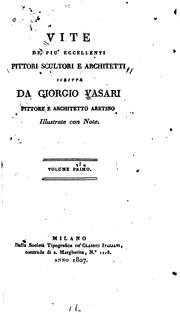
《艺苑名人传》,全名《由契马布埃至当代最优秀的意大利建筑师、画家、雕刻家的生平》(Le vite de' più eccellenti architetti, pittori, et scultori italiani, da Cimabue insino a' tempi nostri),是严格意义上的西方第一本艺术史著作,作者是乔尔乔·瓦萨里,该书从13世纪佛罗伦萨画家契马布埃开始,一直写到16世纪的艺术巨匠米开朗基罗,写到书的最末卷是他自己,共讲述了260多位意大利文艺复兴时期杰出艺术家的生平及其重要作品。它是“艺术史上最早的重要著作”。
瓦萨里是第一位意大利艺术史学家,而他的这部著作也成为了现代艺术家传记的先驱。此书首版由Lorenzo Torrentino印刷出版于1550年的佛罗伦萨。1568年再版,并加上了艺术家肖像。
以上文字摘自维基百科「艺苑名人传」(去掉了参考文献等尾部小节),按 CC BY-SA 4.0 使用,作者为维基百科的各位编者。
中文维基百科的条目比较短,下面附上英文维基百科的内容(英文原文):
The Lives of the Most Excellent Painters, Sculptors, and Architects (Italian: Le vite de' più eccellenti pittori, scultori, e architettori) is a series of artist biographies written by 16th-century Italian painter and architect Giorgio Vasari, which is considered "perhaps the most famous, and even today the most-read work of the older literature of art", "some of the Italian Renaissance's most influential writing on art", and "the first important book on art history".
Vasari published The Lives in two editions with substantial differences between them; the first edition, two volumes, in 1550 and the second, three volumes, in 1568 (which is the one usually translated and referred to). One important change was the increased attention paid to Venetian art in the second edition, even though Vasari still was, and has ever since been, criticised for an excessive emphasis on the art of his native Florence.
Background
The writer Paolo Giovio expressed his desire to compose a treatise on contemporary artists at a party in the house of Cardinal Farnese, who asked Vasari to provide Giovio with as much relevant information as possible. Giovio instead yielded the project to Vasari.
As the first Italian art historian, Vasari initiated the genre of an encyclopedia of artistic biographies that continues today. Vasari's work was first published in 1550 by Lorenzo Torrentino in Florence, and dedicated to Cosimo I de' Medici, Grand Duke of Tuscany. It included a valuable treatise on the technical methods employed in the arts. It was partly rewritten and enlarged in 1568 and provided with woodcut portraits of artists (some conjectural).
The work has a consistent and notorious favour of Florentines and tends to attribute to them all the new developments in Renaissance art – for example, the invention of engraving. Venetian art in particular, let alone other parts of Europe, is systematically ignored. Between his first and second editions, Vasari visited Venice and the second edition gave more attention to Venetian art (finally including Titian) without achieving a neutral point of view. John Symonds claimed in 1899 that, "It is clear that Vasari often wrote with carelessness, confusing dates and places, and taking no pains to verify the truth of his assertions" (in regards to Vasari's life of Nicola Pisano), while acknowledging that, despite these shortcomings, it is one of the basic sources for information on the Renaissance in Italy.
Vasari's biographies are interspersed with amusing gossip. Many of his anecdotes have the ring of truth, although likely inventions. Others are generic fictions, such as the tale of young Giotto painting a fly on the surface of a painting by Cimabue that the older master repeatedly tried to brush away, a genre tale that echoes anecdotes told of the Greek painter Apelles. He did not research archives for exact dates, as modern art historians do, and naturally his biographies are most dependable for the painters of his own generation and the immediately preceding one. Modern criticism—with all the new materials opened up by research—has corrected many of his traditional dates and attributions. The work is widely considered a classic even today, though it is widely agreed that it must be supplemented by modern scientific research.
Vasari includes a forty-two-page sketch of his own biography at the end of his Vite, and adds further details about himself and his family in his lives of Lazzaro Vasari and Francesco de' Rossi.
Influence
Vasari's Vite has been described as "by far the most influential single text for the history of Renaissance art" and "the most important work of Renaissance biography of artists". Its influence is situated mainly in three domains: as an example for contemporary and later biographers and art historians, as a defining factor in the view on the Renaissance and the role of Florence and Rome in it, and as a major source of information on the lives and works of early Renaissance artists from Italy.
以上文字摘自英文维基百科「Lives of the Most Excellent Painters, Sculptors, and Architects」(有删节,去掉了参考文献等尾部小节),按 CC BY-SA 4.0 使用,作者为维基百科的各位编者。
资料卡
- 原题
- Le vite de piu eccellenti architetti, pittori, et scultori italiani, da Cimabue insino a' tempi nostri
- 译者
- Eliza Foster
- 原作语言
- 意大利语
- 首次出版
- 1550 年
- 体裁
- 传记辞典
- 主题
- 传记、美术史
资料卡来自 Wikidata Q1645493(CC0),众包数据,个别字段可能不全。