书单
百科
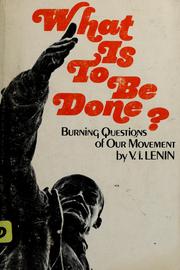
《怎么办?(我们运动中的迫切问题)》(俄语:Что делать? Наболевшие вопросы нашего движения),是列宁于1901年撰写并于1902年出版的政治小册子。列宁说,这篇文章代表了“一个骨架,将在现在准备印刷的小册子中更详细地阐述”,它的标题来自19世纪俄国革命家尼古拉·车尔尼雪夫斯基的同名小说。
列宁认为,工人阶级不会仅仅通过在工资、工作时间等方面与雇主的经济斗争而自发地成为政治上的阶级。为了把工人阶级转变为马克思主义,列宁坚持认为马克思主义者应该组成一个政党,或者说“先锋队”,这些革命者应该在工人中间传播马克思主义的政治思想。
以上文字摘自维基百科「怎么办?」(去掉了参考文献等尾部小节),按 CC BY-SA 4.0 使用,作者为维基百科的各位编者。
中文维基百科的条目比较短,下面附上英文维基百科的内容(英文原文):
What Is to Be Done? Burning Questions of Our Movement is a political pamphlet written by Vladimir Lenin (credited as N. Lenin) in 1901 and published in March 1902. He previewed the work in a May 1901 Iskra article, "Where to Begin", which he called "a skeleton plan to be developed in greater detail in a pamphlet now in preparation for print". The title of What Is to Be Done? was taken from an 1863 novel of the same name by Russian revolutionary Nikolai Chernyshevsky.
The booklet's central focus is the ideological formation of the proletariat. Lenin argues that the working class will not become politically advanced simply by fighting economic battles against employers over wages, hours, and the like. To imbue the working class with Marxist principles, he recommends a cadre of dedicated revolutionaries form a vanguard political party that can teach Marxism to workers.
The legacy of What Is to Be Done? has been much debated. The ideas put forth in the pamphlet regarding the composition and organization of a successful revolutionary party were said to have precipitated the 1903 split of the Russian Social Democratic Labor Party (RSDLP) into the Bolshevik ("majority") faction and Menshevik ("minority") faction. Some, including Lenin, claimed that readers of What Is to Be Done? misrepresented its contents to further their own agendas.
Main points
Lenin first confronts the so-called economist trend in Russian social democracy that followed the line of the German Marxist Eduard Bernstein. Lenin labels Bernstein's position opportunistic, a point proven (in Lenin's estimation) when French socialist Alexandre Millerand accepted a cabinet post in his country's bourgeois government. In response to the economists' demand for freedom of criticism, Lenin asserts that orthodox Marxists must have the same right to criticize. He emphasizes that in fighting the bourgeoisie, Russian revolutionaries should pay particular attention to theoretical questions, recalling Friedrich Engels' statement that in the struggle for social democracy, the theoretical form of struggle was as important as the political and economic.
Lenin explains that workers will not automatically develop class consciousness as a result of economic conflicts with their employers or through actions like spontaneous strikes and demonstrations. Instead, professional revolutionaries need to form a political party to advocate Marxist ideas and persuade workers to join the movement for change. He writes that political understanding requires understanding the entirety of society, not just what happens in the workplace:Class political consciousness can be brought to the workers only from without; that is, only from outside the economic struggle, from outside the sphere of relations between workers and employers. The sphere from which alone it is possible to obtain this knowledge is the sphere of relationships (of all classes and strata) to the state and the government, the sphere of the interrelations between all classes.
Reflecting on the wave of strikes in late 19th century Russia, Lenin observes that "the history of all countries shows that the working class, exclusively by its own efforts, is able to develop only trade union consciousness"; that is, the conviction that it must combine into unions, petition the government for pro-labor legislation, etc. However, socialist theory in Russia, and elsewhere in Europe, was the product of the "educated representatives of the propertied classes", the intellectuals or "revolutionary socialist intelligentsia". Lenin states that Marx and Engels themselves, the founders of modern scientific socialism, belonged to this bourgeois intelligentsia.
以上文字摘自英文维基百科「What Is to Be Done?」(有删节,去掉了参考文献等尾部小节),按 CC BY-SA 4.0 使用,作者为维基百科的各位编者。
资料卡
- 原题
- Что дѣлать?
- 原作语言
- 俄语
- 首次出版
- 1902 年 3 月
- 体裁
- 舆论新闻业、随笔
- 主题
- 列宁主义、先锋队
资料卡来自 Wikidata Q946877(CC0),众包数据,个别字段可能不全。
更多资料与书评
在哪读
列宁 的其他作品
作者页 ›